
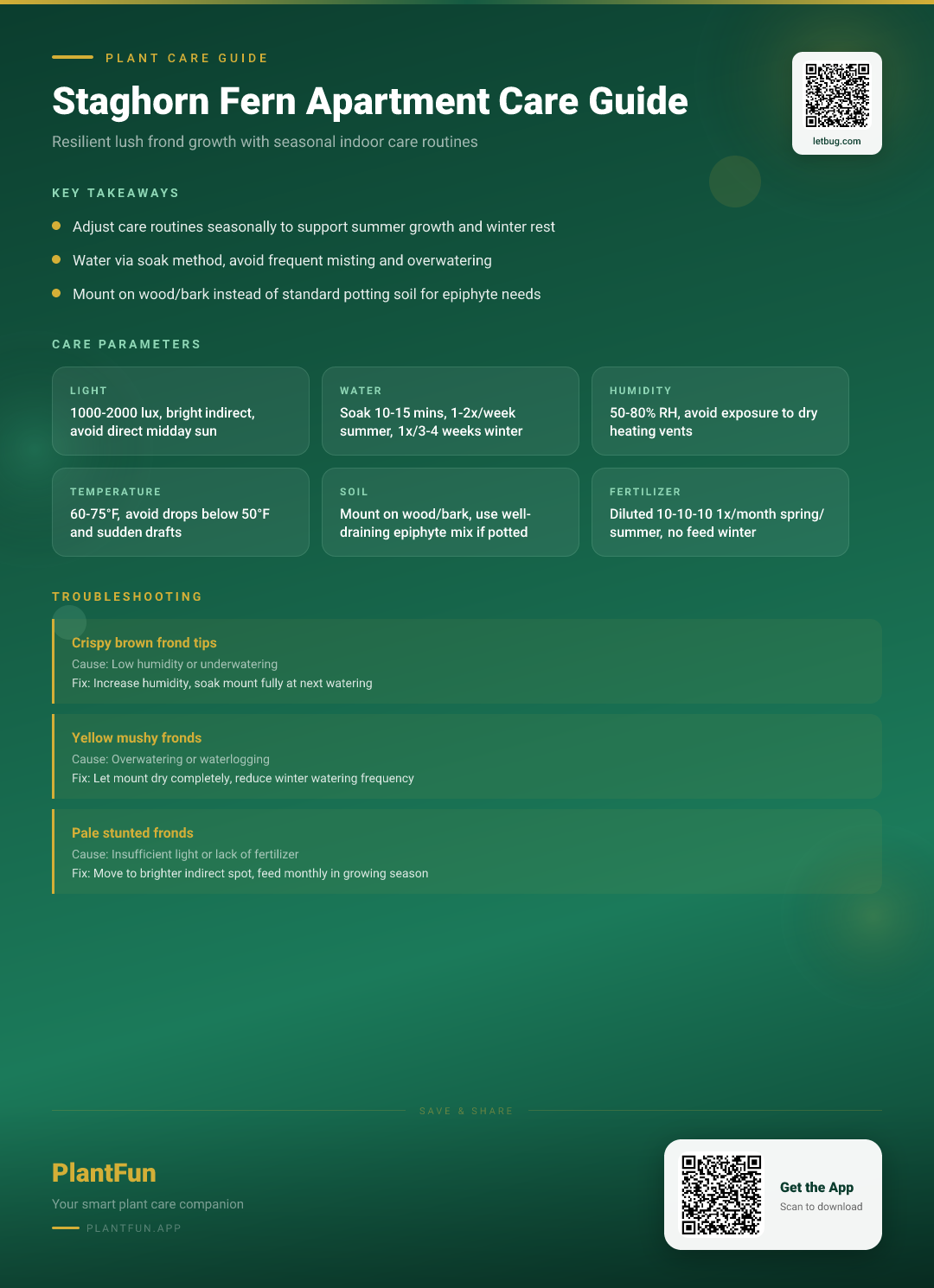
Key Takeaways
- Check soil moisture before watering — overwatering is the #1 killer of houseplants.
- Ensure your plant gets the right amount of light for its species.
- Be patient with recovery — most plants need 2–4 weeks to bounce back.
Quick Care Card: Essential Thresholds for Apartment Success
| Feature | Requirement |
|---|---|
| Light | Bright, indirect light (filtered sun) |
| Water | Soak when weight feels light (every 1-3 weeks) |
| Humidity | Moderate to high (50-70%) |
| Temperature | 60°F to 80°F (15°C–27°C) |
| Substrate | Sphagnum moss (if mounted) |
| Fertilizer | Balanced liquid feed during active growth |
| Toxicity | Non-toxic to cats and dogs (ASPCA, 2026) |
TL;DR: Why Your Staghorn Fern Needs a Seasonal Approach
When I first started keeping Platycerium bifurcatum, I treated them like standard potted houseplants. I learned the hard way that these epiphytes demand a cycle: heavy hydration and feeding during their summer growth phase, followed by a “rest” period in winter where they prioritize root and shield frond development. If you don’t adjust your care to match their natural rhythm, you risk rot or stunted growth. Successful Staghorn fern care in an apartment is all about mimicking a forest canopy environment within your living space.
Understanding Your Apartment Environment: Light & Humidity Basics
Staghorn ferns are epiphytes, meaning they grow on trees rather than in soil (NC State Extension, 2026). In an apartment, your goal is to find the “Goldilocks” spot.
- Light: They need bright, indirect light. Placing them too close to a south-facing window can scorch the delicate fronds, while deep corners will lead to light-starved, leggy growth (NC State Extension, 2026). I find that a north or east-facing window is usually ideal.
- Humidity: My apartment air often drops below 30% in the winter. Because these plants absorb moisture through their fronds, I keep them near a humidifier or in a bathroom where ambient moisture is higher (Park Brown, 2007).
Step-by-Step Care: Watering via the Soak Method
Forget the watering can. The most effective way to hydrate a Staghorn fern is the soak method. When I notice the moss feels dry and the mount feels “light” to the touch, it is time for a drink.
- Preparation: Fill a basin or sink with room-temperature, filtered water.
- Submersion: Gently place the entire mount into the water, ensuring the root ball/moss is submerged.
- Soak Time: Allow the mount to soak for 10–15 minutes. This ensures the substrate is fully saturated.
- Draining: Lift the fern and let it drip for at least 20 minutes before returning it to the wall. This prevents stagnant water from causing rot.
Seasonal Calendar: Adjusting Care from Summer Growth to Winter Rest
- Spring/Summer (Active Growth): This is when your fern produces new fronds. I increase my watering frequency and introduce a diluted, balanced fertilizer once a month (Park Brown, 2007).
- Fall/Winter (Dormancy): Growth slows down. I pull back on fertilizer entirely and wait until the moss is almost entirely dry before soaking. The plant needs this rest to maintain its resilience (Burns, 2021).
The Science of Epiphytes: Why They Prefer Mounts Over Soil
Unlike traditional ferns, Platycerium bifurcatum uses its “shield fronds” (the flat, circular leaves at the base) to trap organic debris and moisture. This evolutionary strategy allows them to thrive on tree trunks (Burns, 2021). By mounting your fern, you are recreating this vertical existence, which allows for superior airflow around the root system—a crucial factor in preventing fungal pathogens that often plague potted specimens (NC State Extension, 2026).
Common Mistakes to Avoid
- Mistake: Over-misting the fronds.
- What happens: Trapped water on the leaf surface can lead to bacterial spots.
- Instead: Focus on soaking the root ball/moss base.
- Mistake: Using standard potting soil.
- What happens: It suffocates the roots, which need massive amounts of oxygen.
- Instead: Always mount them on a board with long-fiber sphagnum moss.
Voice FAQ
Why are the brown tips on my Staghorn fern fronds crispy? This is a classic sign of low humidity or underwatering. Try increasing the duration of your soak or moving the fern to a location with better airflow and consistent humidity (Park Brown, 2007).
Can I grow a Staghorn fern in my bathroom if there is no window? Unfortunately, no. While they love the humidity, they require light for photosynthesis. If your bathroom is windowless, you must provide a dedicated grow light to support the plant.
How do I know when my fern is thirsty? Pick up your mount. If it feels remarkably light, the moss has lost its water content and it’s time for a soak. If the fronds look slightly “droopy,” it’s already very thirsty.
Advanced Care: When and How to Fertilize Your Fern
I only fertilize during the peak summer months. I use a 1:4 dilution of a balanced, water-soluble fertilizer added directly to the soaking water. Be careful not to overdo it; excess salts can accumulate in the moss, which will eventually burn the root system (Park Brown, 2007).
Troubleshooting Guide: Identifying Pest Patterns
Scale Insects
Symptom: Small, brown, bump-like protrusions on the fronds.
Likely cause: Low airflow or infestation from neighboring plants.
Fix:
- Wipe the fronds with a soft cloth dipped in rubbing alcohol.
- Monitor the plant weekly to ensure no new scales appear.
Root Rot
Symptom: The center of the plant or the shield fronds turn mushy and dark brown.
Likely cause: Leaving the mount soaking for too long or improper drainage.
Fix:
- Remove excess moisture with paper towels.
- Increase airflow around the plant immediately.
Conclusion: Building a Long-Term Relationship with Your Fern
Staghorn ferns are not “difficult”; they are just specific. By respecting their need for moisture cycles and bright, filtered light, you can enjoy these architectural wonders for years. Remember: they are non-toxic to pets (ASPCA, 2026), making them a safe addition to your home.
References
- Burns, K. (2021). On the selective advantage of coloniality in staghorn ferns (Platycerium bifurcatum, Polypodiaceae). Plant Signaling & Behavior. https://doi.org/10.1080/15592324.2021.1961063. Accessed 2026-03-19.
- Park Brown, S. (2007). Staghorn Ferns at a Glance. EDIS. https://doi.org/10.32473/edis-mg015-2007. Accessed 2026-03-19.
- ASPCA. (2026). Toxic and Non-Toxic Plants List — ASPCA. https://www.aspca.org/pet-care/animal-poison-control/toxic-and-non-toxic-plants. Accessed 2026-03-19.
- NC State Extension. (2026). Staghorn Ferns — NC State Extension Gardener Plant Toolbox. https://plants.ces.ncsu.edu/plants/staghorn-fern/. Accessed 2026-03-19.
Optional Helper: Plantfun.App
Plantfun.App identifies your plants by photo, diagnoses pests and diseases with clear fixes, and creates personalised watering and light schedules that adapt to your home conditions — a handy companion for putting this guide into daily practice.
Found an error or have suggestions? We'd love your feedback.
Need help identifying this problem?
Get instant identification, personalized care schedules, and effective pest treatment plans directly on your phone.
Sponsored • We may earn a commission from app downloads
Related Guides
The Complete Staghorn Fern Care Checklist for Resilient Growth in Budget Apartments
Grow lush, resilient staghorn ferns in your apartment without expensive gear. Get a free printable checklist, exact light/water thresholds, and zero-cost hacks to avoid brown fronds.
Care GuideStaghorn Fern in a Low-Humidity Apartment: The Complete Resilience and Care Guide
Master Staghorn fern care in your apartment with our 4-step moisture protocol. Boost foliage health, prevent browning, and keep your fern lush year-round.
Care GuideStaghorn Fern Care Checklist for Typical Apartments: 8 Fixes for Resilient Lush Growth
Stop struggling to keep your staghorn fern alive in your apartment. Get 8 actionable care fixes, measurable thresholds, and a free printable checklist for lush, resilient growth.
Pest ControlAnts on Plants: What They Mean and What to Do
Ants usually aren't eating your plant. They are farming other pests.