
Key Takeaways
- Check soil moisture before watering — overwatering is the #1 killer of houseplants.
- Ensure your plant gets the right amount of light for its species.
- Be patient with recovery — most plants need 2–4 weeks to bounce back.
TL;DR: Quick Success for Apartment Staghorn Ferns
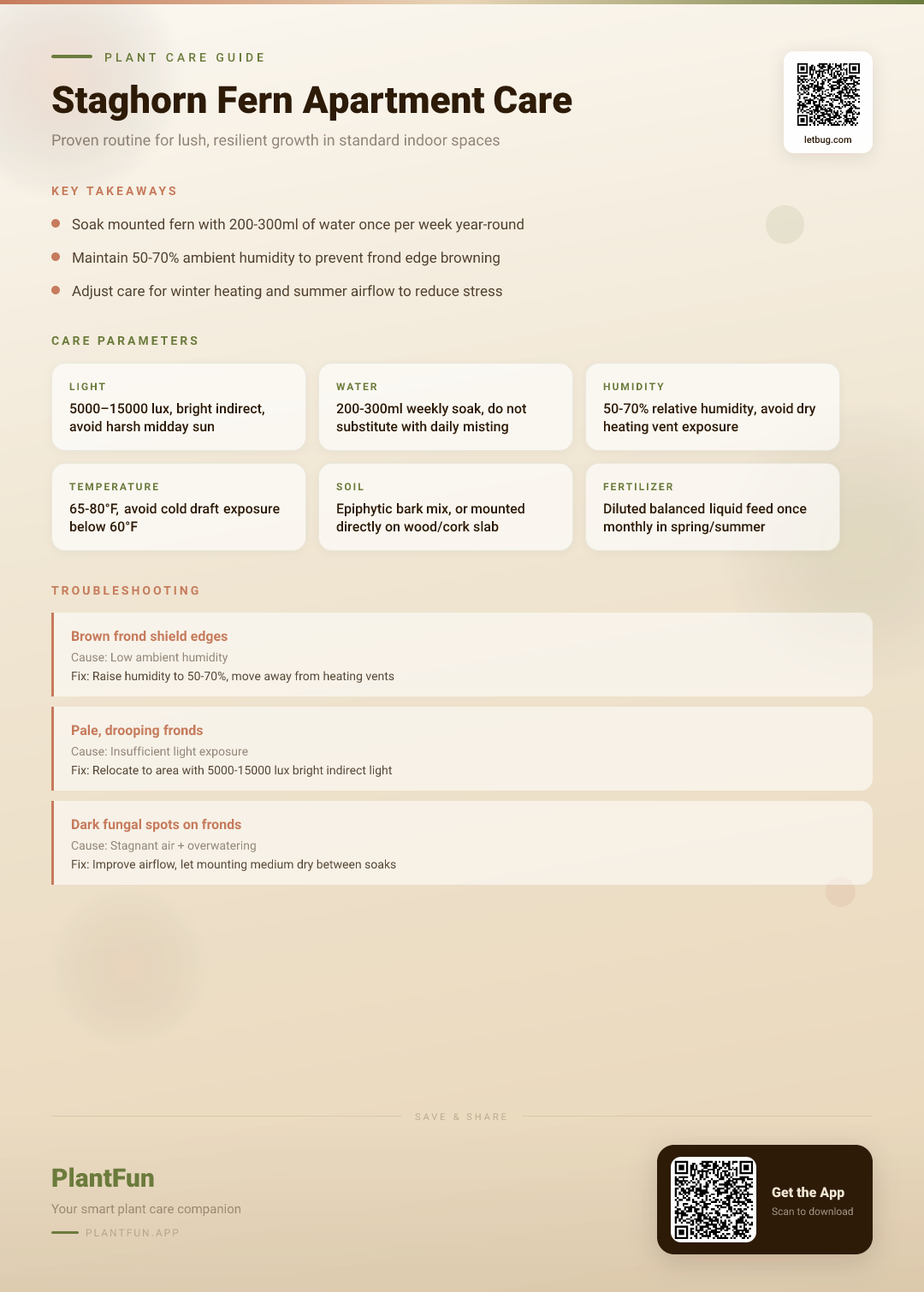
To keep your Platycerium thriving in an apartment, focus on mimicking its natural epiphytic life: provide bright, indirect light (5,000–15,000 lux), ensure high airflow to prevent rot, and soak the root ball (200-300ml of water) when the shield fronds feel lightweight. Avoid daily misting, which invites fungal issues. Always use a well-draining mounting medium like sphagnum moss to protect the sensitive root system.
Quick Care Card: Essential Data
| Feature | Requirement |
|---|---|
| Light | 5,000–15,000 lux (bright, indirect) |
| Water | 200-300ml soak per week |
| Humidity | 50-70% |
| Temperature | 65-80°F (18-27°C) |
| Substrate | Sphagnum moss/wood mount |
| Fertilizer | Balanced liquid feed (monthly) |
| Toxicity | Non-toxic to pets (ASPCA, 2026) |
Why Staghorn Ferns Struggle in Modern Apartments: A Botanical Perspective
When I first brought home my Platycerium bifurcatum, I made the mistake of placing it in a dark corner of my bedroom. Within weeks, the lush green fronds turned dull and the shield fronds—the hardened, plate-like structures at the base—began to collapse. The issue? Apartment environments often mimic the opposite of a tropical canopy. We prioritize low light and stagnant, dry air, whereas these ferns are biologically hardwired to capture nutrients from debris and moisture from moving, humid air (Burns, 2021).
Understanding Platycerium Needs: Natural Habitat vs. Living Room Conditions
In the wild, staghorn ferns are epiphytes, meaning they grow on trees rather than in soil (NC State Extension, 2026). Their survival strategy relies on two types of fronds: the basal (shield) fronds that protect the roots and trap organic matter, and the fertile (antler) fronds that handle photosynthesis and reproduction (Burns, 2021). In your apartment, you must recreate the high-flow, high-humidity environment where these plants naturally thrive.
Format A: The Complete Scenario Guide - Step-by-Step Installation and Mounting
- Select a Board: Choose cedar or teak, as these are rot-resistant. Avoid pressure-treated wood.
- Prepare the Bed: Lay a thick layer of damp, long-fiber sphagnum moss on the board.
- Position the Fern: Place the fern root ball centrally, ensuring the “bud” (the growth point) is facing up.
- Secure the Plant: Use fishing line to wrap around the shield fronds and the board. Keep the wrap snug but not so tight that you crush the delicate rhizomes.
- Initial Soak: Submerge the entire mount in room-temperature water for 15 minutes to hydrate the initial moss layer.
Mastering the Soak: A Precise Watering Methodology for Mounted Ferns
Forget the watering can. The most effective way to water a mounted specimen is the soak method.
- The Process: Fill a basin with 200-300ml of water. Place the mounted fern face-down or flat in the water for 10-15 minutes (Park Brown, 2007).
- The Indicator: A well-hydrated fern is heavy; a thirsty one feels light as a feather when you lift it.
- The Drying Phase: Allow the mount to drip-dry in the sink for 20 minutes before rehanging to prevent water damage to your wall.
Seasonal Care Calendar: Adapting to Apartment Winter Heating vs. Summer Airflow
- Summer: Increase watering frequency to twice a week as higher temperatures accelerate evaporation.
- Winter: Apartment heaters dry the air significantly. If your ambient humidity drops below 40%, use a small humidifier nearby to maintain the required 50-70% range (Park Brown, 2007).
FAQ: Why are the edges of my Staghorn Fern shields turning brown?
This is typically a symptom of low humidity or mineral buildup from hard tap water. If the shield edges are crisp and brown, increase your ambient humidity and consider using distilled or rainwater for your soaks.
FAQ: How do I know if my fern is getting enough light in my apartment?
Use a light meter app or your observation: if the fertile fronds are reaching and stretching, or if the growth rate is stagnant, your plant needs to be moved closer to a window, provided it is out of direct, scorching afternoon sun.
FAQ: Can I safely mist my fern daily instead of soaking it?
I strongly advise against daily misting. While it sounds intuitive, misting often results in surface-level moisture that evaporates too quickly to hydrate the root ball and can lead to fungal issues if water pools in the crevices of the fronds.
Managing Airflow: Preventing Fungal Issues in Still-Air Indoor Environments
In the forest, these plants enjoy constant airflow, which prevents pathogens from settling. In an apartment, stagnant air is the enemy. Use a small, oscillating desk fan for a few hours a day to simulate a breeze, which keeps the foliage dry and healthy.
Common Mistakes to Avoid
- Mistake: Over-handling the fertile fronds. What happens: You rub off the fuzzy white coating (trichomes) which protects the plant from dehydration. Instead: Handle the plant only by the shield fronds or the mount.
- Mistake: Heavy fertilization. What happens: Fertilizer burn on the roots. Instead: Use a balanced, water-soluble fertilizer diluted to 1/4 strength, applied only during the growing season (NC State Extension, 2026).
References
- Burns, K. (2021). On the selective advantage of coloniality in staghorn ferns (Platycerium bifurcatum, Polypodiaceae). Plant Signaling & Behavior. https://doi.org/10.1080/15592324.2021.1961063. Accessed 2026-03-13.
- Park Brown, S. (2007). Staghorn Ferns at a Glance. EDIS. https://doi.org/10.32473/edis-mg015-2007. Accessed 2026-03-13.
- ASPCA. (2026). Toxic and Non-Toxic Plants List — ASPCA. https://www.aspca.org/pet-care/animal-poison-control/toxic-and-non-toxic-plants. Accessed 2026-03-13.
- NC State Extension. (2026). Staghorn Ferns — NC State Extension Gardener Plant Toolbox. https://plants.ces.ncsu.edu/plants/fern-care/. Accessed 2026-03-13.
Optional Helper: Plantfun.App
Plantfun.App identifies your plants by photo, diagnoses pests and diseases with clear fixes, and creates personalised watering and light schedules that adapt to your home conditions — a handy companion for putting this guide into daily practice.
Found an error or have suggestions? We'd love your feedback.
Need help identifying this problem?
Get instant identification, personalized care schedules, and effective pest treatment plans directly on your phone.
Sponsored • We may earn a commission from app downloads
Related Guides
Staghorn Fern in a Dim Apartment: The Complete Care Guide for Low-Light Resilience
Transform your dim apartment into a lush sanctuary. Master the 4 key metrics of Staghorn Fern care with our budget-friendly, step-by-step resilience plan.
Care GuideThe Budget Staghorn Fern Care Checklist for Resilient Growth in Standard Urban Apartments
Grow a lush staghorn fern in your apartment without expensive specialty gear. Get our 8-step budget checklist, exact light, water, and humidity thresholds for resilient, year-round growth.
Care GuideStaghorn Fern Care Checklist for Typical Apartments: 8 Fixes for Resilient Lush Growth
Stop struggling to keep your staghorn fern alive in your apartment. Get 8 actionable care fixes, measurable thresholds, and a free printable checklist for lush, resilient growth.
Pest ControlAnts on Plants: What They Mean and What to Do
Ants usually aren't eating your plant. They are farming other pests.