
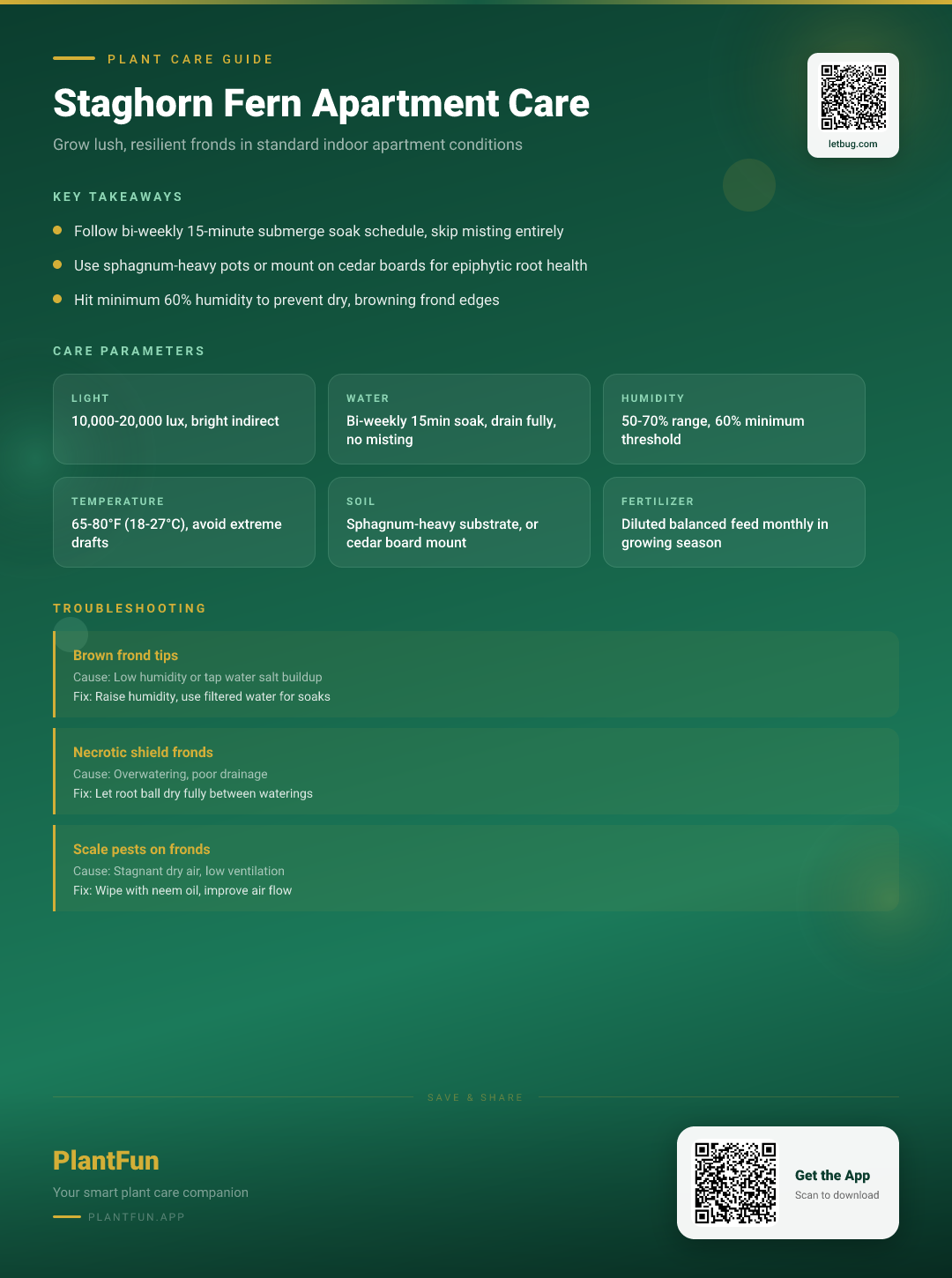
Key Takeaways
- Check soil moisture before watering — overwatering is the #1 killer of houseplants.
- Ensure your plant gets the right amount of light for its species.
- Be patient with recovery — most plants need 2–4 weeks to bounce back.
Quick Care Card: The TL;DR Version
| Feature | Requirement |
|---|---|
| Light | 10,000–20,000 lux (Bright, indirect) |
| Water | Soak root ball 15 minutes bi-weekly |
| Humidity | 50–70% relative humidity |
| Temperature | 65–80°F (18–27°C) |
| Substrate | Sphagnum moss or bark-heavy orchid mix |
| Fertilizer | Balanced liquid feed (diluted) monthly |
| Toxicity | Non-toxic to cats and dogs (ASPCA, 2026) |
When I first brought home my Platycerium bifurcatum, I treated it like a delicate rainforest specimen, misting it daily and keeping it in a dark corner. Predictably, it began to brown at the edges. I learned the hard way that these are robust epiphytes—plants that grow on trees, not in soil—that demand airflow and deep, infrequent hydration. Once I moved mine to a bright spot and stopped the “misting madness,” it finally began producing the lush, lime-green fertile fronds I had hoped for.
Why Staghorn Ferns Struggle in Typical Apartments
In their native tropical habitats, Platycerium bifurcatum attach to tree trunks and intercept moisture from humidity and rain (Park Brown, 2007). Apartment air is often stagnant and artificially dry due to HVAC systems. This physiological gap causes the plant to desicate. Unlike terrestrial plants, the staghorn’s roots are evolved to cling to surfaces rather than burrow into soil, making them highly susceptible to root rot if confined in heavy potting medium (NC State Extension, 2026).
The Watering Science: Why ‘Misting’ is a Myth
Misting is the most common mistake for beginners. It does not provide the deep hydration a root ball requires and often encourages fungal issues on the fronds.
To properly water, follow the 15-minute submerge method:
- Fill a basin with room-temperature water.
- Submerge the root ball (or the entire mounted board) for 15 minutes.
- Allow it to drain completely until no more water drips from the moss.
- Rehang or return to its pot. This process mimics the intense, episodic rainfall the plant encounters in the wild.
Measuring Your Light: How to Calculate 10,000–20,000 Lux
You do not need a expensive light meter. A simple, free light meter app on your smartphone is surprisingly accurate for measuring the 10,000–20,000 lux range required for optimal growth. Place your phone at the level of your fern to see if the reading falls within that bracket. If you are lacking natural light, a standard full-spectrum LED bulb placed 2–3 feet away can prevent the spindly, pale growth that often precedes the plant’s decline.
Step-by-Step Mounting vs. Potted Care
Mounting on Cedar
- Soak a handful of long-fiber sphagnum moss until saturated.
- Place the fern base against the board with the moss behind it.
- Secure the shield frond (the flat, circular leaf) to the board using nylon fishing line or plastic-coated wire.
- Ensure the plant is snug, but do not compress the root ball excessively.
Potted Care
If you prefer containers, treat them like epiphytic orchids. Use a loose, well-draining mix of 70% long-fiber sphagnum moss and 30% orchid bark. Never bury the crown of the plant, as this leads to decay (NC State Extension, 2026).
Seasonal Adjustments
Keep your plant between 65–80°F (18–27°C). During winter, central heating creates a desert-like climate that drops humidity below 30%. I recommend using a dedicated room humidifier nearby during these months to prevent necrotic frond tips. In summer, ensure adequate air circulation to prevent the heat from causing the plant to “cook” in its own stagnant humidity.
Addressing Common ‘Apartment’ Mistakes
- Mistake: Using tap water with high mineral content.
- What happens: Salts accumulate on the fronds and root zone, leading to necrotic brown tips.
- Instead: Use filtered or rainwater to mimic the neutral pH of natural forest rain.
- Mistake: Over-watering while expecting it to act like a houseplant.
- What happens: The shield fronds turn mushy and black.
- Instead: Only water when the moss feels crisp to the touch (Burns, 2021).
Troubleshooting Guide
Yellowing Fronds
Symptom: Leaves lose their vibrant green color and look washed out.
Likely cause: Nitrogen deficiency or low light exposure.
Fix:
- Move the plant closer to a light source.
- Apply a balanced, liquid houseplant fertilizer diluted to 1/4 strength during the growing season.
Scale Insects
Symptom: Small brown bumps on the underside of fronds.
Likely cause: Pests introduced from other indoor plants.
Fix:
- Gently wipe the fronds with a damp cloth.
- Apply neem oil or insecticidal soap specifically formulated for ferns.
Brown/Dry Shield Fronds
Symptom: The bottom shield frond becomes brown, papery, and brittle.
Likely cause: Normal aging process.
Fix:
- Do not remove these! They provide structural integrity and nutrients to the plant (Burns, 2021).
Frequently Asked Questions
-
How do I know if my Staghorn Fern is actually thirsty? The most reliable test is the “weight test.” A fully hydrated fern feels heavy. If the moss feels brittle or the plant feels significantly lighter when lifted, it is time for a soak.
-
Can I hang my Staghorn Fern in a windowless bathroom? No. While they enjoy the humidity of a bathroom, they still require photosynthesis to survive. If you have no window, you must install a dedicated grow light to keep the plant healthy.
-
Is it normal for the bottom shield frond to turn brown and paper-like? Yes, this is the natural lifecycle of the shield frond. As it ages, it dies back to protect the root ball (Burns, 2021).
References
- ASPCA. (2026). Toxic and Non-Toxic Plants List — ASPCA. https://www.aspca.org/pet-care/animal-poison-control/toxic-and-non-toxic-plants. Accessed 2026-03-20.
- Burns, K. (2021). On the selective advantage of coloniality in staghorn ferns (Platycerium bifurcatum, Polypodiaceae). Plant Signaling & Behavior. https://doi.org/10.1080/15592324.2021.1961063. Accessed 2026-03-20.
- NC State Extension. (2026). Staghorn Ferns — NC State Extension Gardener Plant Toolbox. https://plants.ces.ncsu.edu/plants/platycerium-bifurcatum/. Accessed 2026-03-20.
- Park Brown, S. (2007). Staghorn Ferns at a Glance. EDIS. https://doi.org/10.32473/edis-mg015-2007. Accessed 2026-03-20.
Optional Helper: Plantfun.App
Plantfun.App identifies your plants by photo, diagnoses pests and diseases with clear fixes, and creates personalised watering and light schedules that adapt to your home conditions — a handy companion for putting this guide into daily practice.
Found an error or have suggestions? We'd love your feedback.
Need help identifying this problem?
Get instant identification, personalized care schedules, and effective pest treatment plans directly on your phone.
Sponsored • We may earn a commission from app downloads
Related Guides
Staghorn Fern in a Typical Apartment: The Only Care Guide You’ll Ever Need
Transform your living space with a thriving Staghorn Fern. Master the exact 50-70% humidity levels and watering techniques needed for lush, emerald-green fronds.
Care GuideStaghorn Fern in a Low-Humidity Apartment: The Complete Care Guide to Resilient Growth
Transform your dry apartment into a lush sanctuary. Master Staghorn Fern care with specific humidity targets, mounting secrets, and a 10-minute weekly routine.
Care GuideThe Budget Staghorn Fern Care Checklist for Resilient Growth in Standard Urban Apartments
Grow a lush staghorn fern in your apartment without expensive specialty gear. Get our 8-step budget checklist, exact light, water, and humidity thresholds for resilient, year-round growth.
Pest ControlAnts on Plants: What They Mean and What to Do
Ants usually aren't eating your plant. They are farming other pests.