
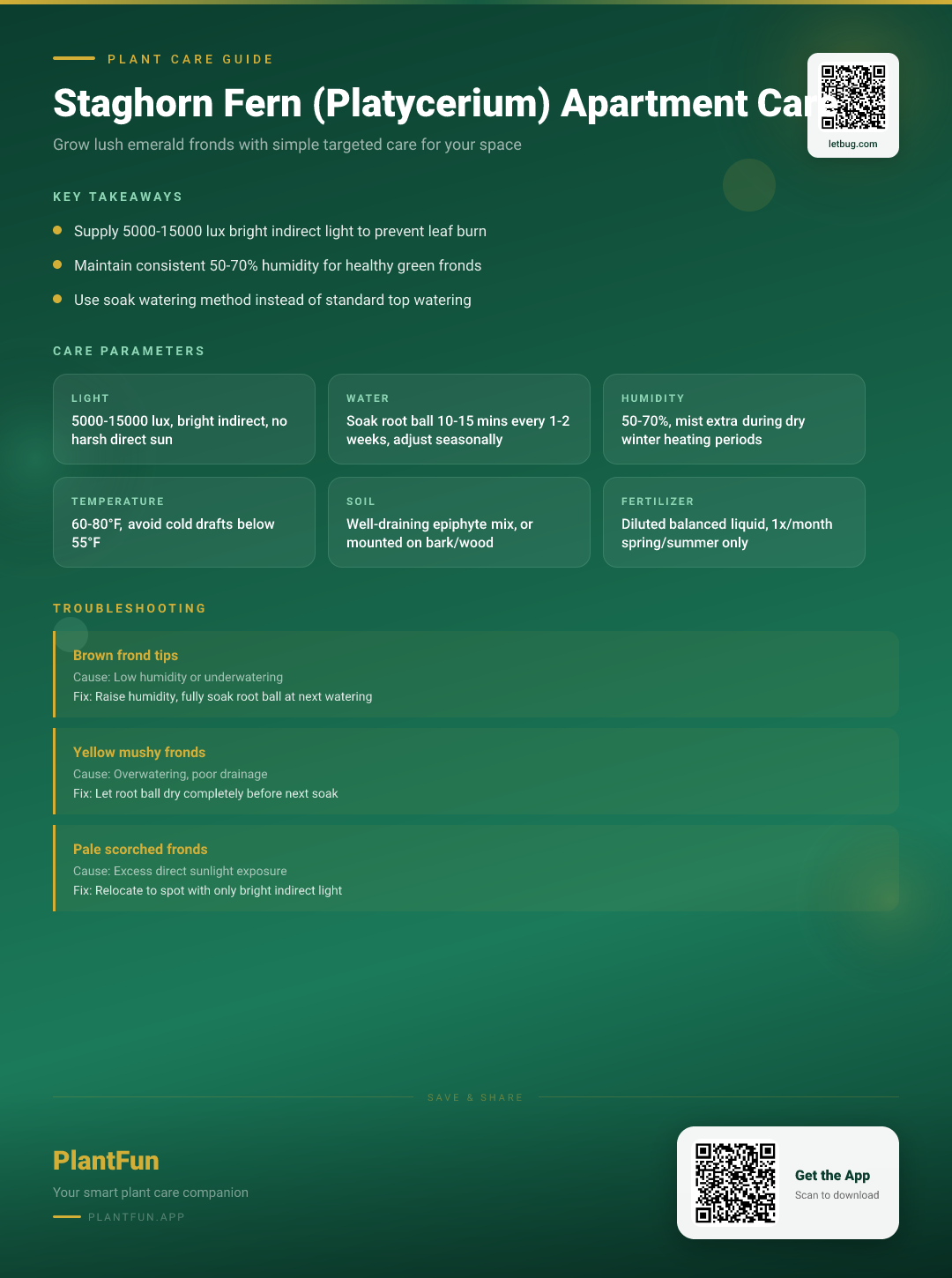
Key Takeaways
- Check soil moisture before watering — overwatering is the #1 killer of houseplants.
- Ensure your plant gets the right amount of light for its species.
- Be patient with recovery — most plants need 2–4 weeks to bounce back.
Quick Care Card: Measuring Vitality
| Feature | Requirement |
|---|---|
| Light | 5,000–15,000 Lux (Bright, Indirect) |
| Water | Soak when moss feels dry to the touch |
| Humidity | 50%–70% (Crucial for frond health) |
| Temperature | 60°F–80°F (15°C–27°C) |
| Substrate | Sphagnum moss or epiphytic mix |
| Fertilizer | Balanced liquid feed (monthly in spring/summer) |
| Toxicity | Non-toxic to cats and dogs (ASPCA, 2026) |
TL;DR: The Golden Rule of Platycerium Care
To successfully keep a Platycerium in your apartment, prioritize drainage and humidity over soil. These epiphytes feed through their shield fronds, not just roots. Soak the entire mount in water for 10–15 minutes when the moss feels light and dry—never let them sit in stagnant water, and avoid direct, scorching sun.
My Experience: Why Your Apartment is Actually Perfect for a Staghorn Fern
When I first got my Platycerium bifurcatum, I made the mistake of treating it like a standard tropical houseplant. I placed it in a pot with heavy soil and watered it from the top. Within weeks, the base turned mushy. I learned the hard way that an apartment environment requires mimicking their natural canopy life. Once I mounted mine on a wooden board with high-quality sphagnum moss, it flourished. Apartments actually offer stable temperatures, which these ferns prefer over the wild fluctuations of an outdoor garden.
Decoding Natural Habitat: Why Epiphytes Need Different Care
Staghorn ferns are epiphytes, meaning they grow on trees rather than in soil (NC State Extension, 2026). They use their brown, papery shield fronds to anchor themselves and collect decaying organic matter. In your home, they don’t need traditional soil; they need air circulation and consistent moisture around their root ball.
Step-by-Step: The Mounting vs. Potted Dilemma
I generally recommend mounting for authenticity, but pots are acceptable if you use an airy, bark-heavy substrate.
- For Mounting: Use a rot-resistant wood plank. Soak long-fiber sphagnum moss in water. Place the fern on the moss and secure it with fishing line or jute twine.
- For Potting: Choose a basket with large drainage holes. Fill with a mix of orchid bark and moss to ensure oxygen reaches the roots.
Mastering the Soak: A Precise Watering Frequency Checklist
- Check: Lift the mount or pot. If it feels significantly lighter than when wet, it is time to hydrate.
- Submerge: Place the entire mount or basket into a basin of room-temperature water.
- Duration: Leave it for 10–15 minutes until the moss is fully saturated.
- Drain: Let it drip-dry for 20 minutes before returning to the wall. This prevents fungal issues often caused by standing water.
Light Requirements: Providing 5,000–15,000 Lux without Leaf Burn
These plants thrive in bright, filtered light. Think of the light found under a canopy. If your apartment has a south-facing window, use a sheer curtain. If you have a light meter, aim for 5,000 to 15,000 lux (Hoshizaki, 1975).
Seasonal Shifts: Adjusting for Winter Heating and Summer Humidity
During winter, your furnace will lower ambient humidity. Use a humidifier to keep levels between 50-70%. During summer, if the air is stagnant, a small oscillating fan can prevent rot by mimicking the natural airflow of their native environment (Hamasaki, 1977).
Common Mistakes: Stop Treating Your Fern Like a Traditional Potted Plant
- Mistake: Over-potting in dense soil. What happens: Root rot. Instead: Use a shallow, well-draining epiphytic mount.
- Mistake: Watering the fronds directly. What happens: Water spots and bacterial infection. Instead: Focus water at the center root mass.
Frequently Asked Questions
Can I hang my Staghorn Fern in a north-facing bathroom?
Yes, if the room receives enough bright indirect light. Bathrooms provide excellent humidity, which is a major advantage for Platycerium maintenance.
Why is my Staghorn Fern developing brown tips on the fronds?
This is typically a sign of low humidity. Ensure you are hitting the 50-70% threshold. If the edges are crispy and curling, your plant is losing water faster than it can intake it.
How do I know if my fern is getting enough moisture?
Perform the “weight test.” A fully hydrated mount will feel noticeably heavy. If the moss looks grey or feels brittle, soak it immediately.
Advanced Care: When and How to Fertilize Your Fern
Use a balanced liquid fertilizer diluted to 1/4 strength. Apply this during your soaking process once a month during the growing season (spring and summer). Never fertilize in the winter when the plant is semi-dormant (NC State Extension, 2026).
References
- ASPCA. (2026). Toxic and Non-Toxic Plants List — ASPCA. https://www.aspca.org/pet-care/animal-poison-control/toxic-and-non-toxic-plants. Accessed 2026-03-15.
- Hoshizaki, B. (1975). A Staghorn Fern (Platycerium) Hybrid. American Fern Journal. https://doi.org/10.2307/1546341. Accessed 2026-03-15.
- Hamasaki, D. (1977). How Fast Does a Staghorn Fern Grow?. American Fern Journal. https://doi.org/10.2307/1545969. Accessed 2026-03-15.
- NC State Extension. (2026). Staghorn Fern — NC State Extension Gardener Plant Toolbox. https://plants.ces.ncsu.edu/plants/staghorn-fern/. Accessed 2026-03-15.
Optional Helper: Plantfun.App
Plantfun.App identifies your plants by photo, diagnoses pests and diseases with clear fixes, and creates personalised watering and light schedules that adapt to your home conditions — a handy companion for putting this guide into daily practice.
Found an error or have suggestions? We'd love your feedback.
Need help identifying this problem?
Get instant identification, personalized care schedules, and effective pest treatment plans directly on your phone.
Sponsored • We may earn a commission from app downloads
Related Guides
Staghorn Fern in a Low-Humidity Apartment: The Complete Care Guide to Resilient Growth
Transform your dry apartment into a lush sanctuary. Master Staghorn Fern care with specific humidity targets, mounting secrets, and a 10-minute weekly routine.
Care GuideThe Budget Staghorn Fern Care Checklist for Resilient Growth in Standard Urban Apartments
Grow a lush staghorn fern in your apartment without expensive specialty gear. Get our 8-step budget checklist, exact light, water, and humidity thresholds for resilient, year-round growth.
Care GuideStaghorn Fern in Typical Apartments: The Only Resilient Growth Checklist You’ll Need
Stop guessing at staghorn fern care. Get exact light levels, watering amounts, and a printable checklist to grow lush, resilient fronds even in dry, low-light apartments.
Pest ControlAnts on Plants: What They Mean and What to Do
Ants usually aren't eating your plant. They are farming other pests.