
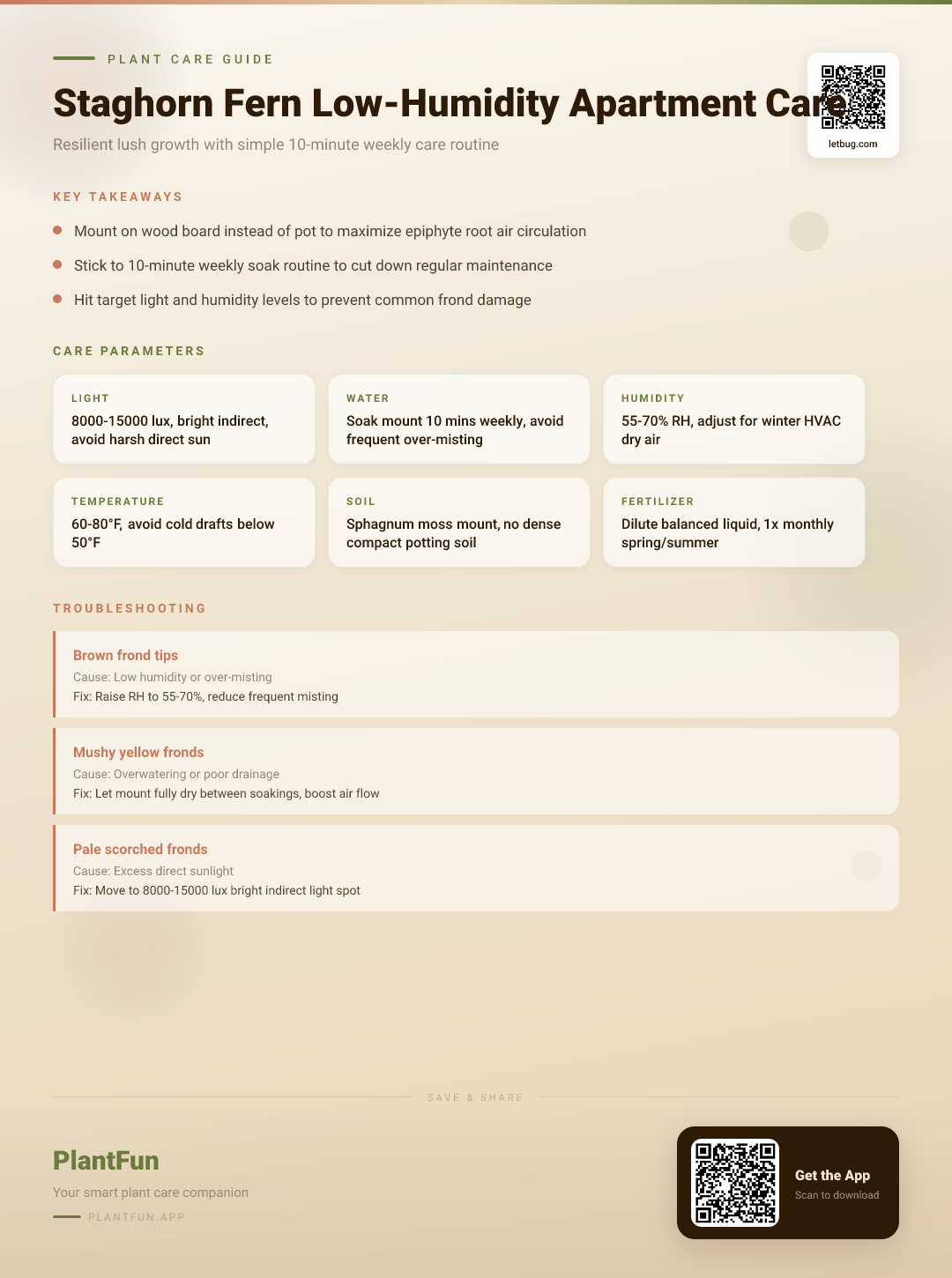
Key Takeaways
- Check soil moisture before watering — overwatering is the #1 killer of houseplants.
- Ensure your plant gets the right amount of light for its species.
- Be patient with recovery — most plants need 2–4 weeks to bounce back.
Quick Care Card: Essential Parameters for Apartment Success
| Feature | Requirement |
|---|---|
| Light | 8,000–15,000 lux (Bright, indirect) |
| Water | Soak once weekly when weight drops |
| Humidity | 55–70% (Use a humidifier) |
| Temperature | 60°F–80°F (15°C–27°C) |
| Media | Sphagnum moss (on wood board) |
| Toxicity | Non-toxic to cats and dogs (ASPCA, 2026) |
TL;DR: Why Staghorn Ferns Struggle in Modern Apartments
Most indoor Platycerium failures stem from a misunderstanding of their epiphytic nature. In modern, climate-controlled apartments, air is often too dry (dropping below 40% humidity) and air circulation is stagnant. By switching to a mounted display and adopting a weekly soaking method, you can replicate their natural canopy environment even in an urban apartment.
Understanding the Epiphytic Lifestyle: Natural Habitat vs. Living Room
In the wild, Platycerium bifurcatum grows on tree trunks and branches, not in soil (NC State Extension, 2026). They are epiphytes—plants that grow on other plants without being parasitic.
When I first got my Staghorn fern, I kept it in a standard pot. It struggled for months, prone to root rot because the soil stayed too wet. Once I researched their biological needs, I realized their root systems are adapted to periodic, rapid wetting followed by significant airflow (Hoshizaki, 1975). In your apartment, you are not just keeping a plant; you are managing a small ecosystem that requires sharp drainage and ambient moisture.
Step-by-Step Mounting: Why Boards Outperform Pots for Air Circulation
Mounting is the single most effective way to prevent the root rot I experienced with my first plant.
- Select a Board: Use rot-resistant wood like cedar or cypress.
- Apply Moss: Place a handful of damp long-fiber sphagnum moss on the board.
- Position the Fern: Place the root ball onto the moss.
- Secure: Use fishing line or plastic-coated wire to tie the fern firmly to the board, wrapping around the basal fronds (the shield fronds) without crushing them.
Critical Light Requirements: Achieving 8,000-15,000 lux without Scorching
Staghorn ferns require significant light to thrive. In my experience, they are often placed in corners that are too dark. Aim for 8,000–15,000 lux. A south-facing window with a sheer curtain or an east-facing window is ideal. If your apartment lacks bright natural light, a dedicated full-spectrum LED grow light placed 12–18 inches from the plant will suffice.
The Budget-Friendly Watering Routine: Soaking vs. Misting Guidelines
Forget the misting bottle; it is rarely enough to hydrate these ferns. My routine is simple:
- Check the Weight: If the mount feels significantly lighter, it is time to water.
- The Soak: Submerge the moss portion in a basin of room-temperature water for 10–15 minutes.
- Drain: Let the mount drip dry for 20 minutes before re-hanging to prevent wall damage.
Humidity & Temperature Control: Maintaining 55-70% Relative Humidity
Platycerium care is defined by your ability to manage moisture. Apartment heating systems in winter create an arid desert environment. I use a hygrometer near my fern; if levels drop below 50%, I run a humidifier nearby. According to NC State Extension (2026), these plants tolerate average home temperatures but suffer when placed directly in front of heat vents or drafts.
Seasonal Care Calendar: Adjusting for Winter HVAC Cycles
- Spring/Summer: Increase watering frequency as growth accelerates (Hamasaki, 1977). Provide liquid fertilizer diluted to 1/4 strength monthly.
- Fall/Winter: Reduce watering. If you have forced-air heating, increase the proximity of your humidifier. Stop fertilizing during the dormant cycle.
Common Mistakes to Avoid: The Dangers of Over-Mist and Poor Drainage
- Mistake: Misting daily instead of soaking.
- What happens: The plant receives surface moisture but the root ball remains bone dry, leading to dehydration.
- Instead: Deep soak the moss weekly.
- Mistake: Potting in dense potting soil.
- What happens: Roots suffocate and rot rapidly (NC State Extension, 2026).
- Instead: Always use sphagnum moss on a board or a very chunky orchid bark mix.
FAQ: Why are my Staghorn Fern fronds turning brown at the tips?
This is typically a sign of low humidity or underwatering. Check the moss; if it is crispy to the touch, your watering interval is too long for your home’s humidity level.
FAQ: Can I keep my Staghorn Fern in a bathroom with no windows?
No. While they enjoy the humidity of a bathroom, they cannot survive without a source of bright light. If you must keep it there, you need a high-quality, water-resistant grow light to meet their photosynthetic needs.
FAQ: How do I know when it is time to soak my fern mount?
The most accurate method is the ‘lift test.’ A hydrated fern will feel heavy. When the moss is dry to the touch and the board feels light, it is time for a soak.
References and Botanical Resources
- Hoshizaki, B. (1975). A Staghorn Fern (Platycerium) Hybrid. American Fern Journal. https://doi.org/10.2307/1546341. Accessed 2026-03-10.
- Hamasaki, D. (1977). How Fast Does a Staghorn Fern Grow? American Fern Journal. https://doi.org/10.2307/1545969. Accessed 2026-03-10.
- ASPCA. (2026). Toxic and Non-Toxic Plants List — ASPCA. https://www.aspca.org/pet-care/animal-poison-control/toxic-and-non-toxic-plants. Accessed 2026-03-10.
- NC State Extension. (2026). Staghorn Fern — NC State Extension Gardener Plant Toolbox. https://plants.ces.ncsu.edu/plants/staghorn-fern/. Accessed 2026-03-10.
Optional Helper: Plantfun.App
Plantfun.App identifies your plants by photo, diagnoses pests and diseases with clear fixes, and creates personalised watering and light schedules that adapt to your home conditions — a handy companion for putting this guide into daily practice.
Found an error or have suggestions? We'd love your feedback.
Need help identifying this problem?
Get instant identification, personalized care schedules, and effective pest treatment plans directly on your phone.
Sponsored • We may earn a commission from app downloads
Related Guides
Staghorn Fern in a Typical Apartment: The Only Care Guide You’ll Ever Need
Transform your living space with a thriving Staghorn Fern. Master the exact 50-70% humidity levels and watering techniques needed for lush, emerald-green fronds.
Care GuideThe Complete Staghorn Fern Care Checklist for Resilient Growth in Budget Apartments
Grow lush, resilient staghorn ferns in your apartment without expensive gear. Get a free printable checklist, exact light/water thresholds, and zero-cost hacks to avoid brown fronds.
Care GuideStaghorn Fern in a Low-Humidity Apartment: The Complete Resilience and Care Guide
Master Staghorn fern care in your apartment with our 4-step moisture protocol. Boost foliage health, prevent browning, and keep your fern lush year-round.
Pest ControlAnts on Plants: What They Mean and What to Do
Ants usually aren't eating your plant. They are farming other pests.