
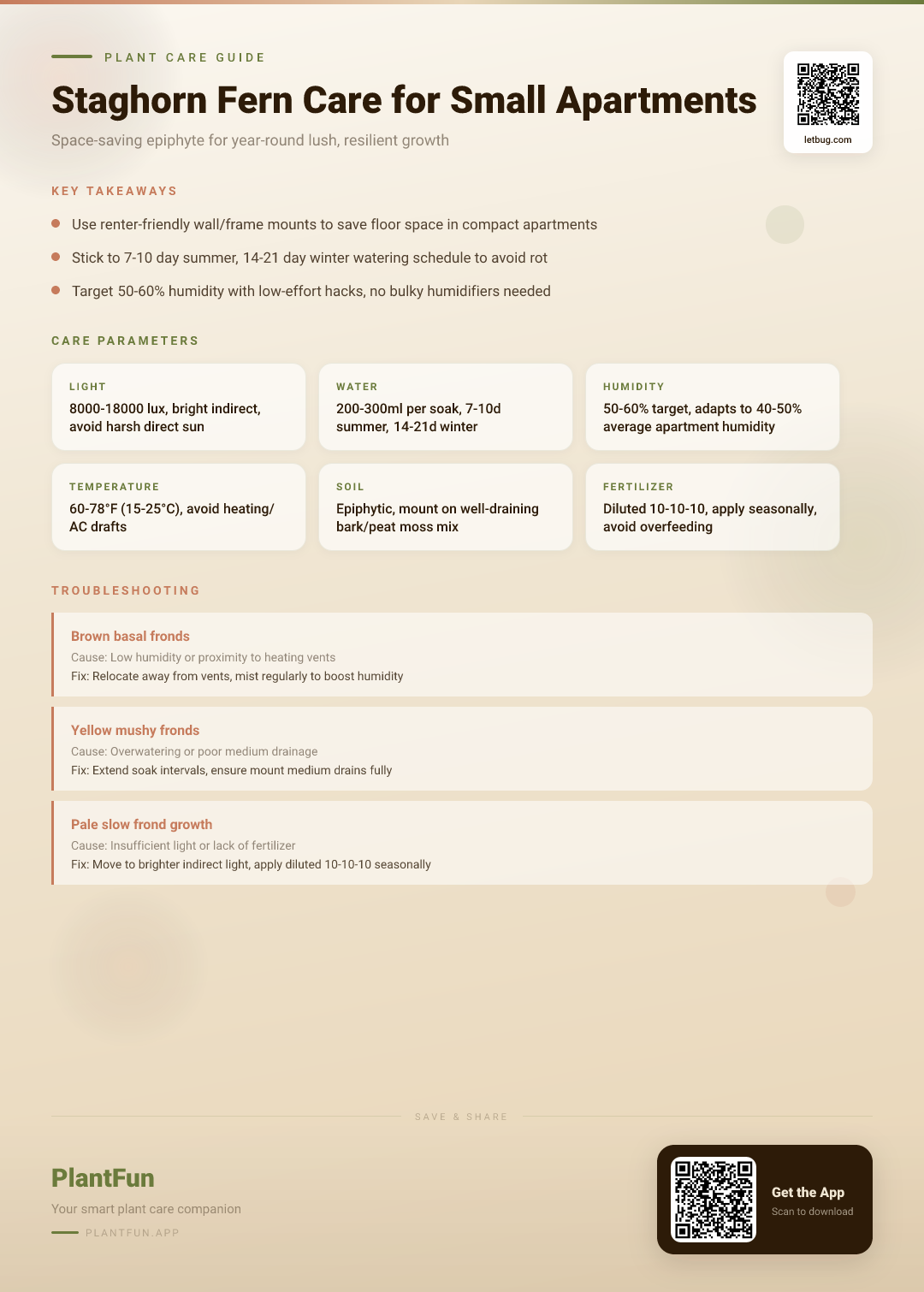
Key Takeaways
- Check soil moisture before watering — overwatering is the #1 killer of houseplants.
- Ensure your plant gets the right amount of light for its species.
- Be patient with recovery — most plants need 2–4 weeks to bounce back.
Quick Care Card
| Parameter | Exact Apartment-Specific Threshold |
|---|---|
| Light | 8,000–18,000 lux bright indirect light (6+ hours daily) |
| Water | 200–300ml per soak, 7–10 days summer, 14–21 days winter |
| Humidity | 50–60% target, tolerate 40% minimum |
| Temperature | 60–78°F (15–25°C), avoid drops below 55°F (13°C) |
| Mounting Medium | 50/50 long-fiber sphagnum moss + orchid bark, no potting soil |
| Fertilizer | 1/4 strength 10-10-10 liquid, once monthly spring/summer only |
| Toxicity | Non-toxic to cats, dogs, and humans (ASPCA, 2026) |
Why Staghorn Ferns Are Ideal for Small Apartments
Staghorn ferns (Platycerium spp.) are epiphytes, meaning they naturally grow on tree trunks instead of in soil, making them perfect for cramped urban living (NC State Extension, 2026). Their vertical growth habit requires zero floor or shelf space, so you can add greenery without rearranging your entire layout. They also filter formaldehyde and xylene from indoor air, and are safe for pets and kids per the ASPCA (2026). For anyone looking for small space staghorn fern ideas, these resilient plants work equally well in studios, 1-bedrooms, and shared dorm spaces.
Step 1: Space-Optimized Placement & No-Drill Mounting Guide
Staghorn fern light requirements indoors are 8,000–18,000 lux of bright indirect light (NC State Extension, 2026). Quick test to confirm placement: hold your hand 1 foot from the spot you want to mount the fern. If you see a soft, fuzzy shadow without sharp edges, the light level is perfect. If you see no shadow, the spot is too dim; if you see a sharp, defined shadow, it gets too much direct sun.
For renter-friendly staghorn fern mount ideas no drill, use these options that leave zero wall damage:
- Over-the-door hook mounts for hollow closet or bedroom doors (best for east-facing doors that get morning light)
- Heavy-duty adhesive wall hooks (rated for 5lbs+ to support the fern and wet moss) for empty wall space
- Suction cup mounts for glass window frames (north or east-facing windows only, to avoid sunburn) If you’re looking for more small-space plant mounting ideas, check out our guide to renter-friendly no-drill plant mount ideas for more inspiration.
Step 2: Exact Watering Routine for Apartment Conditions
Wondering how often to water staghorn fern in a standard apartment with 40–50% average humidity? Follow these measurable thresholds:
- Each soak: 200–300ml of room-temperature water, or submerge the moss portion of the mount for 10 minutes
- Summer (when indoor temps stay above 68°F/20°C): Water every 7–10 days (staghorn fern summer watering schedule)
- Winter (when heating runs regularly): Water every 14–21 days (core of staghorn fern winter care) Quick test before watering: Press 1 inch into the moss mount. If it’s completely dry, water; if it’s still damp, wait 2–3 days and test again (NC State Extension, 2026). Always let the mount drain fully for 15 minutes after watering to avoid dripping on floors or furniture.
Step 3: Humidity & Temperature Adjustments for Typical Apartments
Ideal staghorn fern humidity levels are 50–60%, but they tolerate down to 40% which matches the average humidity of most heated/cooled apartments (NC State Extension, 2026). No bulky humidifier required: use these low-effort hacks to hit your target:
- Group your staghorn fern with 2–3 other small plants to create a humid microclimate
- Place a 4oz pebble tray with ½ inch of water under the mount (ensure the mount never sits directly in standing water)
- Mist the antler fronds 2x weekly with room-temperature distilled water For more low-effort hacks, see our full guide to increasing humidity for indoor plants without a bulky humidifier.
Keep your fern in the 60–78°F (15–25°C) safe temperature range, and avoid mounting within 3ft of drafty AC units, windows, or heating vents.
Step 4: Fertilizing Schedule for Resilient Frond Growth
To get lush staghorn fern fronds without overfeeding in lower-light apartment environments, follow this schedule:
- Use a balanced 10-10-10 liquid fertilizer diluted to 1/4 the recommended strength
- Apply once monthly only during the spring and summer growing seasons (March–August in the Northern Hemisphere)
- Skip fertilizing entirely in fall and winter, when lower light slows the fern’s growth (Hamasaki, 1977) If you’re new to fertilizing houseplants, our beginner’s indoor plant fertilizer guide walks you through dilution and application best practices.
Seasonal Care Calendar for Apartment Staghorn Ferns
Adjust your routine to match the fluctuating conditions common in multi-unit buildings:
- January–February (Winter): Water every 18–21 days, keep 3ft away from heating vents, no fertilizer
- March–April (Spring): Increase watering to 10–14 days, start monthly fertilizing when light stays above 8,000 lux for 6+ hours daily
- May–August (Summer): Water every 7–10 days, move 3ft away from AC drafts, mist 3x weekly if humidity drops below 45%
- September–October (Fall): Reduce watering to 10–14 days, stop fertilizing as light levels drop
- November–December (Early Winter): Water every 14–18 days, avoid mounting above radiators or near exterior doors with cold drafts
7 Common Small-Apartment Staghorn Fern Mistakes to Avoid
- Mistake: Placing mount within 1ft of heating vents or radiators. What happens: Fronds crisp up in 1–2 weeks as local humidity drops below 30%. Instead: Mount at least 3ft away from heat sources, add a pebble tray if you can’t move it further.
- Mistake: Overwatering in low light (below 8,000 lux). What happens: Basal fronds rot, mold grows on the moss mount. Instead: Extend watering intervals by 50% if your space gets less than 8,000 lux of light.
- Mistake: Using a mount larger than 12x12 inches for small apartment walls. What happens: Crowds limited wall space, becomes a hazard if mounted near walkways. Instead: Use 8x8 inch mounts for juvenile ferns, upgrade by 2 inches only when basal fronds cover the entire existing mount.
- Mistake: Mounting in a window with more than 2 hours of direct midday sun. What happens: Antler fronds burn, develop brown crispy patches. Instead: Hang a sheer curtain over south or west facing windows to filter direct sun.
- Mistake: Using regular potting soil for the mount. What happens: Roots suffocate, as epiphytes need consistent air flow around their root systems. Instead: Use a 50/50 mix of long-fiber sphagnum moss and orchid bark for mounting medium.
- Mistake: Fertilizing in winter when light levels are low. What happens: Fertilizer salts build up in the moss, burn the root system. Instead: Only fertilize between March and August when natural light is above 8,000 lux for 6+ hours a day.
- Mistake: Forgetting to drain the mount fully after watering. What happens: Excess water drips onto floors or furniture, causing water damage in rental units. Instead: Take the mount down to water over the sink, let it drain for 15 minutes before rehanging.
FAQ 1: Why is my staghorn fern’s basal frond turning brown in my apartment?
First, distinguish between normal aging and rot. Myth: All brown fronds mean your fern is dying. Reality: Brown, papery basal fronds are completely normal as the fern matures, as these fronds protect the root system and hold moisture (NC State Extension, 2026). If the brown fronds are mushy or smell like rot, you are overwatering, so let the moss dry out completely before watering again. This is one of the most common questions around why is my staghorn fern turning brown for new apartment growers.
FAQ 2: Can I mount my staghorn fern above my apartment radiator?
No, radiators emit dry, hot air that drops humidity below 30% within 2ft of the unit, which will crisp your fern’s fronds in less than a week (Hoshizaki, 1975). If you have no other wall space, mount it at least 3ft above the radiator, add a pebble tray, and mist 3x weekly to compensate for low humidity.
FAQ 3: How often do I need to water my staghorn fern in a low-light apartment?
If your space gets less than 8,000 lux of bright indirect light (test with a free light meter app), extend your watering schedule by 50%: water every 14–15 days in summer, 21–30 days in winter. Always test the moss first: if it’s damp 1 inch deep, wait to water. If you’re wondering can staghorn ferns live in low light apartments long-term, they can survive, but will grow slower than in brighter spots. If your apartment gets very little natural light, you can find more suitable plant options in our roundup of best low-light indoor plants for apartments.
Troubleshooting Quick Fixes for Common Staghorn Issues
Yellow Antler Fronds
Symptom: Soft, yellowing fronds that fall off easily.
Likely cause: Overwatering or poor drainage from the mount.
Fix:
- Stop watering for 2 weeks, let the moss dry out completely 1 inch deep
- If mold is present, remove the top ½ inch of moss and replace with fresh sphagnum moss
Crispy Frond Edges
Symptom: Brown, dry edges on the tips of antler fronds, rest of the frond is green.
Likely cause: Humidity below 40% or placement near a drafty AC or heating vent.
Fix:
- Move the mount at least 3ft away from any vents or draft sources
- Add a pebble tray with ½ inch of water under the mount, mist fronds 2x weekly
Stunted Growth
Symptom: No new antler frond growth for 3+ months during spring and summer.
Likely cause: Insufficient light (below 8,000 lux) or lack of fertilizer during growing season.
Fix:
- Move the mount to a brighter spot that gets 6+ hours of bright indirect light daily
- Apply 1/4 strength 10-10-10 fertilizer once monthly for 3 months to encourage new growth
Brown Spots on Fronds
Symptom: Irregular brown spots with yellow halos on antler fronds.
Likely cause: Sunburn from direct midday sun exposure.
Fix:
- Trim off badly burned fronds with sterile scissors
- Hang a sheer curtain over the window to filter direct sun, or move the mount 2ft further back from the window
References
- NC State Extension. (2026). Staghorn Fern Care Checklist — NC State Extension Gardener Plant Toolbox. https://plants.ces.ncsu.edu/plants/staghorn-fern/. Accessed 2026-03-03.
- Hoshizaki, B. (1975). A Staghorn Fern (Platycerium) Hybrid. American Fern Journal. https://doi.org/10.2307/1546341. Accessed 2026-03-03.
- Hamasaki, D. (1977). How Fast Does a Staghorn Fern Grow? American Fern Journal. https://doi.org/10.2307/1545969. Accessed 2026-03-03.
- ASPCA. (2026). Toxic and Non-Toxic Plants List — ASPCA. https://www.aspca.org/pet-care/animal-poison-control/toxic-and-non-toxic-plants. Accessed 2026-03-03.
Optional Helper: Plantfun.App
Plantfun.App identifies your plants by photo, diagnoses pests and diseases with clear fixes, and creates personalised watering and light schedules that adapt to your home conditions — a handy companion for putting this guide into daily practice.
Found an error or have suggestions? We'd love your feedback.
Need help identifying this problem?
Get instant identification, personalized care schedules, and effective pest treatment plans directly on your phone.
Sponsored • We may earn a commission from app downloads
Related Guides
Staghorn Fern in Small Urban Apartments: The Only Resilient Growth Care Checklist You Need
Grow a lush, thriving staghorn fern even in your cramped small apartment. Get our actionable checklist with exact light, water, and humidity levels for resilient, low-fuss growth all year long.
Care GuideStaghorn Fern in Small East-Facing Apartments: The Only Care Guide You’ll Ever Need
Grow a lush, resilient staghorn fern even in a tiny east-facing apartment. Get exact light levels, watering amounts, space-saving mounting tips, and a free printable care checklist today.
Care GuideThe Complete Staghorn Fern Care Checklist for Resilient Growth in Typical Small Apartments
Stop watching your staghorn fern develop crispy brown fronds. Get a space-specific checklist, exact light and humidity thresholds, and no-fuss tips for lush growth in your small apartment.
Pest ControlAnts on Plants: What They Mean and What to Do
Ants usually aren't eating your plant. They are farming other pests.