
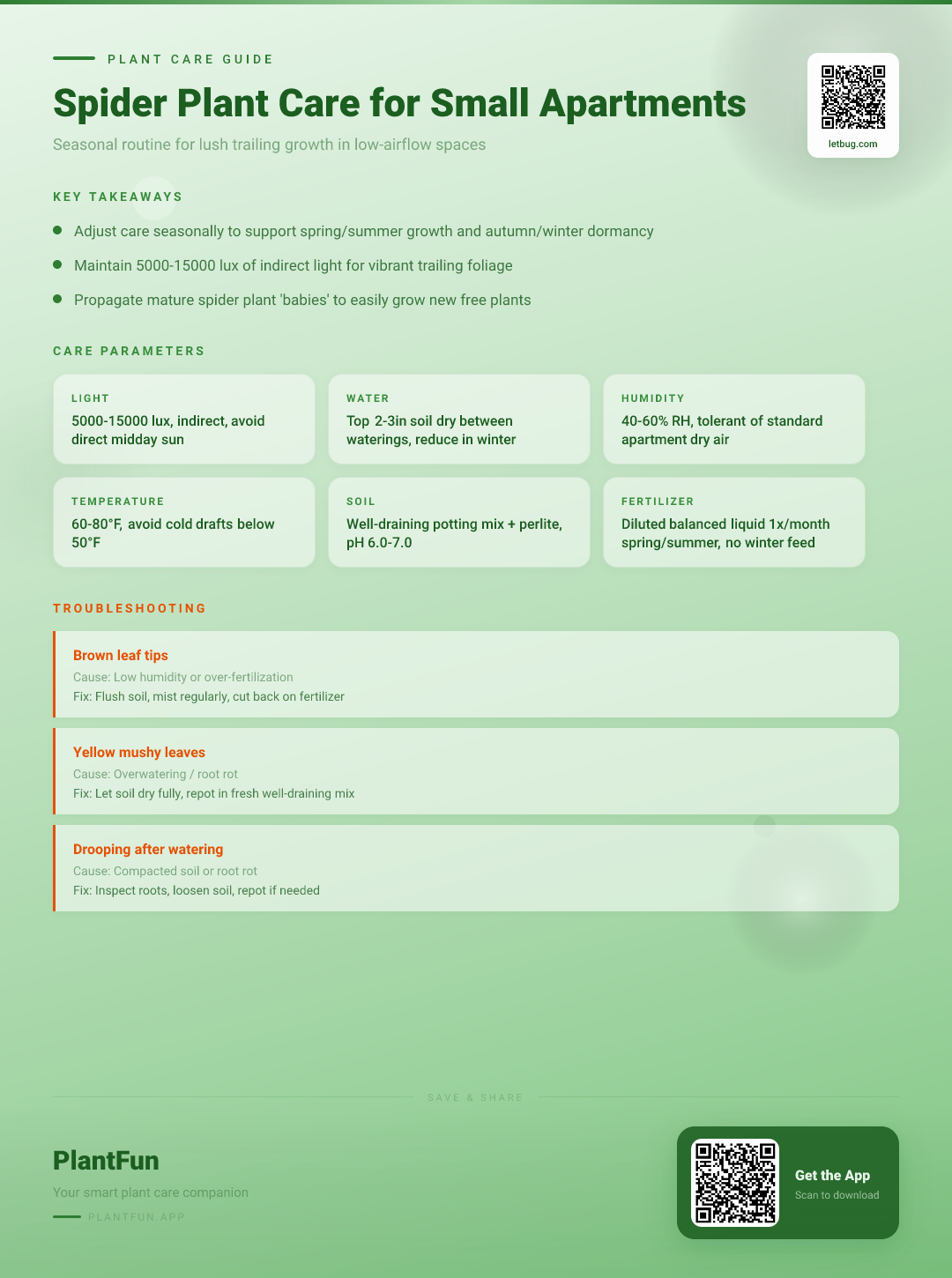
Key Takeaways
- Check soil moisture before watering — overwatering is the #1 killer of houseplants.
- Ensure your plant gets the right amount of light for its species.
- Be patient with recovery — most plants need 2–4 weeks to bounce back.
TL;DR: The Apartment Spider Plant Success Strategy
To keep your Chlorophytum comosum thriving in an apartment, focus on these four pillars: mimic natural light (5,000–15,000 lux), avoid overwatering by checking soil depth, provide moderate humidity, and rotate your plant regularly. When I first started growing spider plants in my 400-square-foot studio, I made the mistake of placing them in a dark corner; they quickly became leggy. By moving them to a brighter spot and adopting a seasonal watering schedule, I saw an immediate shift in vitality.
Quick Care Card: Essential Thresholds for Your Spider Plant
| Factor | Requirement |
|---|---|
| Light | Bright, indirect (5,000–15,000 lux) |
| Water | Allow top 2 inches to dry out |
| Humidity | 40–60% (average apartment levels) |
| Temperature | 60°F–80°F (15°C–27°C) |
| Soil | Well-draining, peat-based mix |
| Fertilizer | Balanced liquid (10-10-10) monthly in growing season |
| Toxicity | Non-toxic to cats and dogs (ASPCA, 2026) |
Why Your Apartment Environment Challenges Spider Plants
Apartments are often climate-controlled environments that lack the natural airflow found outdoors. While these plants are exceptionally resilient, stagnant air and artificial heating can create micro-climates that stress the plant (Chaffey, 2001). As an apartment gardener, you are managing a container-bound ecosystem where evaporation rates differ drastically from natural soil (Halawa & Aisuwarya, 2023).
Format A: The Complete Seasonal Care Calendar
- Spring: Increase water frequency; begin monthly fertilization.
- Summer: Peak growth period; monitor soil moisture weekly to prevent dehydration.
- Autumn: Reduce water frequency as growth slows; cease fertilization.
- Winter: Allow soil to dry deeper; keep away from direct heat vents.
Spring & Summer: Boosting Growth and Offshoot Production
During the warmer months, your spider plant enters its active growth cycle. This is when you will see the famous “spiderettes” or plantlets appearing on long stems. To encourage this, ensure the plant receives consistent light and consistent moisture. I find that using a well-draining potting mix allows for better oxygen exchange during these high-growth weeks.
Autumn & Winter: Managing Dormancy in Temperature-Controlled Spaces
When the days shorten, your plant’s metabolic rate drops (Chaffey, 2001). I reduce my watering frequency by about 50% during these months. Avoid letting the pot sit in cold drafts near windows or directly in the path of a heater, which can cause excessive transpiration and dry out the foliage.
Critical Watering Techniques: Preventing Root Rot in Low-Airflow Apartments
In apartments, water doesn’t evaporate as quickly as it does in a garden.
- The Finger Test: Insert your index finger 2 inches into the soil. If it feels damp, wait two more days.
- The Weight Test: Lift the pot. If it feels suspiciously light, it is time to hydrate.
- The Drainage Check: Never allow the plant to sit in standing water within a saucer (Halawa & Aisuwarya, 2023).
Optimizing Light: Achieving 5,000-15,000 Lux in Typical Apartment Corners
Most apartment windows provide far less light than they appear to. I suggest placing your spider plant within 3 feet of an east-facing window. If your plant looks pale, it is likely light-starved. Use a light meter app or sensor to ensure your chosen spot hits at least 5,000 lux.
Common Apartment Mistakes: Why Your Leaf Tips Are Turning Brown
Improper Water Quality
Symptom: Leaf tips turn brown and crispy.
Likely cause: Sensitivity to chemicals like fluoride or chlorine in tap water.
Fix:
- Let tap water sit for 24 hours before use.
- Switch to filtered or distilled water.
Low Ambient Humidity
Symptom: Crispy, browning edges on otherwise healthy leaves.
Likely cause: Dry air from AC units or radiators.
Fix:
- Place the plant on a tray filled with pebbles and water.
- Group plants together to create a localized humid micro-climate.
Voice Search FAQ: Why is my spider plant drooping even though I watered it?
Drooping is often a sign of root suffocation. If the soil is constantly wet, the roots cannot breathe, leading to root rot (Halawa & Aisuwarya, 2023). Check your drainage holes immediately.
Voice Search FAQ: How often should I fertilize my spider plant in the winter?
Stop completely. Fertilizing during the plant’s winter dormancy can lead to salt buildup in the soil, which causes root burn. Resume in early spring when you see new growth.
Advanced Care: When to Propagate Your Spider Plant ‘Babies’
Wait until the plantlets (spiderettes) develop small, visible root nubs before clipping them. Place the nub in water or directly into a small pot of moist soil to propagate new indoor spider plant growth.
References
- ASPCA. (2026). Toxic and Non-Toxic Plants List — ASPCA. https://www.aspca.org/pet-care/animal-poison-control/toxic-and-non-toxic-plants. Accessed 2026-03-10.
- Chaffey, N. (2001). The true spider plant. Trends in Plant Science. https://doi.org/10.1016/s1360-1385(01)02109-4. Accessed 2026-03-10.
- Halawa, H.; Aisuwarya, R. (2023). Smart Plant Pot Robot with IoT Integration for Indoor Ornamental Plants Care. JITCE (Journal of Information Technology and Computer Engineering). https://doi.org/10.25077/jitce.7.2.97-106.2023. Accessed 2026-03-10.
Optional Helper: Plantfun.App
Plantfun.App identifies your plants by photo, diagnoses pests and diseases with clear fixes, and creates personalised watering and light schedules that adapt to your home conditions — a handy companion for putting this guide into daily practice.
Found an error or have suggestions? We'd love your feedback.
Need help identifying this problem?
Get instant identification, personalized care schedules, and effective pest treatment plans directly on your phone.
Sponsored • We may earn a commission from app downloads
Related Guides
The Complete Spider Plant Care Checklist for Lush Resilient Growth in Typical Apartments
Stop struggling to keep your spider plant thriving in your apartment. Get exact light, water, humidity thresholds plus a printable checklist for lush, resilient growth all year.
Care GuideSpider Plant Care for Small Apartments: A 4-Season Guide to Lush, Resilient Growth
Transform your small apartment with a vibrant Chlorophytum comosum. Follow our 4-season routine with precise light, water, and humidity data for year-round growth.
Care GuideSpider Plant Care in Low-Light Apartments: 5 Proven Steps for Lush, Resilient Growth
Revive your apartment Spider Plant with our precise, expert-backed care guide. Learn exact watering volumes, light thresholds, and simple fixes for brown tips.
Pest ControlAnts on Plants: What They Mean and What to Do
Ants usually aren't eating your plant. They are farming other pests.