
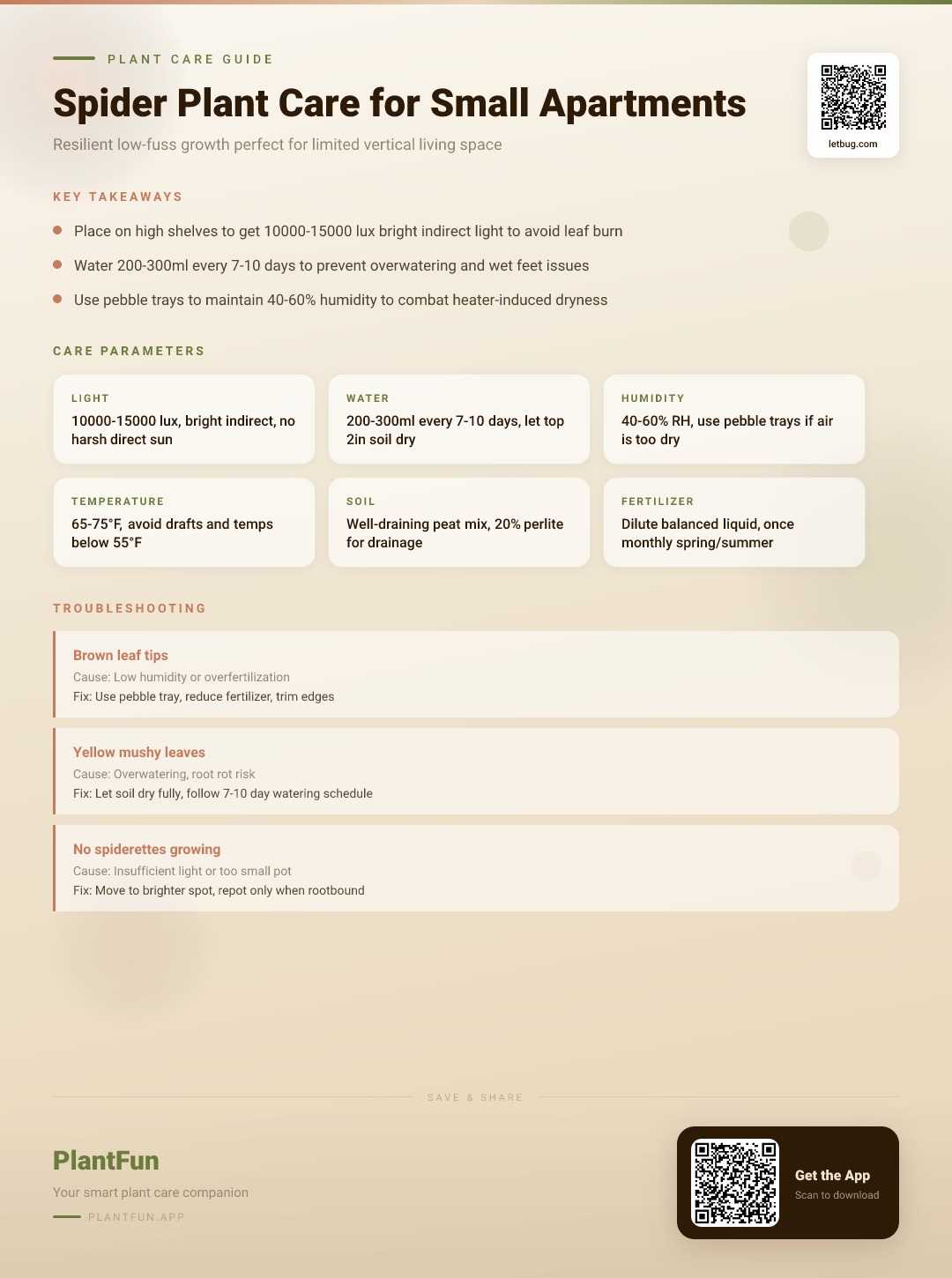
Key Takeaways
- Check soil moisture before watering — overwatering is the #1 killer of houseplants.
- Ensure your plant gets the right amount of light for its species.
- Be patient with recovery — most plants need 2–4 weeks to bounce back.
TL;DR: The Apartment dweller’s Cheat Sheet for Chlorophytum comosum resilience.
To keep your Chlorophytum comosum thriving in a small apartment, focus on three pillars: bright, indirect light (10,000–15,000 lux), consistent but moderate watering (200–300ml every 7–10 days), and active humidity management (40–60%). Avoid overwatering to prevent root rot—the number one killer in stagnant indoor air. Treat your plant as a vertical accent to save precious floor space.
Quick Care Card: Essential Thresholds for Apartment Success
| Feature | Threshold |
|---|---|
| Light | 10,000–15,000 lux (bright, indirect) |
| Water | 200–300ml per cycle (every 7–10 days) |
| Humidity | 40–60% relative humidity |
| Temperature | 65–75°F (18–24°C) |
| Soil | Well-draining, peat-based potting mix |
| Fertilizer | Balanced liquid feed, monthly during growing season |
| Toxicity | Non-toxic (Safe for cats/dogs) |
Why Your Small Space is Actually Perfect for Spider Plants
When I first started gardening in a 400-square-foot studio, I worried my limited space would stifle my plants. I quickly learned that Chlorophytum comosum actually thrives in restricted root zones (NC State Extension, 2026). Unlike tropical plants that demand massive floor space, these plants are highly adaptable to the varied light conditions found in apartments, making them ideal for the “urban jungle” aesthetic.
Step 1: Optimizing Light in Compact Footprints
Light is a finite resource in an apartment. I use high-shelf placement to capture 10,000–15,000 lux. By placing your plant on a high shelf near an east-facing window, you maximize exposure without the scorching direct noon sun that causes leaf burn.
Step 2: Precision Watering Protocols
In stagnant apartment air, moisture stays in the soil longer. I suggest a measured approach: use 200–300ml of water every 7–10 days. Always perform the “finger test”—stick your finger two inches into the soil; if it feels damp, wait. Overwatering is the primary cause of decay in indoor settings (Chaffey, 2001).
Step 3: Managing Humidity in Urban Environments
Central heating often drops apartment humidity well below 30%, which is why your plant develops brown tips. I maintain 40–60% humidity by grouping my plants together to create a micro-climate or using a pebble tray filled with water to increase localized vapor pressure.
Step 4: Vertical Space Optimization
I utilize hanging baskets and tension rods to elevate my Spider Plants. This saves floor space and allows for the cascading growth they are famous for. Rotate the pot 90 degrees every time you water to ensure even light distribution and prevent one-sided “leggy” growth.
Seasonal Care Calendar
- Winter: Radiator heat is the enemy. Move your plant away from direct heat sources and reduce watering by 20% to account for the slower growth phase.
- Summer: Peak growth requires consistent feeding and increased water. Monitor soil moisture daily if temperatures exceed 80°F.
Common Mistakes: Identifying brown tips early
- Mistake: Repotting too soon.
- What happens: Root shock and stunted growth.
- Instead: Only repot when roots are visibly lifting the plant out of the pot.
- Mistake: Using tap water with high fluoride.
- What happens: Brown, crispy leaf tips.
- Instead: Use distilled or filtered water to avoid mineral salt accumulation (NC State Extension, 2026).
Voice Search FAQ
Why is my Spider Plant getting brown tips in my living room?
This is typically a response to low humidity or mineral buildup from tap water (NC State Extension, 2026). Increase your ambient humidity and switch to filtered water.
How do I prune ‘spiderettes’ without stressing the mother plant?
Use sterilized scissors to snip the runner as close to the base of the spiderette as possible. This allows the mother plant to redirect energy back into its own foliage.
Can I grow a Spider Plant in a room with no direct windows?
Yes, but you will need artificial supplemental lighting to meet the 10,000 lux threshold (Halawa & Aisuwarya, 2023).
References
- Halawa, H.; Aisuwarya, R. (2023). Smart Plant Pot Robot with IoT Integration for Indoor Ornamental Plants Care. JITCE (Journal of Information Technology and Computer Engineering). https://doi.org/10.25077/jitce.7.2.97-106.2023. Accessed 2026-03-11.
- Chaffey, N. (2001). The true spider plant. Trends in Plant Science. https://doi.org/10.1016/s1360-1385(01)02109-4. Accessed 2026-03-11.
- ASPCA. (2026). Toxic and Non-Toxic Plants List — ASPCA. https://www.aspca.org/pet-care/animal-poison-control/toxic-and-non-toxic-plants. Accessed 2026-03-11.
- NC State Extension. (2026). Spider Plant Care — NC State Extension Gardener Plant Toolbox. https://plants.ces.ncsu.edu/plants/plant-care/. Accessed 2026-03-11.
Optional Helper: Plantfun.App
Plantfun.App identifies your plants by photo, diagnoses pests and diseases with clear fixes, and creates personalised watering and light schedules that adapt to your home conditions — a handy companion for putting this guide into daily practice.
Found an error or have suggestions? We'd love your feedback.
Need help identifying this problem?
Get instant identification, personalized care schedules, and effective pest treatment plans directly on your phone.
Sponsored • We may earn a commission from app downloads
Related Guides
The Complete Spider Plant Care Checklist for Lush Resilient Growth in Typical Apartments
Stop struggling to keep your spider plant thriving in your apartment. Get exact light, water, humidity thresholds plus a printable checklist for lush, resilient growth all year.
Care GuideThe Complete Spider Plant Care Checklist for Resilient Growth in Small Urban Apartments
Grow lush, trailing spider plants in your small urban apartment without fancy expensive tools. Grab our free 7-item checklist, exact light, water, and soil parameters for zero-fuss, resilient growth year-round.
Care GuideThe Complete Spider Plant Care Checklist for Thriving Growth in Small City Apartments
Grow lush, baby-producing spider plants even in tiny apartments. Get exact light, water, and humidity thresholds plus a free printable weekly checklist to take the guesswork out of care.
Pest ControlAnts on Plants: What They Mean and What to Do
Ants usually aren't eating your plant. They are farming other pests.