
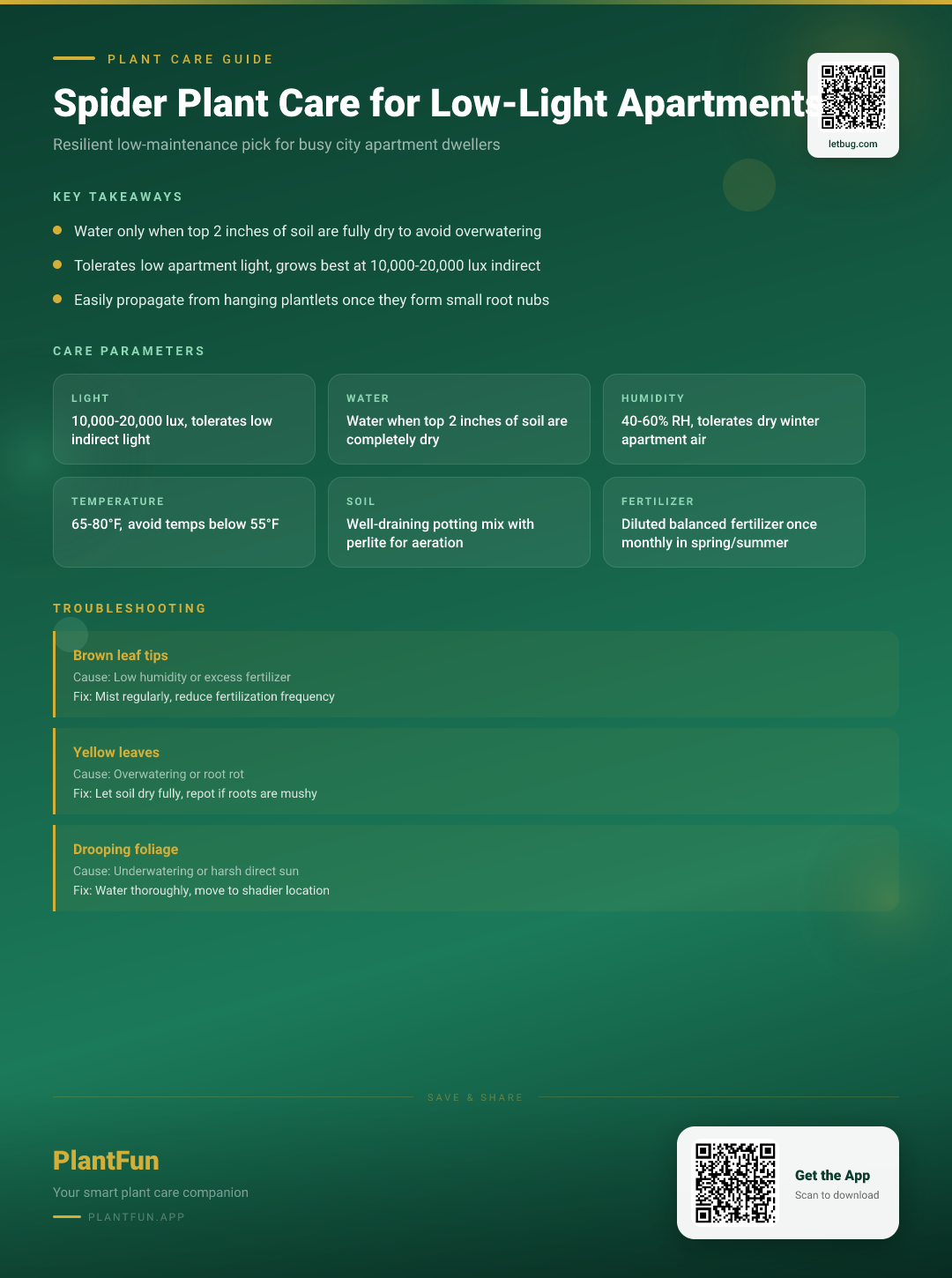
Key Takeaways
- Check soil moisture before watering — overwatering is the #1 killer of houseplants.
- Ensure your plant gets the right amount of light for its species.
- Be patient with recovery — most plants need 2–4 weeks to bounce back.
When I first brought home my Chlorophytum comosum, I made the mistake of placing it in a dark corner of my studio apartment, assuming its ‘indestructible’ reputation meant it could survive without any natural light. Within weeks, the vibrant variegation faded, and the leaves began to droop. Through years of trial and error in urban living, I’ve learned that while these plants are resilient, they thrive only when we respect their biological thresholds.
Quick Care Card: Essential Thresholds for Success
| Feature | Requirement |
|---|---|
| Light | 10,000–20,000 lux (bright, indirect) |
| Water | When top 2 inches of soil are dry |
| Humidity | 40–60% relative humidity |
| Temperature | 65–80°F (18–27°C) |
| Soil | Well-draining peat-based mix |
| Fertilizer | Balanced liquid 10-10-10 monthly in spring/summer |
| Toxicity | Non-toxic to cats and dogs (ASPCA, 2026) |
TL;DR: The Apartment-Resilient Spider Plant Manifesto
Spider plants are perfect for city dwellers because they tolerate varying light levels and are non-toxic to pets (ASPCA, 2026). To keep yours healthy, place it in bright, indirect light, water only when the top 2 inches of soil feel dry, and maintain ambient room temperatures between 65–80°F. If you see brown tips, it is usually a sign of fluoride sensitivity or low humidity, not necessarily neglect.
Understanding Your Apartment Micro-Climate: Light vs. Reality
In my experience, apartment light is deceptive. While Chlorophytum comosum is often labeled a ‘low-light’ plant, that is a misnomer (Chaffey, 2001). It survives in low light, but it grows optimally in 10,000–20,000 lux. In a window-filled living room, this is easy; in a North-facing bedroom, you may need to move the plant closer to the glass or supplement with a dedicated grow light to prevent the ‘stretching’ (etiolation) caused by insufficient energy intake.
Step-by-Step Care Guide: From Watering to Soil Aeration
- Check the Soil: Before watering, stick your finger 2 inches into the soil. If it feels moist, wait two more days.
- The Water Quality Factor: I use filtered water when possible. Tap water often contains chlorine and fluoride, which can build up in the soil and cause leaf damage.
- Aeration: Every few months, gently stir the top inch of soil with a chopstick to prevent compaction, which helps oxygen reach the roots as noted in recent studies on plant pot micro-environments (Halawa & Aisuwarya, 2023).
- Drainage: Always use a pot with drainage holes. If you are using a decorative cachepot, ensure you remove the nursery pot to drain any excess water after each soak.
Symptom-to-Action: Why Are My Spider Plant Tips Turning Brown?
Browning Leaf Tips
Symptom: The ends of the leaves are dry, crisp, and brown.
Likely cause: Accumulation of minerals from tap water or low ambient humidity.
Fix:
- Switch to distilled or filtered water to reduce mineral buildup.
- Increase local humidity by grouping plants or using a pebble tray.
Yellowing Leaves
Symptom: Lower leaves turn soft, yellow, and mushy.
Likely cause: Overwatering or waterlogged soil.
Fix:
- Immediately cease watering and inspect the roots for signs of rot.
- Repot into fresh, well-draining soil if the current mix is sour or soggy.
Managing Humidity in Dry Apartment Winters
In city apartments, radiator heat can drop humidity below 30%, which is stressful for tropical foliage. I often place my spider plants near a humidifier or on a gravel tray filled with water (ensuring the pot sits above the water line, not in it). This creates a localized micro-climate that mimics the plant’s natural habitat (Chaffey, 2001).
Advanced Care: When and How to Propagate Your Plantlets
When your spider plant produces ‘babies’ (plantlets) on long stolons, don’t rush to remove them. I wait until they develop tiny, visible root nubs. To propagate, simply snip the plantlet off, place the base in a small glass of water until roots reach 1 inch in length, then pot into a small, well-draining container.
Common Apartment Mistakes: The Overwatering Trap
- Mistake: Watering on a strict schedule (e.g., ‘every Monday’).
- What happens: The soil remains constantly wet, leading to root rot.
- Instead: Use the finger-check method to gauge actual need.
- Mistake: Using a pot that is too large.
- What happens: Excess soil holds too much moisture for the root system to handle.
- Instead: Only size up by 1–2 inches in diameter.
FAQ: Voice-Optimized Care Answers
Can I keep my spider plant in a windowless room? No. While it may survive for a few weeks, it needs consistent light to produce energy. Without at least 10,000 lux, it will eventually decline (Chaffey, 2001).
Why is my spider plant drooping despite regular watering? This is often a sign of ‘limp’ roots from overwatering. If the roots aren’t firm and white, they can’t hydrate the leaves, making the plant look thirsty even when the soil is wet.
How do I know if my spider plant needs a bigger pot? If you see fleshy, tuberous roots emerging from the drainage holes or pushing the plant upward out of the soil, it is time for an upgrade (Halawa & Aisuwarya, 2023).
References and Botanical Best Practices
- ASPCA. (2026). Toxic and Non-Toxic Plants List — ASPCA. https://www.aspca.org/pet-care/animal-poison-control/toxic-and-non-toxic-plants. Accessed 2026-03-14.
- Chaffey, N. (2001). The true spider plant. Trends in Plant Science. https://doi.org/10.1016/s1360-1385(01)02109-4. Accessed 2026-03-14.
- Halawa, H.; Aisuwarya, R. (2023). Smart Plant Pot Robot with IoT Integration for Indoor Ornamental Plants Care. JITCE (Journal of Information Technology and Computer Engineering). https://doi.org/10.25077/jitce.7.2.97-106.2023. Accessed 2026-03-14.
Optional Helper: Plantfun.App
Plantfun.App identifies your plants by photo, diagnoses pests and diseases with clear fixes, and creates personalised watering and light schedules that adapt to your home conditions — a handy companion for putting this guide into daily practice.
Found an error or have suggestions? We'd love your feedback.
Need help identifying this problem?
Get instant identification, personalized care schedules, and effective pest treatment plans directly on your phone.
Sponsored • We may earn a commission from app downloads
Related Guides
Chlorophytum Comosum in a Low-Light Apartment: The Ultimate Budget-Friendly Resilient Growth Care Plan
Master your Spider Plant care with this 0-dollar apartment strategy. Learn exact watering frequencies, light placement, and propagation tips for lush growth.
Care GuideSpider Plant Care for Small Apartments: A 4-Season Guide to Lush, Resilient Growth
Transform your small apartment with a vibrant Chlorophytum comosum. Follow our 4-season routine with precise light, water, and humidity data for year-round growth.
Care GuideChlorophytum Comosum in a Low-Light Apartment: The Complete Care Guide for Resilient Growth
Transform your dim apartment into a lush sanctuary. Master the exact light, water, and humidity thresholds needed for a thriving, vibrant Chlorophytum Comosum.
Pest ControlAnts on Plants: What They Mean and What to Do
Ants usually aren't eating your plant. They are farming other pests.