
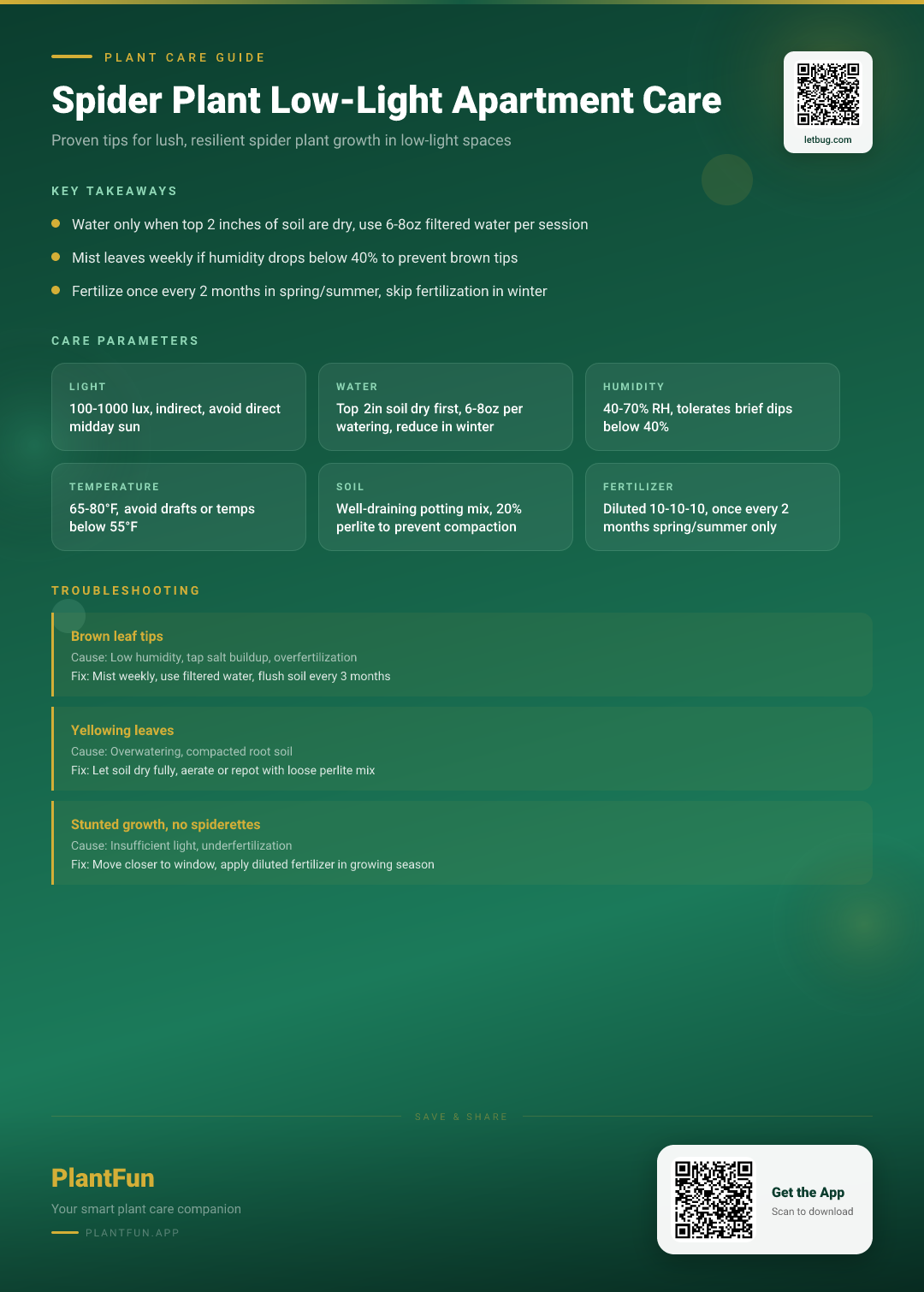
Key Takeaways
- Check soil moisture before watering — overwatering is the #1 killer of houseplants.
- Ensure your plant gets the right amount of light for its species.
- Be patient with recovery — most plants need 2–4 weeks to bounce back.
Quick Care Card: Essential Thresholds for Apartment Success
| Feature | Requirement |
|---|---|
| Light | Bright, indirect light; tolerates low light |
| Water | Allow top 50% of soil to dry before watering |
| Temperature | 65-80°F (18-27°C) |
| Humidity | Moderate (40-60%) |
| Soil | Well-draining, peat-based potting mix |
| Toxicity | Non-toxic to cats and dogs (ASPCA, 2026) |
TL;DR: The Reality of Keeping Spider Plants in Apartments
While often labeled “indestructible,” Chlorophytum comosum requires specific environmental management to thrive indoors. In apartments, success hinges on avoiding waterlogged soil and providing adequate, though not necessarily direct, light. Stick to a 50% soil dryness rule, provide moderate ambient light, and ensure your pot has drainage. If your plant is struggling, it is almost certainly a reaction to inconsistent watering or low-light stress.
My Experience: The “Indestructible” Myth
When I first brought home my own Spider Plant to my dimly lit studio apartment, I made the mistake of assuming it would thrive in a dark corner. Within three weeks, the leaves were losing their vigor, and the tips turned a crispy, frustrating brown. I realized then that while Chlorophytum comosum is resilient, it isn’t magic. It needs enough photosynthesis to maintain its cellular structure (Chaffey, 2001). Once I moved it closer to a window and implemented a strict “finger test” for watering, it exploded with growth.
Why Your Spider Plant Needs Specific Light Management
Although these plants handle lower light better than most, they still require energy to survive. If the light is too dim, the plant cannot photosynthesize effectively, leading to thin, leggy growth.
Step-by-Step: The Precision Watering Method for Apartment Environments
- The Finger Test: Insert your finger 2 inches into the soil. If it feels damp, wait. If dry, proceed (NC State Extension, 2026).
- The Volume: Water until you see liquid exit the drainage holes. For a standard 6-inch pot, this is usually 150-200ml.
- The Drainage: Discard any water collected in the saucer after 15 minutes. Standing water is the primary cause of root rot in apartment settings (Halawa & Aisuwarya, 2023).
Understanding the 65-80°F Temperature Comfort Zone
Spider Plants are tropical perennials. When temperatures dip below 60°F or spike above 85°F due to radiator proximity, the plant enters stress. Keep them away from drafty windows or direct heat vents to ensure optimal gas exchange and metabolic function (Chaffey, 2001).
Identifying the Root Cause: Why Are the Leaves Turning Brown at the Tips?
Brown Leaf Tips
Symptom: The ends of the leaves become dry, brittle, and brown.
Likely cause: Low humidity or salt buildup from tap water.
Fix:
- Use filtered or distilled water to avoid fluoride sensitivity.
- Increase ambient humidity with a pebble tray.
Myth-Busting: Do Spider Plants Really Thrive in Total Darkness?
No plant can thrive in total darkness. While Chlorophytum comosum will survive for weeks in low light, it will eventually lose its variegation (if present) and become susceptible to pests. It is a misconception that they can live in a windowless room indefinitely.
Seasonal Care Calendar: Adjusting for Winter Heating and Summer Growth
- Spring/Summer: Increase watering frequency as growth accelerates.
- Autumn/Winter: Reduce water. The plant’s metabolism slows significantly in lower light (NC State Extension, 2026).
How do I fix yellowing leaves on my indoor Spider Plant?
Yellowing is usually a sign of overwatering. Check the roots; if they are mushy and dark, prune them away and repot in fresh, dry, well-draining soil. Ensure your pot has adequate drainage to prevent future rot (Halawa & Aisuwarya, 2023).
Can I keep my spider plant in an apartment with no windows?
Not long-term. You would need a dedicated grow light to simulate the necessary light spectrum required for the plant to produce food (Halawa & Aisuwarya, 2023).
How often should I really water my spider plant in a 70-degree apartment?
Generally, every 7-10 days, but this depends on your specific home humidity. Always use the 50% dry rule mentioned in the precision watering section.
Common Mistakes: Avoiding Overwatering and Soil Compaction
- Mistake: Using a pot without drainage. What happens: Root rot. Instead: Always use a pot with bottom holes.
- Mistake: Compressing soil too tightly. What happens: Lack of oxygen to roots. Instead: Use a light, peat-heavy mix (NC State Extension, 2026).
Advanced Care: When to Repot and Soil Amendment Ratios
Repot when you see thick, fleshy roots growing out of the drainage holes. Use a mix of 60% potting soil and 40% perlite to ensure maximum aeration.
References
- ASPCA. (2026). Toxic and Non-Toxic Plants List — ASPCA. https://www.aspca.org/pet-care/animal-poison-control/toxic-and-non-toxic-plants. Accessed 2026-03-12.
- Chaffey, N. (2001). The true spider plant. Trends in Plant Science. https://doi.org/10.1016/s1360-1385(01)02109-4. Accessed 2026-03-12.
- Halawa, H., & Aisuwarya, R. (2023). Smart Plant Pot Robot with IoT Integration for Indoor Ornamental Plants Care. JITCE (Journal of Information Technology and Computer Engineering). https://doi.org/10.25077/jitce.7.2.97-106.2023. Accessed 2026-03-12.
- NC State Extension. (2026). Spider Plant Care — NC State Extension Gardener Plant Toolbox. https://plants.ces.ncsu.edu/plants/plant-care/. Accessed 2026-03-12.
Optional Helper: Plantfun.App
Plantfun.App identifies your plants by photo, diagnoses pests and diseases with clear fixes, and creates personalised watering and light schedules that adapt to your home conditions — a handy companion for putting this guide into daily practice.
Found an error or have suggestions? We'd love your feedback.
Need help identifying this problem?
Get instant identification, personalized care schedules, and effective pest treatment plans directly on your phone.
Sponsored • We may earn a commission from app downloads
Related Guides
Spider Plant Care for Small Apartments: A Seasonal Guide for Resilient Growth
Transform your apartment Spider Plant with a seasonal care routine that ensures lush, trailing growth. Master these 4 expert thresholds for vibrant foliage.
Care GuideSpider Plant Care for Small Apartments: A 4-Season Guide to Lush, Resilient Growth
Transform your small apartment with a vibrant Chlorophytum comosum. Follow our 4-season routine with precise light, water, and humidity data for year-round growth.
Care GuideChlorophytum Comosum in a Low-Light Apartment: The Complete Care Guide for Resilient Growth
Transform your dim apartment into a lush sanctuary. Master the exact light, water, and humidity thresholds needed for a thriving, vibrant Chlorophytum Comosum.
Pest ControlAnts on Plants: What They Mean and What to Do
Ants usually aren't eating your plant. They are farming other pests.