
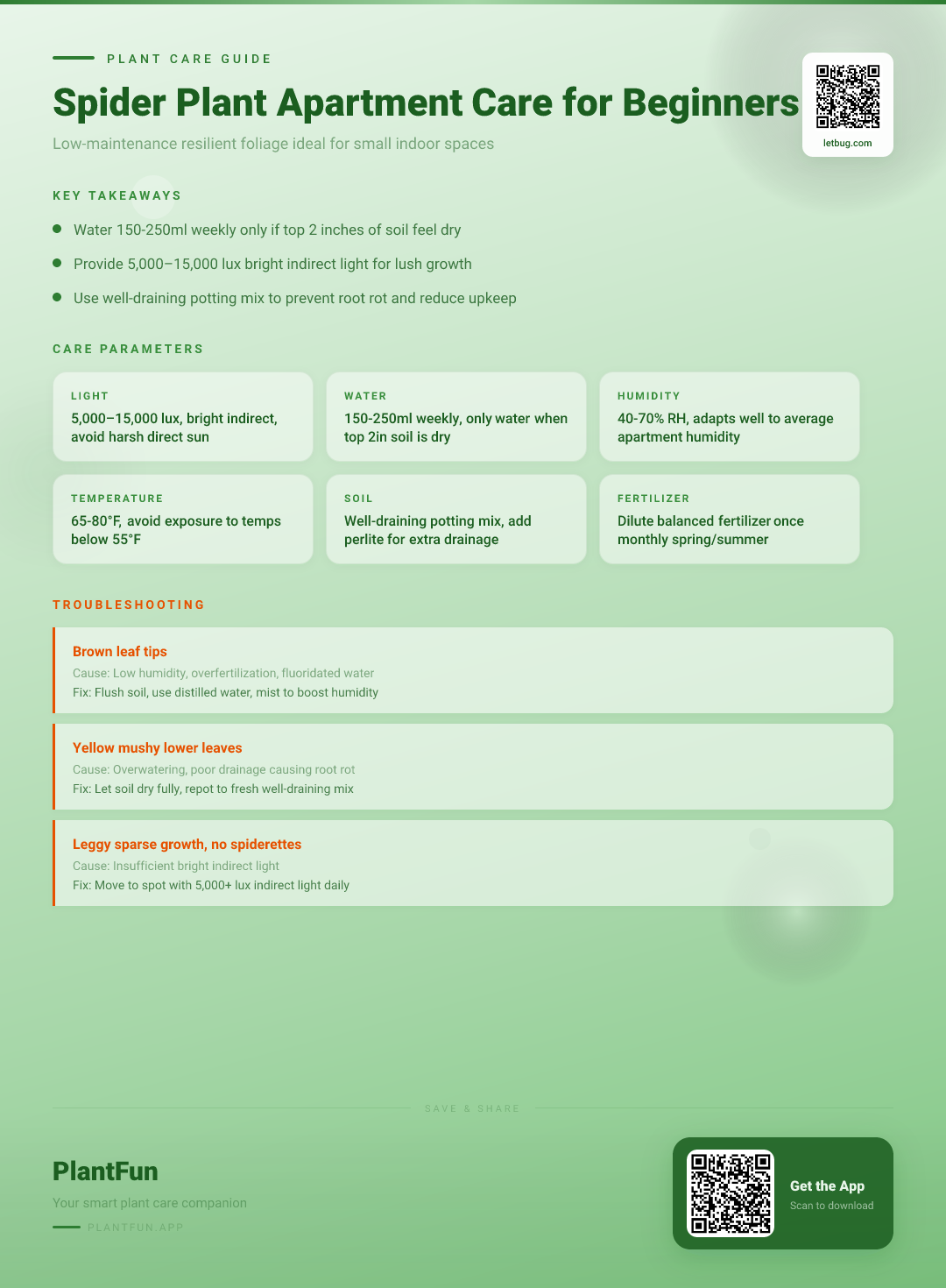
Key Takeaways
- Check soil moisture before watering — overwatering is the #1 killer of houseplants.
- Ensure your plant gets the right amount of light for its species.
- Be patient with recovery — most plants need 2–4 weeks to bounce back.
Quick Care Card: The Essentials for Apartment Resilience
| Feature | Requirement |
|---|---|
| Light | 5,000–15,000 Lux (Bright, indirect) |
| Water | 150ml–250ml per week (Soil-dependent) |
| Humidity | 40%–60% |
| Temperature | 65°F–80°F (18°C–27°C) |
| Soil | Well-draining, peat-based mix |
| Fertilizer | Balanced liquid feed (monthly, spring-summer) |
| Toxicity | Non-toxic to pets (ASPCA, 2026) |
TL;DR: The Low-Maintenance Secret to Lush Spider Plant Foliage
To keep your Chlorophytum comosum thriving in an apartment, focus on three pillars: bright indirect light, consistent but infrequent hydration, and well-draining soil. Avoid overwatering—the number one killer—by checking the top two inches of soil before adding water. Provide these conditions, and your spider plant will reward you with rapid growth and miniature “spiderettes.”
Understanding Your Apartment Environment: Why Light and Airflow Matter
When I first got my spider plant, I made the mistake of placing it in a dark corner of my studio, assuming it would be “low-light tolerant” enough to survive. Within a month, the leaves grew thin and leggy. I learned that while these plants are resilient, they need specific environmental inputs to thrive. As discussed in Trends in Plant Science, the plant’s structural integrity depends on balancing light absorption and transpiration rates (Chaffey, 2001).
Light Requirements: Targeting 5,000–15,000 Lux in Typical Living Rooms
Spider plants crave bright, indirect light. In an apartment, this means positioning your plant near a north or east-facing window. If you are using a light meter, aim for a range of 5,000 to 15,000 Lux. If the leaves start to pale or the plant stops producing offsets, it is a clear sign that you need to move it closer to the light source.
The Budget Hydration Plan: Watering 150ml-250ml per Week Depending on Soil Dryness
Consistency is your best tool. In my experience, I use a measuring cup to deliver 150ml to 250ml of water once a week, but only after checking that the top two inches of soil feel dry to the touch. In small apartments, air circulation can be lower, which slows down evaporation. If the soil stays soggy, you risk root rot, as noted in recent smart-pot research focusing on moisture regulation (Halawa & Aisuwarya, 2023).
Humidity and Temperature: Keeping Your Plant Happy Between 65-80°F
Spider plants are adaptable to standard home temperatures, typically 65°F to 80°F. If your apartment fluctuates outside this range, you may notice tips turning brown. I find that a simple pebble tray with water helps stabilize the local humidity without requiring expensive humidifiers.
Soil and Drainage: Why Well-Draining Mixes Save You Money and Stress
Using a standard potting mix is often insufficient because it retains too much water. I recommend mixing 70% high-quality potting soil with 30% perlite to ensure the root system gets the oxygen it needs. Proper aeration is crucial for the health of the rhizomes, which are the specialized root structures that store water.
Common Mistakes: Addressing Brown Tips and Root Rot in Small Spaces
Brown Leaf Tips
Symptom: The ends of the leaves turn dry, crispy, and brown.
Likely cause: Low humidity or high mineral content in tap water.
Fix:
- Use filtered or distilled water to avoid fluoride buildup.
- Increase ambient humidity by grouping plants or using a pebble tray.
Yellowing Leaves
Symptom: Lower leaves turn yellow and mushy.
Likely cause: Overwatering leading to oxygen-deprived roots.
Fix:
- Remove the plant from the pot and inspect the roots.
- Trim away mushy, black roots and repot in fresh, dry, porous mix.
FAQ: Why is my Spider Plant turning brown at the ends?
This is usually a result of fluoride toxicity or dry air. Try switching to filtered water and moving the plant away from direct radiator heat.
FAQ: Can I keep my Spider Plant in a room without windows?
Technically, it can survive for a short time, but it will not thrive. It will eventually lose its variegation and stop growing. If you must, use a full-spectrum LED grow light for 8–10 hours a day.
Seasonal Care Calendar: Adapting to Apartment Temperature Swings
- Spring: Increase watering as growth picks up; apply balanced fertilizer.
- Summer: Keep away from harsh, direct sun that can scorch leaves.
- Autumn: Reduce watering as temperatures drop.
- Winter: Keep the plant away from drafty windows or heating vents.
References and Further Reading
- Chaffey, N. (2001). The true spider plant. Trends in Plant Science. https://doi.org/10.1016/s1360-1385(01)02109-4. Accessed 2026-03-13.
- Halawa, H.; Aisuwarya, R. (2023). Smart Plant Pot Robot with IoT Integration for Indoor Ornamental Plants Care. JITCE (Journal of Information Technology and Computer Engineering). https://doi.org/10.25077/jitce.7.2.97-106.2023. Accessed 2026-03-13.
- ASPCA. (2026). Toxic and Non-Toxic Plants List — ASPCA. https://www.aspca.org/pet-care/animal-poison-control/toxic-and-non-toxic-plants. Accessed 2026-03-13.
Optional Helper: Plantfun.App
Plantfun.App identifies your plants by photo, diagnoses pests and diseases with clear fixes, and creates personalised watering and light schedules that adapt to your home conditions — a handy companion for putting this guide into daily practice.
Found an error or have suggestions? We'd love your feedback.
Need help identifying this problem?
Get instant identification, personalized care schedules, and effective pest treatment plans directly on your phone.
Sponsored • We may earn a commission from app downloads
Related Guides
Chlorophytum Comosum in a Low-Light Apartment: The Complete Care Guide for Resilient Growth
Transform your dim apartment into a lush sanctuary. Master the exact light, water, and humidity thresholds needed for a thriving, vibrant Chlorophytum Comosum.
Care GuideThe Complete Spider Plant Care Checklist for Resilient Growth in Small Urban Apartments
Grow lush, trailing spider plants in your small urban apartment without fancy expensive tools. Grab our free 7-item checklist, exact light, water, and soil parameters for zero-fuss, resilient growth year-round.
Care GuideThe Complete Spider Plant Care Checklist for Lush Resilient Growth in Typical Apartments
Stop struggling to keep your spider plant thriving in your apartment. Get exact light, water, humidity thresholds plus a printable checklist for lush, resilient growth all year.
Pest ControlAnts on Plants: What They Mean and What to Do
Ants usually aren't eating your plant. They are farming other pests.