
Key Takeaways
- Check soil moisture before watering — overwatering is the #1 killer of houseplants.
- Ensure your plant gets the right amount of light for its species.
- Be patient with recovery — most plants need 2–4 weeks to bounce back.
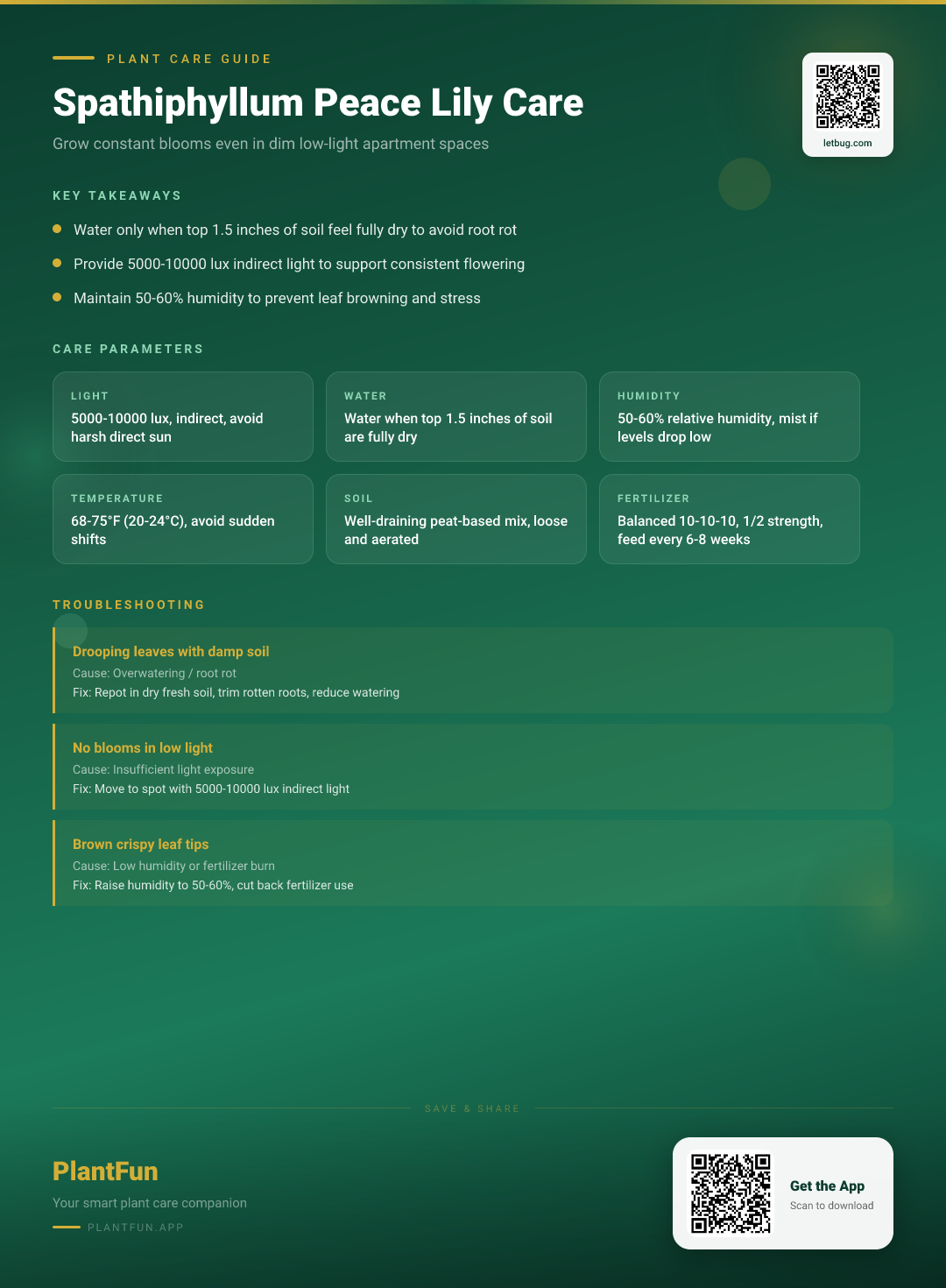
Quick Care Card: Essential Data for Peace Lily Success
| Feature | Requirement |
|---|---|
| Light | 5,000–10,000 Lux (Indirect) |
| Water | When top 1.5 inches of soil is dry |
| Humidity | 50–60% |
| Temperature | 68–75°F (20–24°C) |
| Soil | Well-draining, peaty mix |
| Fertilizer | Balanced liquid feed, bi-monthly |
| Toxicity | Toxic to cats/dogs (ASPCA, 2026) |
TL;DR: Why Peace Lilies Actually Thrive in Your Apartment
Peace Lilies (Spathiphyllum) are the ultimate “drama queen” plants, but they are also incredibly resilient. In an apartment setting, they thrive by mimicking their native rainforest floor habitat. By providing consistent indirect light, keeping humidity above 50%, and watering only when the top 1.5 inches of soil are dry, you can stop the cycle of constant wilting and encourage frequent, elegant white spathes (NC State Extension, 2026).
My Experience: Learning to Stop the Over-Correction
When I first brought home my Spathiphyllum, I thought its dramatic drooping was a silent plea for more water. Every time it dipped, I reached for the watering can. I ended up with yellowing leaves and root rot within a month. I learned the hard way that this plant doesn’t need constant “rescuing”; it needs a steady, predictable routine. Once I stopped reacting to the drama and started trusting my moisture meter, my Peace Lily finally stayed upright and started pushing out new blooms.
The Biology of the Droop: Why Your Plant Signals Distress
Peace Lilies use turgor pressure—the internal water pressure against cell walls—to stay rigid. When water evaporates from the leaves faster than the roots can supply it, the cells lose pressure, and the plant wilts. While often interpreted as a lack of water, drooping can also signal root damage from over-watering or environmental shock (Henny & Chen, 2013).
Light Requirements: Providing 5,000–10,000 Lux for Steady Photosynthesis
While often marketed as “low-light” plants, Spathiphyllum actually requires roughly 5,000 to 10,000 lux to bloom consistently. In a dark apartment, this usually means placing the plant within 3–5 feet of a north-facing window or slightly further from an east-facing one. If your leaves are large and dark green but the plant refuses to bloom, it is likely starving for light (NC State Extension, 2026).
Hydration Strategy: Watering When the Top 1.5 Inches of Soil Feel Dry
Stop the “watering schedule” based on days of the week. Instead, use the finger test: insert your index finger into the soil up to the second knuckle (approx. 1.5 inches). If it feels damp, wait. If it feels dry, water thoroughly until liquid exits the drainage holes. This prevents the anaerobic conditions that lead to root rot, a major issue when water is trapped in dense apartment soil (Ibrahim et al., 2024).
Humidity & Temperature: Maintaining 50-60% Humidity and 68-75°F (20-24°C) Ranges
Peace Lilies struggle in the dry air common in centrally heated or air-conditioned apartments. Aim for 50–60% humidity. You can achieve this by grouping plants or using a pebble tray. Keep temperatures stable between 68–75°F; sudden cold drafts from AC units or heaters will trigger leaf drop (Henny & Chen, 2013).
Myth-Busting: Why ‘Self-Watering’ Pots Often Lead to Root Rot
Many apartment dwellers turn to self-watering pots, but these often keep the roots in a perpetual state of saturation, preventing the “wet-dry” cycle necessary for root health. My advice is to use a high-quality, free-draining mix and standard pots with drainage holes, which allow for better gas exchange in the root zone (Ibrahim et al., 2024).
Voice Search FAQ
Why is my Peace Lily drooping even when the soil is damp?
This is typically a sign of root rot. When roots die from being waterlogged, they can no longer transport water to the leaves, causing the plant to wilt despite the wet soil. Inspect the roots for mushy, brown textures.
How do I get my Peace Lily to bloom again in a dark room?
To trigger blooming, you must increase light intensity. Move the plant closer to a window or add a supplemental grow light to hit that 5,000-lux threshold. Consistent light is the primary driver for inflorescence (NC State Extension, 2026).
Can I put my Peace Lily in the bathroom?
Yes, as long as it receives natural light. The higher humidity levels in bathrooms often mimic their native environment better than a dry living room.
Seasonal Maintenance Calendar: From Summer Flushing to Winter Dormancy
- Spring/Summer: Increase watering frequency slightly as growth accelerates. Apply balanced fertilizer at half-strength every 8 weeks.
- Autumn/Winter: Growth slows significantly. Allow the soil to dry slightly further between waterings. Cease fertilization until spring (NC State Extension, 2026).
Common Mistakes to Avoid
-
Mistake: Watering on a strict schedule.
What happens: Root rot and fungal growth.
Instead: Check the soil moisture manually before adding water. -
Mistake: Placing near a heater.
What happens: Browning leaf tips and crispy edges (Ibrahim et al., 2024).
Instead: Keep at least 6 feet away from direct heat sources.
References
- Henny, R.; Chen, J. (2013). Florida Foliage House Plant Care: Spathiphyllum. EDIS. https://doi.org/10.32473/edis-ep477-2013. Accessed 2026-03-20.
- Ibrahim, H.; Mahmoud, A.; Soliman, M. (2024). Assessing biochar, clinoptilolite zeolite and zeo-char loaded nano-nitrogen for boosting growth performance and biochemical ingredients of peace lily (Spathiphyllum Wallisii) plant under water shortage. BMC Plant Biology. https://doi.org/10.1186/s12870-024-05592-6. Accessed 2026-03-20.
- ASPCA. (2026). Toxic and Non-Toxic Plants List — ASPCA. https://www.aspca.org/pet-care/animal-poison-control/toxic-and-non-toxic-plants. Accessed 2026-03-20.
- NC State Extension. (2026). Spathiphyllum Peace Lily Care — NC State Extension Gardener Plant Toolbox. https://plants.ces.ncsu.edu/plants/lily-care/. Accessed 2026-03-20.
Optional Helper: Plantfun.App
Plantfun.App identifies your plants by photo, diagnoses pests and diseases with clear fixes, and creates personalised watering and light schedules that adapt to your home conditions — a handy companion for putting this guide into daily practice.
Found an error or have suggestions? We'd love your feedback.
Need help identifying this problem?
Get instant identification, personalized care schedules, and effective pest treatment plans directly on your phone.
Sponsored • We may earn a commission from app downloads
Related Guides
Spathiphyllum in a Low-Light Apartment: The Complete Peace Lily Care Guide for Resilience
Stop guessing when to water your Peace Lily. Master precise lux levels, humidity hacks, and a seasonal calendar to keep your apartment plant lush and thriving.
Care GuideThe Complete Peace Lily Care Checklist for Resilient Growth in Low-Light Apartments
Stop guessing at peace lily care for your low-light apartment. Get exact light, water, and humidity thresholds plus a printable checklist to grow lush, blooming plants year-round.
Care GuidePeace Lily Care in Low-Light Apartments: A Resilient Growth Guide for Beginners
Revive your wilting Peace Lily with precise light and moisture metrics. Learn how to keep leaves lush in low-light apartments without constant stress. Start now.
Pest ControlAnts on Plants: What They Mean and What to Do
Ants usually aren't eating your plant. They are farming other pests.