
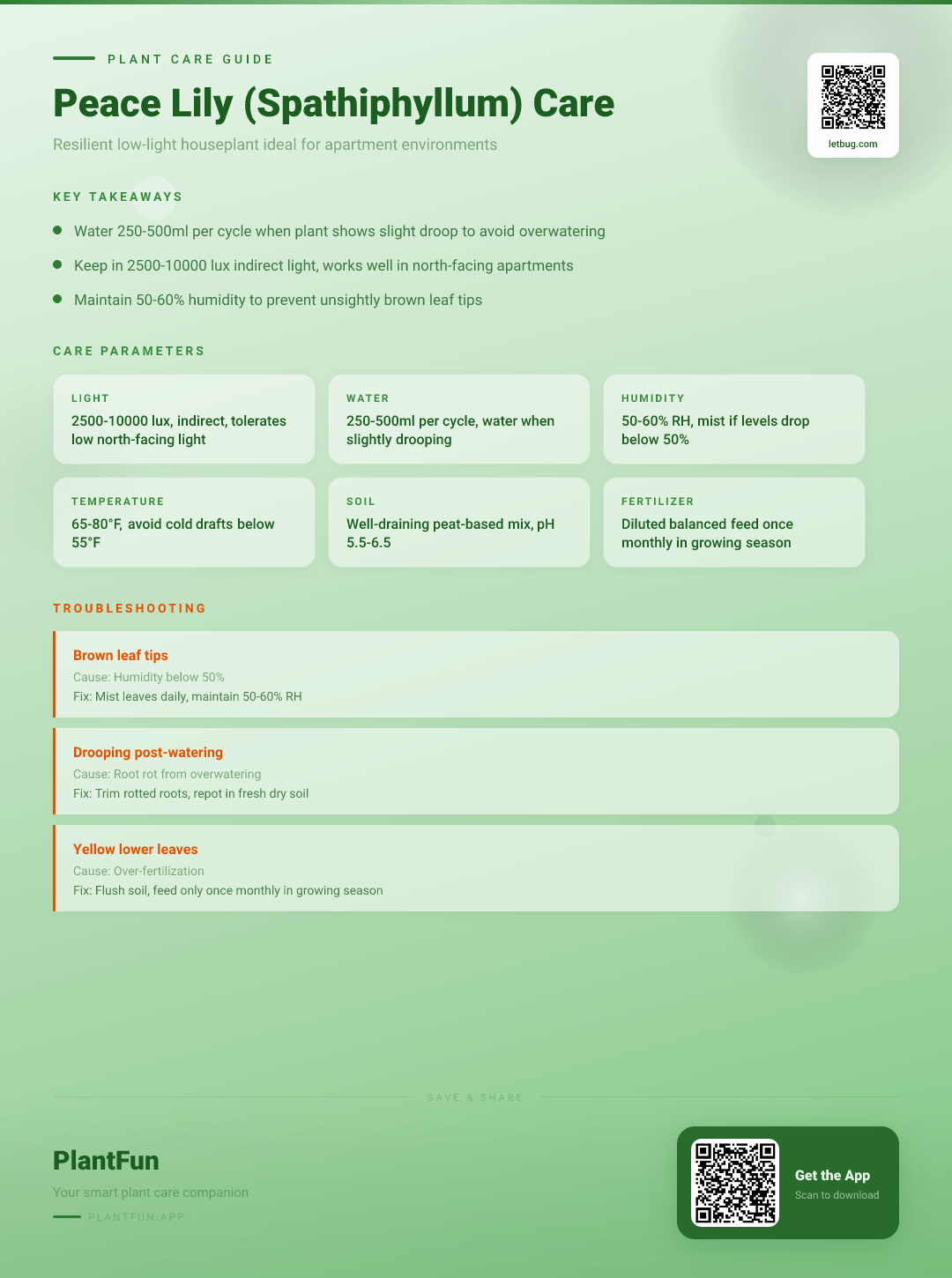
Key Takeaways
- Check soil moisture before watering — overwatering is the #1 killer of houseplants.
- Ensure your plant gets the right amount of light for its species.
- Be patient with recovery — most plants need 2–4 weeks to bounce back.
TL;DR: The Peace Lily Survival Cheat Sheet
To keep your Spathiphyllum thriving in an apartment, maintain 2,500–10,000 lux of indirect light, water only when the top 2 inches of soil feel dry, and keep ambient humidity above 50% to prevent leaf browning. Always use a well-draining soil mix and keep the plant away from pets as it is toxic (ASPCA, 2026).
Quick Care Card: Essential Data
| Feature | Requirement |
|---|---|
| Light | 2,500–10,000 lux (Bright, indirect) |
| Water | 250-500ml per cycle (when soil is dry) |
| Humidity | 50–60% |
| Temperature | 65–80°F (18–27°C) |
| Soil Mix | Peat-based, highly aerated |
| Fertilizer | Balanced 20-20-20 (diluted) in summer |
| Toxicity | Toxic to cats and dogs (ASPCA, 2026) |
Why Your Apartment Needs a Peace Lily: The Science of Low-Light Resiliency
When I first brought home my Spathiphyllum, I thought it was invincible. I made the mistake of shoving it in a dark corner, thinking it would “love” the shade. I soon learned that “low-light tolerant” doesn’t mean “low-light thriving.”
Scientifically, the Peace Lily is a master of gas exchange. According to (Ghate, 2020), Spathiphyllum wallisii is highly effective at phytoremediation, specifically removing indoor pollutants like formaldehyde. However, for the plant to perform this service, it needs enough light to power its metabolic processes. If your apartment has limited natural light, focus on placement near North-facing windows to maximize the available lux without burning the foliage.
Understanding the S. wallisii: Natural Habitat vs. Living Room Reality
In the wild, these plants grow on the forest floor of tropical rainforests. They are used to dappled light filtering through a high canopy and consistently high humidity (Henny & Chen, 2013). In your living room, you are essentially mimicking this microclimate. The biggest challenge is the dry air caused by indoor heating and air conditioning, which often sits far below their tropical requirements.
Step-by-Step Care: Mastering the Watering Schedule
- The Finger Test: Insert your finger 2 inches into the soil. If it feels damp, wait. If it feels dry, proceed to step 2.
- Measurement: Use approximately 250ml to 500ml of room-temperature water. Pour slowly to ensure even saturation.
- Drainage: Never let the plant sit in standing water. If your pot doesn’t have drainage holes, tip the excess water out immediately (NC State Extension, 2026).
Measuring Light: How to Find the Sweet Spot in a North-Facing Apartment
Light intensity is measured in lux. In a North-facing apartment, your plant receives the most consistent, gentle light. If you can read a book comfortably without turning on a lamp, you are likely in the 2,500-5,000 lux range. Avoid placing the plant more than 6 feet away from a window, as the light quality drops significantly beyond that point.
The Humidity Factor: Why 50% Relative Humidity Prevents Browning Tips
Brown, crispy tips on a Peace Lily are almost always a cry for humidity, not a watering issue. If your home humidity is below 40%, the transpiration rate of the leaves exceeds the plant’s water uptake. Use a digital hygrometer to check your levels. To boost humidity, place the plant on a pebble tray filled with water, but ensure the pot base sits above the water line to prevent root rot.
Seasonal Shifts: Adjusting Care from Summer Growth to Winter Dormancy
In summer, your lily is actively growing and requires more frequent waterings. As winter approaches, the plant enters a period of dormancy. Reduce your watering frequency by 30-40% and hold off on all fertilizer until the days start lengthening in late February (Henny & Chen, 2013).
Common Mistakes: Stop Over-Fertilizing and Under-Cleaning Your Leaves
- Mistake: Over-fertilizing. What happens: Fertilizer salts build up, burning the root tips. Instead: Use a balanced fertilizer at half-strength only during the active growing season.
- Mistake: Allowing dust to accumulate on leaves. What happens: Dust blocks the stomata, hindering photosynthesis. Instead: Gently wipe leaves with a damp cloth every two weeks.
The Recovery Protocol: What to do when your plant enters a stress cycle
Yellowing Leaves
Symptom: Leaves turn yellow, often starting at the bottom.
Likely cause: Overwatering or poor soil drainage.
Fix:
- Check the soil moisture; if it is waterlogged, move to a well-draining peat-based mix.
- Ensure the pot has drainage holes at the bottom.
Constant Wilting
Symptom: Plant wilts despite soil being moist.
Likely cause: Root rot damaging the plant’s ability to uptake water.
Fix:
- Remove the plant from the pot and inspect the roots.
- Trim away any mushy, black roots and repot into fresh, sterile, well-draining soil (NC State Extension, 2026).
Voice Search FAQ
-
Can I keep my Peace Lily in a windowless bathroom? No. While they tolerate lower light than most plants, they still require photosynthesis to survive. A windowless bathroom will eventually lead to the plant’s death unless you provide a full-spectrum LED grow light.
-
Why is my Peace Lily drooping even after I water it? This is often a sign of root damage from previous overwatering. If the roots are rotted, they cannot move water to the leaves, causing the plant to droop even when the soil is wet.
-
How often should I mist my plant to keep it happy? Misting is largely ineffective as it only provides a temporary humidity spike. Instead, use a room humidifier or group your plants together to create a localized humid microclimate.
References
- Ghate, S. (2020). Phytoremediation of Indoor Air using Spathiphyllum wallisii Regel, for Formaldehyde as an Indoor Pollutant. International Journal of Plant and Environment. https://doi.org/10.18811/ijpen.v6i03.05. Accessed 2026-03-14.
- Henny, R.; Chen, J. (2013). Florida Foliage House Plant Care: Spathiphyllum. EDIS. https://doi.org/10.32473/edis-ep477-2013. Accessed 2026-03-14.
- ASPCA. (2026). Toxic and Non-Toxic Plants List — ASPCA. American Society for the Prevention of Cruelty to Animals. https://www.aspca.org/pet-care/animal-poison-control/toxic-and-non-toxic-plants. Accessed 2026-03-14.
- NC State Extension. (2026). Spathiphyllum — NC State Extension Gardener Plant Toolbox. North Carolina State University Extension. https://plants.ces.ncsu.edu/plants/lily-care/. Accessed 2026-03-14.
Optional Helper: Plantfun.App
Plantfun.App identifies your plants by photo, diagnoses pests and diseases with clear fixes, and creates personalised watering and light schedules that adapt to your home conditions — a handy companion for putting this guide into daily practice.
Found an error or have suggestions? We'd love your feedback.
Need help identifying this problem?
Get instant identification, personalized care schedules, and effective pest treatment plans directly on your phone.
Sponsored • We may earn a commission from app downloads
Related Guides
The Budget Peace Lily Care Checklist for Resilient Growth in Small Urban Apartments
Grow a lush, flowering peace lily on a $5 monthly budget with our apartment-specific checklist. Get exact light, water, and humidity thresholds to avoid yellow leaves and boost blooms.
Care GuidePeace Lily in Small Urban Apartments: The Only Care Checklist for Resilient Growth
Grow a lush, flowering peace lily even in a cramped small urban apartment. Grab our free 10-point care checklist, exact light/water thresholds, and zero-floor-space hacks for resilient growth.
Care GuideThe Complete Peace Lily Care Checklist for Resilient Growth in Low-Light Apartments
Stop guessing at peace lily care for your low-light apartment. Get exact light, water, and humidity thresholds plus a printable checklist to grow lush, blooming plants year-round.
Pest ControlAnts on Plants: What They Mean and What to Do
Ants usually aren't eating your plant. They are farming other pests.