
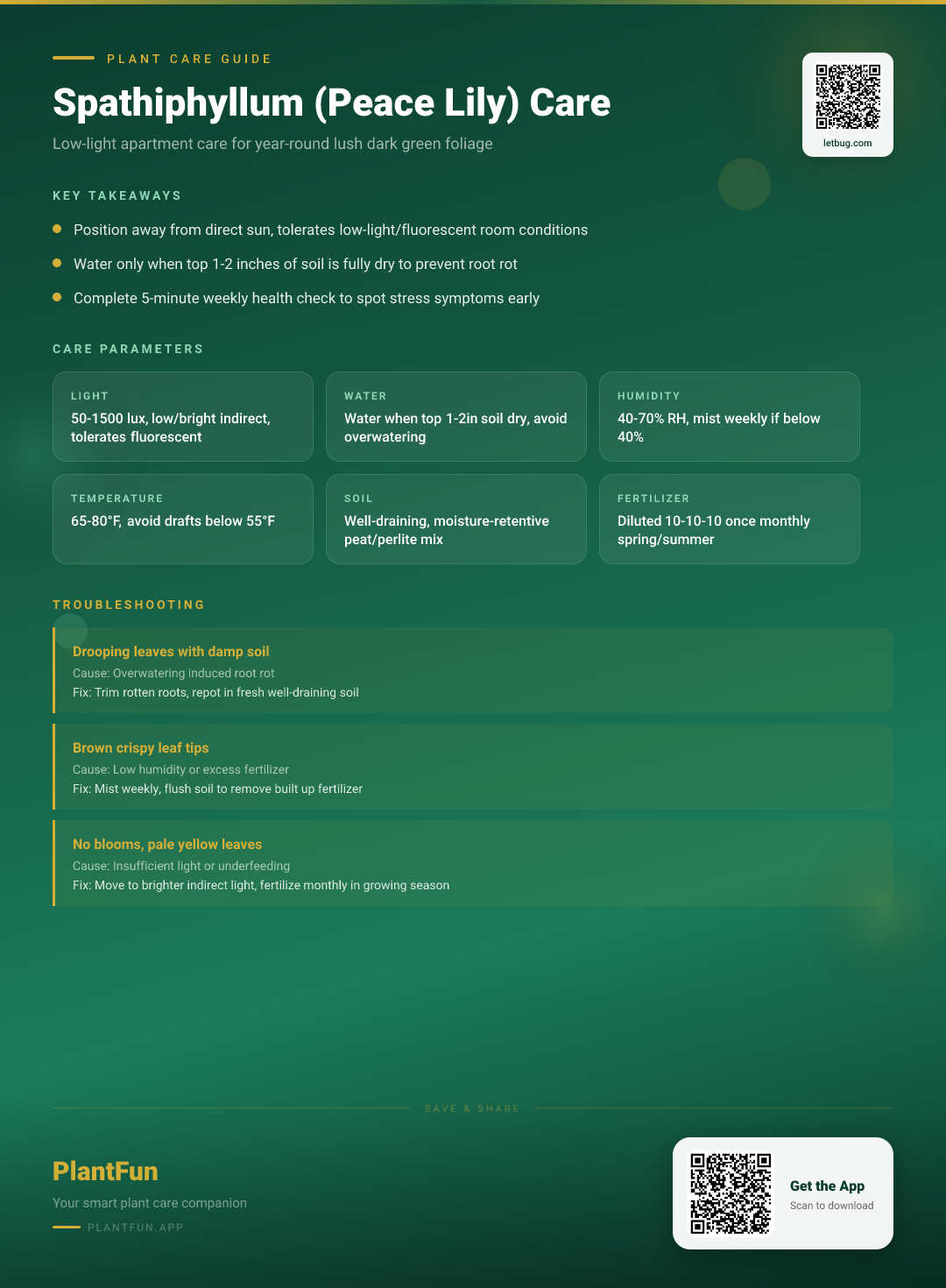
Key Takeaways
- Check soil moisture before watering — overwatering is the #1 killer of houseplants.
- Ensure your plant gets the right amount of light for its species.
- Be patient with recovery — most plants need 2–4 weeks to bounce back.
TL;DR: Peace Lilies (Spathiphyllum) thrive in apartments by mimicking their tropical forest floor origins. Maintain 5,000–10,000 lux, water only when the top 2 inches of soil are dry, and provide 50–60% humidity. Avoid direct sunlight and cold drafts. Remember: they are toxic to pets if ingested (ASPCA, 2026).
Quick Care Card: The Essential Peace Lily Metrics
| Feature | Requirement |
|---|---|
| Light | 5,000–10,000 Lux (Bright, indirect) |
| Water | When top 2 inches of soil are dry |
| Humidity | 50%–60% |
| Temperature | 65°F–80°F (18°C–27°C) |
| Soil | Well-draining, peat-based mix |
| Fertilizer | Balanced 20-20-20 (diluted) monthly |
| Toxicity | Toxic to cats and dogs (ASPCA, 2026) |
Why Your Peace Lily Is Struggling in Your Apartment
When I first got my own Spathiphyllum, I made the mistake of placing it in a dark corner far from any window, assuming its reputation as a “low-light plant” meant it thrived in near-total darkness. My plant quickly developed yellowing leaves and a persistent droop. Peace Lily apartment care is less about “low light” and more about “consistent, filtered light.” Most apartment struggles stem from a disconnect between the plant’s moisture needs and the stagnant airflow indoors.
The Science of Low Light: Assessing Your Window Exposure
Peace Lilies are understory plants. In nature, they receive filtered light through a canopy. While they tolerate lower light levels, growth and blooming require specific intensity (Henny & Chen, 2013).
I recommend aiming for 5,000 to 10,000 lux. You don’t need expensive equipment to verify this—free light meter apps on your smartphone can provide a functional estimate. If you find your plant in a space receiving less than 3,000 lux, it will survive but likely cease flowering (NC State Extension, 2026). If you are new to indoor gardening, learning how to manage light for indoor plants is the single most important skill you can acquire.
Watering Mastery: Avoiding Root Rot in Apartments
Overwatering is the primary killer of indoor Peace Lilies. Because apartment airflow is often restricted, soil moisture evaporates slower than it would in a greenhouse.
The Finger Test: Stick your finger 2 inches into the soil. If it feels cool or damp, wait two more days. Only water when the soil feels dry to the touch (NC State Extension, 2026). When you water, ensure the pot has drainage holes; never let the plant sit in a saucer of standing water, as this invites root rot.
Soil Science: Creating the Perfect Moisture-Retentive Mix
Standard potting soil is often too dense for a Peace Lily. I prefer a mixture of:
- 50% High-quality peat moss or coco coir (for moisture retention)
- 25% Perlite (for drainage)
- 25% Pine bark fines (to prevent soil compaction)
This specific ratio provides the moisture-retentive properties the plant requires while ensuring the root system receives necessary oxygen (Henny & Chen, 2013).
Seasonal Maintenance: Adapting to Apartment Temperature Shifts
Peace Lilies are sensitive to temperature fluctuations. During winter, keep your plant away from heating vents, which dry out the foliage, and away from drafty windows. Maintaining a steady 65°F–80°F range is ideal for year-round health (Henny & Chen, 2013). During the drier months, you may need to increase humidity using a tray of pebbles and water near the plant to reach the recommended 50-60% threshold.
FAQ: Why is my Peace Lily drooping even when the soil is damp?
If your plant droops despite damp soil, you are likely witnessing “root suffocation” from overwatering. The roots can no longer pull up water because they are oxygen-starved. Check for a sour smell coming from the soil—a common indicator of root rot.
FAQ: Can I keep my Peace Lily in a windowless room with only fluorescent light?
Yes, but with caveats. While Spathiphyllum can help mitigate indoor pollutants (Ghate, 2020), it requires significant light intensity to photosynthesize efficiently in windowless spaces. Keep a cool-white fluorescent bulb within 12 inches of the foliage for 12 hours a day.
FAQ: How do I know when it is time to repot my Spathiphyllum?
Look for roots circling the surface of the soil or growing out of the bottom drainage holes. Repotting is a great time to refresh your essential houseplant soil mix for continued vitality.
Common Mistakes: Fertilization Overload and Drafts
- Mistake: Over-fertilizing during winter. What happens: Fertilizer burn on leaf tips. Instead: Halt feeding during the dormant season and resume in spring with a diluted liquid feed (NC State Extension, 2026).
- Mistake: Placing the plant in a drafty hallway. What happens: Rapid leaf drop. Instead: Position it in a stable, warm location away from AC units or radiators.
Optional Helper: Plantfun.App
Plantfun.App identifies your plants by photo, diagnoses pests and diseases with clear fixes, and creates personalised watering and light schedules that adapt to your home conditions — a handy companion for putting this guide into daily practice.
Summary: The 5-Minute Weekly Health Check
- Check the top 2 inches of soil moisture.
- Wipe leaves with a damp cloth to remove dust (improves photosynthesis).
- Rotate the pot 90 degrees to ensure even growth.
- Check the undersides of leaves for pests like spider mites.
References
- ASPCA. (2026). Toxic and Non-Toxic Plants List — ASPCA. https://www.aspca.org/pet-care/animal-poison-control/toxic-and-non-toxic-plants. Accessed 2026-03-19.
- Ghate, S. (2020). Phytoremediation of Indoor Air using Spathiphyllum wallisii Regel, for Formaldehyde as an Indoor Pollutant. INTERNATIONAL JOURNAL OF PLANT AND ENVIRONMENT. https://doi.org/10.18811/ijpen.v6i03.05. Accessed 2026-03-19.
- Henny, R.; Chen, J. (2013). Florida Foliage House Plant Care: Spathiphyllum. EDIS. https://doi.org/10.32473/edis-ep477-2013. Accessed 2026-03-19.
- NC State Extension. (2026). Spathiphyllum — NC State Extension Gardener Plant Toolbox. https://plants.ces.ncsu.edu/plants/lily-care/. Accessed 2026-03-19.
Found an error or have suggestions? We'd love your feedback.
Need help identifying this problem?
Get instant identification, personalized care schedules, and effective pest treatment plans directly on your phone.
Sponsored • We may earn a commission from app downloads
Related Guides
Peace Lily in a Low-Light Apartment: The Complete Care Guide for Resilient Growth
Master your Peace Lily care with 4 exact environmental thresholds. Stop the drooping, fix browning tips, and achieve lush, dark foliage in your apartment today.
Care GuideThe Peace Lily Care Guide for Apartment Living: Achieve Resilient Growth on a Budget
Transform your wilted Peace Lily into a lush apartment centerpiece. Learn exact light levels, budget-friendly watering cues, and 3 simple hacks for daily care.
Care GuidePeace Lily Rescue: A Step-by-Step Recovery Plan for Your Declining Apartment Plant
Revive your wilting Peace Lily with these 5 recovery steps. Learn exact light thresholds and watering fixes to get your plant thriving in your apartment today.
Pest ControlAnts on Plants: What They Mean and What to Do
Ants usually aren't eating your plant. They are farming other pests.