
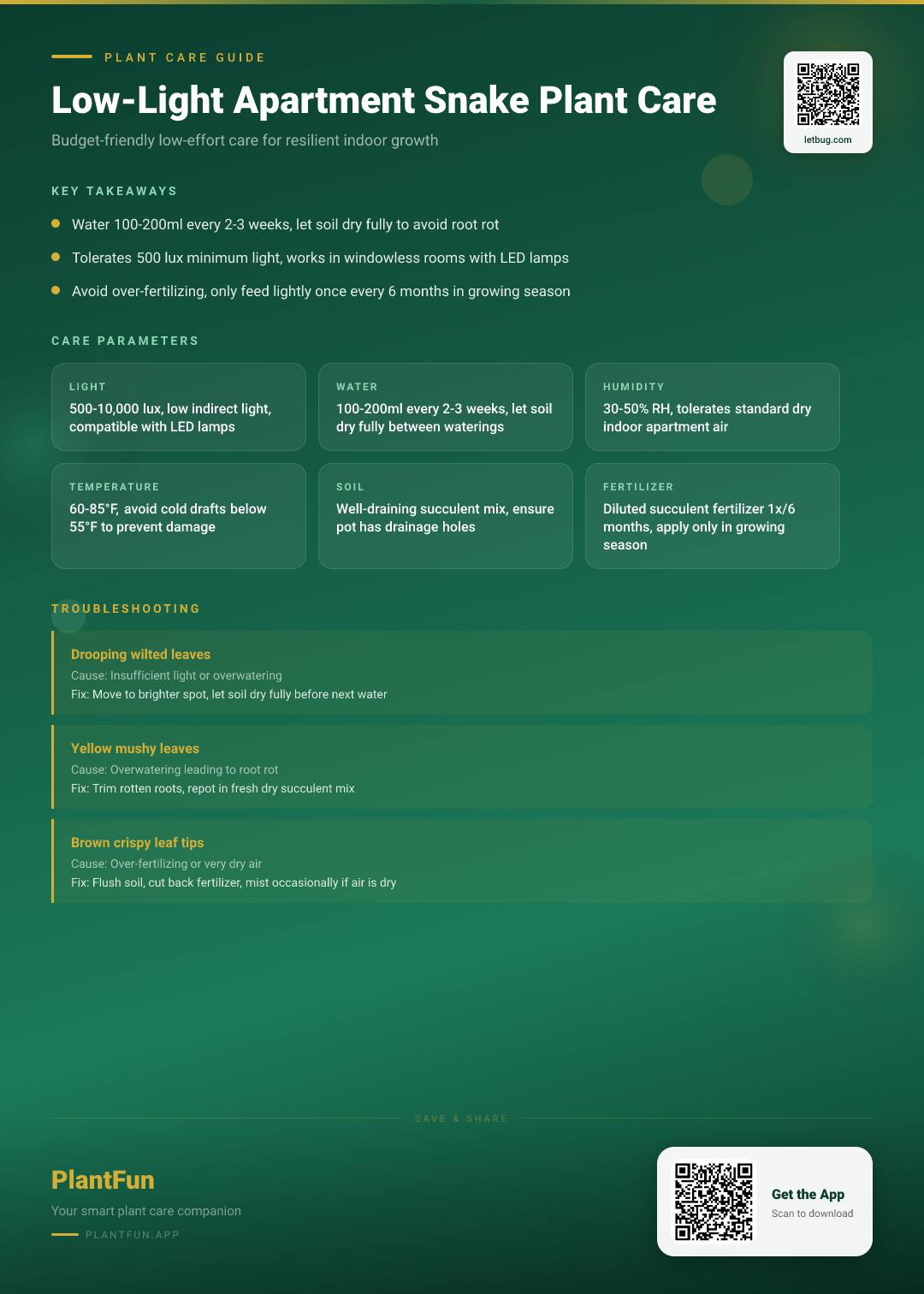
Key Takeaways
- Check soil moisture before watering — overwatering is the #1 killer of houseplants.
- Ensure your plant gets the right amount of light for its species.
- Be patient with recovery — most plants need 2–4 weeks to bounce back.
Quick Care Card: Essential Data
| Feature | Requirement |
|---|---|
| Light | 500–10,000 lux (Low to Bright Indirect) |
| Water | 100–200ml every 2–3 weeks (Seasonally adjusted) |
| Humidity | 30–50% (Ambient apartment levels) |
| Temperature | 60–85°F (15–29°C) |
| Soil | Fast-draining succulent/cactus mix |
| Fertilizer | Balanced liquid 10-10-10 (diluted) in summer only |
| Toxicity | Toxic to cats and dogs (ASPCA, 2026) |
TL;DR: The Minimalist’s Rule for Snake Plant Success
Stop loving your Snake Plant to death. These plants thrive on neglect. In low-light apartments, the secret is to keep them dry and allow the soil to dehydrate completely between waterings. Use a well-draining succulent mix, ensure your pot has a drainage hole, and let natural light—or a simple LED bulb—do the heavy lifting. If the soil is damp, do not water (NC State Extension, 2026).
Why Your Apartment’s Low Light Isn’t a Death Sentence
When I first got my own Dracaena trifasciata, I tucked it into a dim corner of my studio apartment, convinced it would wither. I was wrong. These plants, often sold under the synonym Sansevieria, are biologically adapted to survive with lower photosynthetic activity than most indoor plants. While they prefer brighter light, they can maintain foliage integrity at lower light intensities (Gautam et al., 2021). My experience taught me that the “indestructible” label is actually a trap; they aren’t unkillable, they are just extremely efficient at conserving resources. They don’t need intense sun; they need consistency.
Step-by-Step Care Guide: From Soil Drainage to Nutrient Ratios
- Drainage is Non-Negotiable: Use a pot with holes. If you choose a decorative ceramic cachepot, keep the plant in its plastic nursery liner to prevent water pooling at the base.
- The Soil Mix: Use a standard succulent mix mixed with 20% extra perlite or pumice to ensure aeration. Stagnant, heavy peat moss is the primary cause of root failure.
- Watering Technique: Measure 100ml to 200ml of water. Pour it slowly around the edge of the pot, not directly into the center “rosette,” as moisture trapped there can cause rot.
- Nutrient Management: Only fertilize once during the summer growing season with a balanced, water-soluble fertilizer diluted to half-strength.
The Budget-Care Schedule: A Seasonal Calendar for Apartment Growth
- Spring/Summer: Water every 14 days if the soil is dry 2 inches deep. This is when the plant will produce new leaves (NC State Extension, 2026).
- Fall/Winter: Reduce watering to once every 3–4 weeks. Growth slows significantly as light levels drop, and the plant requires less moisture (NC State Extension, 2026).
Measurable Thresholds: Understanding Lux and Humidity for Dormant vs. Active Growth
We often rely on vague terms like “bright light,” but houseplants respond to measurable photons. Research in controlled indoor environments shows that varying light intensities directly influence the growth rate of ornamental species (Gautam et al., 2021). In my apartment, I aim for at least 500 lux to keep the plant from etiolating (stretching). While humidity is often discussed, Snake Plants are highly resilient to the low-humidity environments typical of apartments (Sheeran & Rasmussen, 2023). Keep them away from heater vents to prevent leaf-tip browning.
Why is my Snake Plant drooping in my dark living room?
Symptom: The leaves are losing their upright, architectural posture and bending over.
Likely cause: Overwatering combined with low light. The plant cannot transpire water fast enough in the dark, leading to water-logged cells that lose structural rigidity.
Fix:
- Check for soil dampness; if wet, stop watering immediately.
- Move the plant to a brighter spot or closer to a window.
- Inspect the base for mushy, brown tissue.
How often do I really need to water my Snake Plant to avoid rot?
Use the “finger test”: stick your finger 2 inches into the soil. If you feel any dampness, wait another week. In most apartments, 3 weeks between waterings is the safest interval.
Can I keep my Snake Plant in a windowless room with just an LED desk lamp?
Yes, provided the light is within the 500–1,000 lux range and remains on for 8–10 hours a day. LED lighting is highly effective for maintaining the physiological health of indoor plants in vertical or windowless spaces (Gautam et al., 2021).
Common Mistakes: The ‘Kindness Trap’ of Over-Fertilizing and Over-Watering
- Mistake: Watering on a strict weekly schedule regardless of soil moisture. What happens: Root rot and fungal pathogens. Instead: Water only when the potting medium is completely dry.
- Mistake: Placing the plant in a pot without drainage. What happens: The roots suffocate in standing water. Instead: Use pots with drainage holes and keep the plant in its original nursery plastic liner.
- Mistake: Heavy fertilization. What happens: Salt buildup in the soil causes brown, crispy tips. Instead: Feed only during the peak of summer at half-strength.
Troubleshooting Guide: Signs of Root Stress vs. Natural Aging
Yellowing Leaves
Symptom: Entire leaves turning soft and yellow.
Likely cause: Chronic overwatering.
Fix:
- Remove from pot and inspect roots; if slimy or brown, trim them back.
- Repot into fresh, dry succulent mix.
Wrinkled Foliage
Symptom: Leaves look shriveled or “raisin-like.”
Likely cause: Extreme dehydration.
Fix:
- Perform a deep soak, allowing water to drain thoroughly.
- Gradually increase the frequency of watering slightly.
Brown Leaf Tips
Symptom: Crispy, brown tips on otherwise green leaves.
Likely cause: Low humidity or mineral buildup from tap water.
Fix:
- Use filtered or distilled water if your tap water is high in salts.
- Trim the brown tip with sanitized shears to maintain aesthetics.
References
- ASPCA. (2026). Toxic and Non-Toxic Plants List — ASPCA. https://www.aspca.org/pet-care/animal-poison-control/toxic-and-non-toxic-plants. Accessed 2026-03-18.
- Gautam, B., Dubey, R., & Kaur, N. (2021). GROWTH RESPONSE OF INDOOR ORNAMENTAL PLANT SPECIES TO VARIOUS ARTIFICIAL LIGHT INTENSITIES (LED) IN AN INDOOR VERTICAL GARDEN. Plant Archives. https://doi.org/10.51470/plantarchives.2021.v21.no1.096. Accessed 2026-03-18.
- NC State Extension. (2026). Snake Plant — NC State Extension Gardener Plant Toolbox. https://plants.ces.ncsu.edu/plants/plant-care/. Accessed 2026-03-18.
- Sheeran, L., & Rasmussen, A. (2023). Aerial roots elevate indoor plant health: Physiological and morphological responses of three high‐humidity adapted Araceae species to indoor humidity levels. Plant, Cell & Environment. https://doi.org/10.1111/pce.14568. Accessed 2026-03-18.
Optional Helper: Plantfun.App
Plantfun.App identifies your plants by photo, diagnoses pests and diseases with clear fixes, and creates personalised watering and light schedules that adapt to your home conditions — a handy companion for putting this guide into daily practice.
Found an error or have suggestions? We'd love your feedback.
Need help identifying this problem?
Get instant identification, personalized care schedules, and effective pest treatment plans directly on your phone.
Sponsored • We may earn a commission from app downloads
Related Guides
Snake Plant Care in Apartments: The Ultimate Guide to Thriving in Low-Light Corners
Master your Snake Plant care in any apartment. Discover exact light-to-water ratios, 4 essential growth thresholds, and a layout plan for small-space success.
Care GuideSnake Plant Care for Apartment Living: A Resilient Growth Guide for Low-Light Homes
Master your Snake Plant care with 4 proven benchmarks. Learn exact light levels, watering schedules, and soil hacks to keep your foliage vibrant in any apartment.
Care GuideSnake Plant in Budget Urban Apartments: The Only Care Checklist for Resilient Growth You’ll Ever Need
Stop neglecting your snake plant in your small urban apartment. Grab our free 7-step budget checklist, exact light, water, and temperature parameters for lush, resilient growth year-round.
Pest ControlAnts on Plants: What They Mean and What to Do
Ants usually aren't eating your plant. They are farming other pests.