
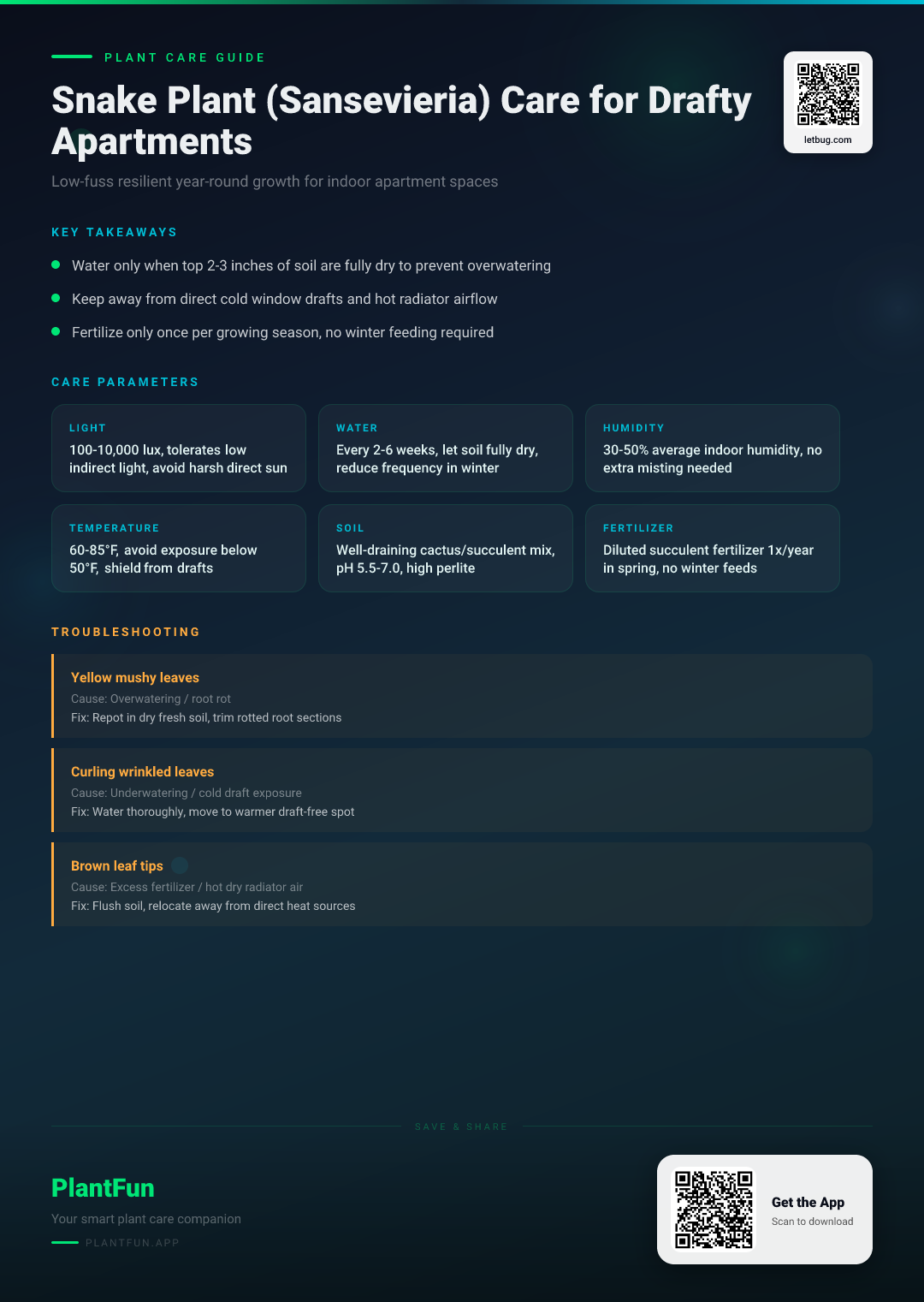
Key Takeaways
- Check soil moisture before watering — overwatering is the #1 killer of houseplants.
- Ensure your plant gets the right amount of light for its species.
- Be patient with recovery — most plants need 2–4 weeks to bounce back.
Quick Care Card: Essential Thresholds for Apartment Resilience
| Feature | Requirement |
|---|---|
| Light | Bright, indirect light to low light (500–2,000 lux) |
| Water | Every 3–4 weeks; soil must be 100% dry |
| Humidity | Low (30–50%) — perfect for standard apartments |
| Temperature | 60°F–85°F (Avoid below 50°F) |
| Soil | Well-draining, cactus-based mix |
| Fertilizer | Balanced 10-10-10, diluted, once in spring |
| Toxicity | Toxic to cats and dogs (ASPCA, 2026) |
TL;DR: Why Snake Plants Struggle in Typical Apartments
Snake plants (Dracaena trifasciata, formerly Sansevieria) are often marketed as indestructible, but apartment environments create specific stressors. When I first started keeping these, I assumed they thrived on neglect. My first plant eventually rotted because I placed it in a dark corner next to an exterior wall in winter. The combination of low light and cold drafts near window panes drastically slows metabolism, leading to root rot (NC State Extension, 2026). To keep yours alive, focus on light stability and long drying periods between watering.
Understanding Your Environment: Managing Radiator Heat vs. Window Drafts
Apartment living presents a unique “microclimate” problem. During winter, many of us deal with dry, searing heat from radiators or forced-air vents. Conversely, thin apartment windows often leak cold air, causing a sharp drop in temperature near the glass.
I have learned to place my Sansevieria at least two feet away from both heat sources and windows. Sudden temperature fluctuations can cause the plant to drop its leaves or suffer from cell death (NC State Extension, 2026). If you are using smart sensors for your home, you can better monitor these fluctuations to optimize health (Halawa & Aisuwarya, 2023).
Step-by-Step Care Guide: Watering, Soil, and Fertilizer Benchmarks
- The Finger Test: Before watering, stick your finger at least 2 inches into the soil. If you feel any moisture, do not water.
- Drainage: Always ensure your pot has drainage holes. Using a well-draining succulent soil mix is critical for preventing root rot.
- Watering Technique: Pour approximately 200-300ml of water slowly around the edges, avoiding the center crown of the plant to prevent fungal issues.
- Fertilizer: During the growing season (May to August), use a balanced liquid fertilizer diluted to 50% strength once. Over-fertilizing leads to weak, floppy leaf growth (NC State Extension, 2026).
Seasonal Care Calendar: A Month-by-Month Guide to Adjusting Care
- Spring (March–May): Increase light as the sun gets stronger. Begin light watering once every 3 weeks.
- Summer (June–August): This is the active growth phase. If the plant is getting good light, you may water every 2 weeks. Monitor for pests.
- Autumn (September–November): Gradually reduce watering as light levels in your apartment drop.
- Winter (December–February): Shift to deep dormancy. I water my plants only once every 6 weeks during this time. Keep away from drafts.
The 4 Key Environmental Thresholds for Success
- Light Stability: While they handle low light, they grow much faster and more resiliently with at least 1,000 lux (NC State Extension, 2026).
- Soil Porosity: Always prioritize aeration. Compacted, wet soil is the primary cause of sudden plant death.
- Thermal Consistency: Avoid locations where temperatures drop below 55°F at night.
- Airflow: Good air circulation prevents common fungal pathogens from settling on the foliage.
Common Mistakes to Avoid: From Overwatering to Poor Drainage
- Mistake: Watering on a calendar schedule regardless of light. What happens: The soil stays soggy, leading to root rot. Instead: Only water when the soil is bone-dry from top to bottom.
- Mistake: Using a pot without holes. What happens: Water pools at the bottom, suffocating roots. Instead: Drill holes or use a nursery pot inside a decorative cover.
Voice-Search FAQ: Can I leave my Snake Plant near a heater in winter?
No. Direct heat dries out the leaves rapidly, leading to dehydration and brown, crispy tips. Keep it at least 3-4 feet away from any active radiators or heat vents.
Voice-Search FAQ: Why is my Snake Plant curling in my bedroom?
Leaf curling is often a sign of underwatering or, ironically, extreme thirst caused by dry, moving air. If the leaves feel thin and soft, increase your watering frequency slightly (Ravindran & Thomas, 2025).
Voice-Search FAQ: How do I know if my apartment has enough light for a Sansevieria?
If you can comfortably read a book in that spot during the day, the plant will survive. If the plant is stretching and losing its variegation, it needs a brighter spot (NC State Extension, 2026).
Troubleshooting Guide: Quick fixes for common indoor symptoms
Root Rot
Symptom: Mushy, foul-smelling base of leaves.
Likely cause: Overwatering in low light.
Fix:
- Remove the plant from the pot immediately.
- Trim away black, slimy roots with sterilized shears.
- Repot in fresh, dry, porous soil and wait two weeks to water.
Leaf Yellowing
Symptom: Yellow margins appearing on otherwise healthy leaves.
Likely cause: Cold stress or overwatering.
Fix:
- Relocate to a warmer, more stable room.
- Check soil moisture; if wet, allow it to dry out entirely.
References
- ASPCA. (2026). Toxic and Non-Toxic Plants List — ASPCA. https://www.aspca.org/pet-care/animal-poison-control/toxic-and-non-toxic-plants. Accessed 2026-03-15.
- Halawa, H.; Aisuwarya, R. (2023). Smart Plant Pot Robot with IoT Integration for Indoor Ornamental Plants Care. JITCE (Journal of Information Technology and Computer Engineering). https://doi.org/10.25077/jitce.7.2.97-106.2023. Accessed 2026-03-15.
- NC State Extension. (2026). Snake Plant Care — NC State Extension Gardener Plant Toolbox. https://plants.ces.ncsu.edu/plants/snake-plant/. Accessed 2026-03-15.
- Ravindran, A.; Thomas, P. (2025). Flora Care: A Smart AI-Based System for Plant Disease Diagnosis and Plant Growth Identification. International Journal of Science and Research (IJSR). https://doi.org/10.21275/mr25425182032. Accessed 2026-03-15.
Optional Helper: Plantfun.App
Plantfun.App identifies your plants by photo, diagnoses pests and diseases with clear fixes, and creates personalised watering and light schedules that adapt to your home conditions — a handy companion for putting this guide into daily practice.
Found an error or have suggestions? We'd love your feedback.
Need help identifying this problem?
Get instant identification, personalized care schedules, and effective pest treatment plans directly on your phone.
Sponsored • We may earn a commission from app downloads
Related Guides
Snake Plant Care in Apartments: The Ultimate Guide to Thriving in Low-Light Corners
Master your Snake Plant care in any apartment. Discover exact light-to-water ratios, 4 essential growth thresholds, and a layout plan for small-space success.
Care GuideSnake Plant Care for Apartment Living: A Resilient Growth Guide for Low-Light Homes
Master your Snake Plant care with 4 proven benchmarks. Learn exact light levels, watering schedules, and soil hacks to keep your foliage vibrant in any apartment.
Care GuideSnake Plant Care for North-Facing Studio Apartments: 7 Steps for Resilient Lush Growth
Keep your snake plant thriving even in dim north-facing studio apartments. Get exact light thresholds, watering amounts, and 7 actionable steps for resilient, lush growth year-round.
Pest ControlAnts on Plants: What They Mean and What to Do
Ants usually aren't eating your plant. They are farming other pests.