
Key Takeaways
- Check soil moisture before watering — overwatering is the #1 killer of houseplants.
- Ensure your plant gets the right amount of light for its species.
- Be patient with recovery — most plants need 2–4 weeks to bounce back.
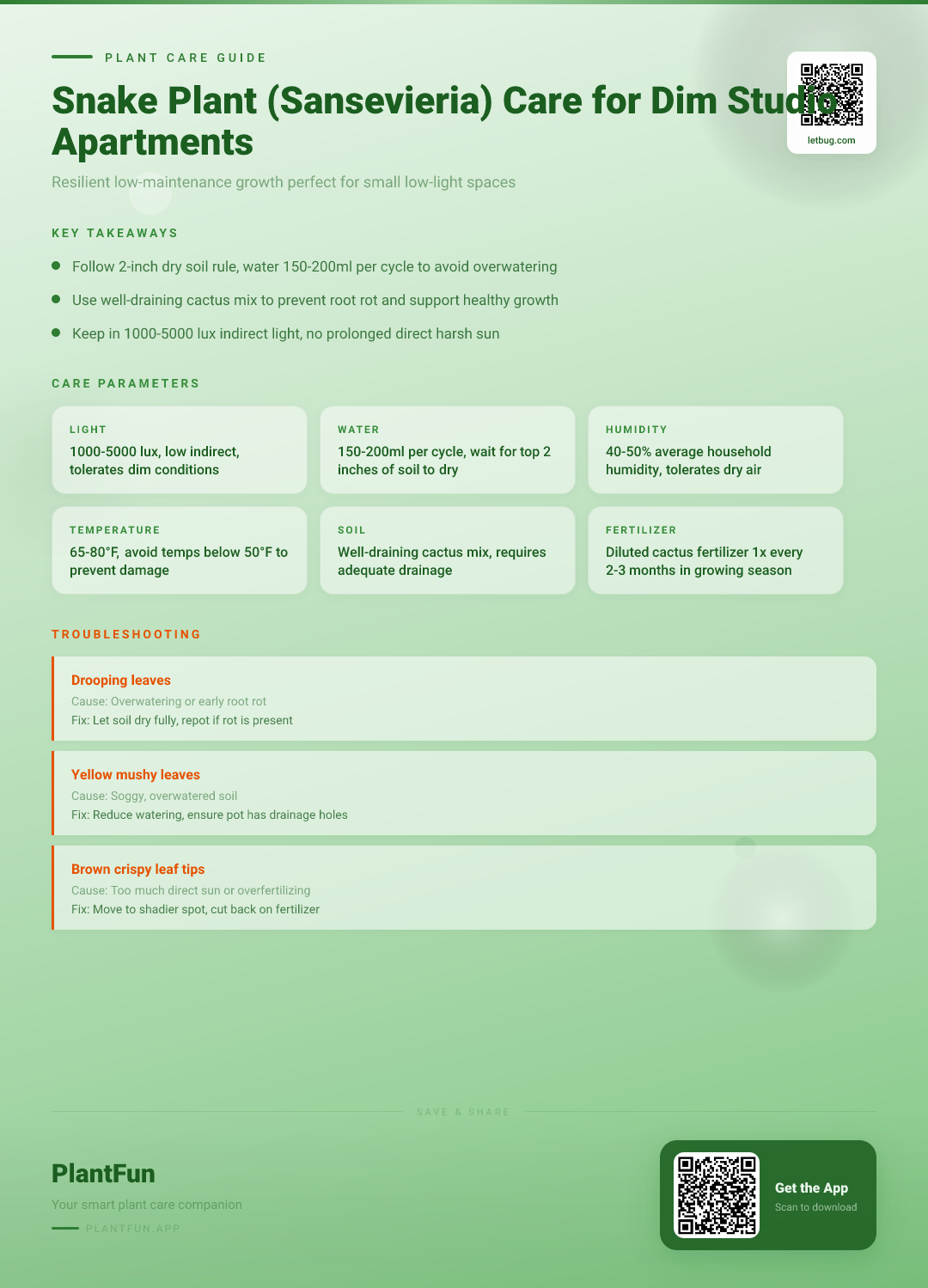
Quick Care Card: Essential Data for Sansevieria
| Feature | Requirement |
|---|---|
| Light | 1,000–5,000 lux (indirect) |
| Water | Every 3-4 weeks (150ml-200ml) |
| Humidity | Low to Moderate (30-50%) |
| Temperature | 65°F–80°F |
| Soil | Well-draining cactus mix |
| Fertilizer | Balanced liquid feed (1/2 strength) in spring |
| Toxicity | Toxic to cats and dogs (ASPCA, 2026) |
TL;DR: The Resilient Apartment Specialist
Snake plants (Sansevieria trifasciata) are the ultimate survivors for studio living. They thrive on neglect, requiring low light (1,000–5,000 lux) and minimal water. The primary cause of failure in small apartments is over-watering, which leads to root decay. By maintaining a strict 150ml-200ml watering schedule once the soil is dry 2 inches deep, you can ensure your plant remains vibrant and upright.
Why Your Studio Apartment Needs a Snake Plant
When I first moved into my 400-square-foot studio, I struggled to keep anything alive in my north-facing corner. I made the mistake of buying high-maintenance tropicals that demanded constant humidity and bright, direct sun. Once I switched to a Sansevieria, the difference was immediate. These plants are built for storage; their thick, succulent leaves act as water reservoirs, making them highly efficient in indoor environments where air circulation and light can be inconsistent (NC State Extension, 2026).
Decoding Light: Defining ‘Low Light’ (1,000–5,000 lux)
In a studio, “low light” is often misunderstood. A windowless room is not sustainable for long-term growth. Sansevieria thrives best in indirect light measuring between 1,000 and 5,000 lux. If you cannot read a book comfortably in the spot where your plant sits, it is likely receiving fewer than 500 lux, which will eventually stunt growth. Avoid placing them in direct, scorching sun, which can cause leaf bleaching.
Hydration Strategy: Using the 2-Inch Rule and 150ml-200ml Watering Cycles
Watering is where most owners go wrong. I treat my snake plants more like desert cacti than common houseplants.
- The 2-Inch Rule: Always insert your finger into the soil. If you feel any moisture at the 2-inch mark, do not water.
- The Dosage: Use 150ml-200ml of water per watering session. This prevents the potting medium from becoming waterlogged.
- Smart Monitoring: For those interested in technology-assisted care, IoT-integrated sensors can help monitor soil moisture levels to prevent the common pitfall of over-hydration (Halawa & Aisuwarya, 2023).
Soil and Drainage: Why Well-Draining Cactus Mix is Non-Negotiable
Standard potting soil is too moisture-retentive for Sansevieria. I always use a specialized cactus and succulent mix amended with perlite to ensure rapid drainage. Poor aeration around the roots is a leading cause of decay, a process that can be identified early through proper observation (Ravindran & Thomas, 2025).
Seasonal Maintenance: Temperature Ranges (65-80°F) and Winter Dormancy
In the winter, your studio’s temperature might dip near drafty windows. Keep your plant between 65°F and 80°F. During the winter, growth naturally slows down. Reduce your watering frequency to once every 6 weeks to respect the plant’s natural dormancy period (NC State Extension, 2026).
Common Mistakes: The Dangers of ‘Over-Loving’ in Small Spaces
- Mistake: Watering on a calendar schedule.
- What happens: The roots suffocate and turn mushy.
- Instead: Water only when the soil is completely dry.
- Mistake: Using a pot without drainage holes.
- What happens: Water collects at the bottom, creating a bacterial swamp.
- Instead: Always use a pot with a drainage hole or a nursery liner.
FAQ: Why is my Snake Plant drooping in my studio?
Drooping is usually a sign of root distress. If the base of the leaves feels soft or “mushy,” you have likely been overwatering. Check the roots immediately.
FAQ: How do I know when my Sansevieria needs water?
The leaves will lose their turgidity and appear slightly wrinkled or thinner than usual. Combine this visual cue with the 2-inch finger test before adding water.
FAQ: Can I keep a snake plant in a windowless room?
While they are incredibly resilient, no plant can thrive indefinitely without any light. If your room has no windows, you must supplement with a LED grow light to maintain health.
Step-by-Step Recovery Plan for Root Rot
- Remove from Pot: Gently pull the plant out of its container and inspect the root system.
- Prune: Use sterilized shears to cut away any black, slimy, or foul-smelling roots.
- Sanitize: If the rot was severe, rinse the remaining healthy roots in a diluted hydrogen peroxide solution (1 part 3% peroxide to 3 parts water).
- Repot: Place the plant in a clean pot with fresh, dry succulent soil. Do not water for at least one week to allow the roots to callous.
References and Further Botanical Reading
- Halawa, H.; Aisuwarya, R. (2023). Smart Plant Pot Robot with IoT Integration for Indoor Ornamental Plants Care. JITCE (Journal of Information Technology and Computer Engineering). https://doi.org/10.25077/jitce.7.2.97-106.2023. Accessed 2026-03-16.
- Ravindran, A.; Thomas, P. (2025). Flora Care: A Smart AI-Based System for Plant Disease Diagnosis and Plant Growth Identification. International Journal of Science and Research (IJSR). https://doi.org/10.21275/mr25425182032. Accessed 2026-03-16.
- ASPCA. (2026). Toxic and Non-Toxic Plants List — ASPCA. https://www.aspca.org/pet-care/animal-poison-control/toxic-and-non-toxic-plants. Accessed 2026-03-16.
- NC State Extension. (2026). Snake Plant Care — NC State Extension Gardener Plant Toolbox. https://plants.ces.ncsu.edu/plants/plant-care/. Accessed 2026-03-16.
Optional Helper: Plantfun.App
Plantfun.App identifies your plants by photo, diagnoses pests and diseases with clear fixes, and creates personalised watering and light schedules that adapt to your home conditions — a handy companion for putting this guide into daily practice.
Found an error or have suggestions? We'd love your feedback.
Need help identifying this problem?
Get instant identification, personalized care schedules, and effective pest treatment plans directly on your phone.
Sponsored • We may earn a commission from app downloads
Related Guides
Snake Plant Care for Apartment Living: A Resilient Growth Guide for Low-Light Homes
Master your Snake Plant care with 4 proven benchmarks. Learn exact light levels, watering schedules, and soil hacks to keep your foliage vibrant in any apartment.
Care GuideSnake Plant Care in Apartments: The Ultimate Guide to Thriving in Low-Light Corners
Master your Snake Plant care in any apartment. Discover exact light-to-water ratios, 4 essential growth thresholds, and a layout plan for small-space success.
Care GuideSnake Plant Care in Dim Apartments: The 5-Step Resilience Guide for Busy Owners
Transform your dim apartment into a green oasis. Master exact Snake Plant light and water needs with our 5-step resilience guide designed for busy owners.
Pest ControlAnts on Plants: What They Mean and What to Do
Ants usually aren't eating your plant. They are farming other pests.