
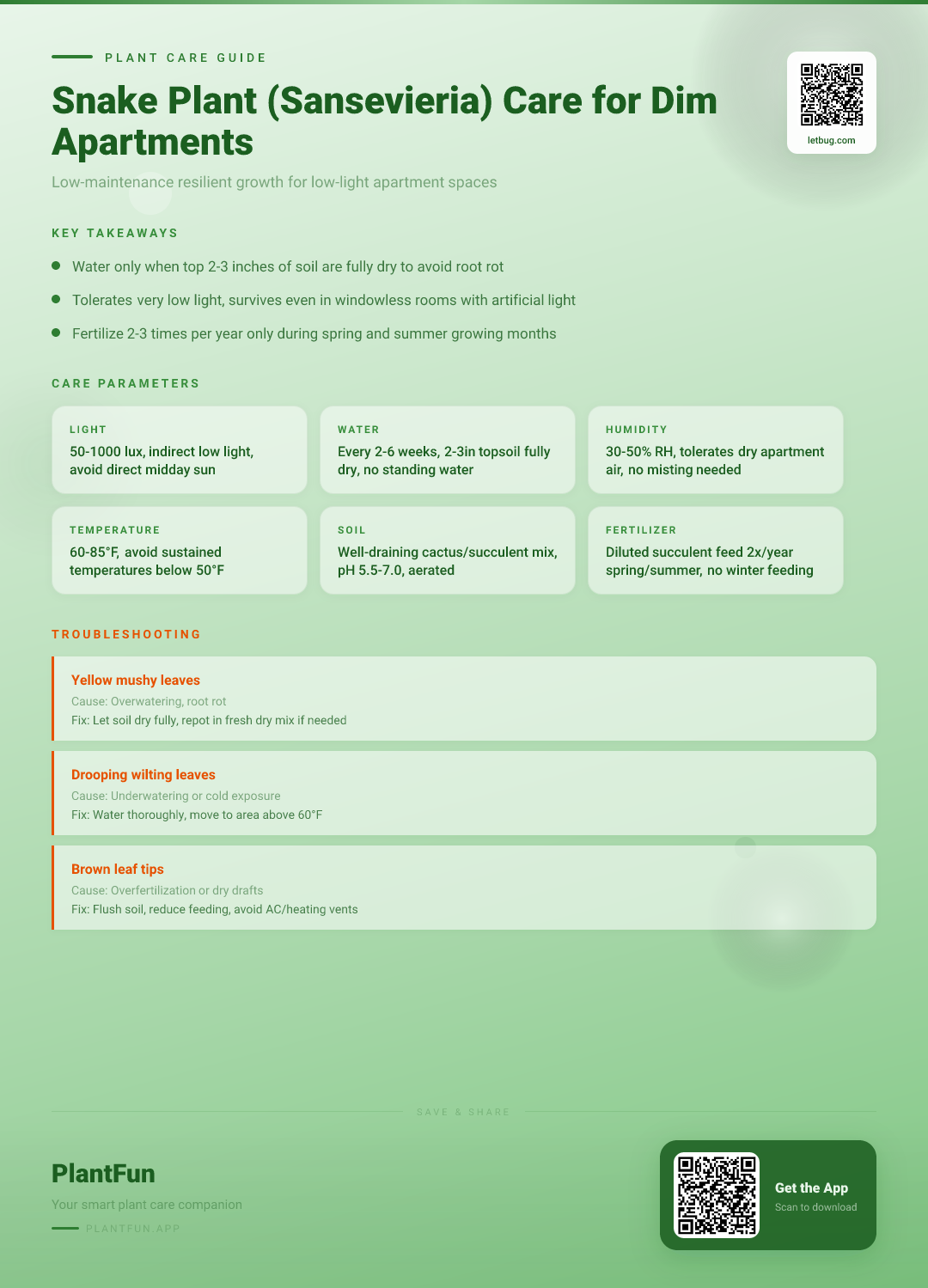
Key Takeaways
- Check soil moisture before watering — overwatering is the #1 killer of houseplants.
- Ensure your plant gets the right amount of light for its species.
- Be patient with recovery — most plants need 2–4 weeks to bounce back.
TL;DR: The Essentials
Snake plants (Dracaena trifasciata) are master survivors of apartment living, but they are not indestructible. In dim conditions, they require significantly less water—often only once every 4–6 weeks. Maintain soil health with a porous, well-draining mix, keep temperatures between 15°C and 27°C (NC State Extension, 2026), and always check moisture levels manually before watering. If you see yellowing leaves or mushy bases, you are overwatering.
Quick Care Card: Essential Parameters
| Parameter | Requirement |
|---|---|
| Light | 2,000–5,000 lux (Low to Medium) |
| Water | Only when soil is 100% dry |
| Temperature | 15°C–27°C |
| Humidity | 40–50% (Average household) |
| Soil | Chunky, cactus-based mix |
| Fertilizer | Balanced liquid, twice per year |
| Toxicity | Toxic to cats and dogs (ASPCA, 2026) |
Why Your Apartment is Actually Perfect for Snake Plants
When I first brought home my first Dracaena trifasciata, I worried my windowless corner would be a death sentence. I soon learned that these plants are adapted to thrive in understory environments. Because they grow slowly in low light, they use less energy and require fewer resources. Your apartment’s stable ambient temperature and lack of harsh, direct scorching sun make it an ideal controlled environment for these architectural wonders.
The 5-Step Resilience Checklist: From Potting to Pruning
- Drainage is Non-Negotiable: Ensure your pot has at least one large drainage hole. Standing water is the primary cause of root death.
- The Right Soil: Use a high-quality succulent or cactus mix amended with perlite. This creates the aeration necessary for root health (NC State Extension, 2026).
- Light Orientation: Even in dark rooms, place the plant as close to a light source as possible. Even a north-facing window is better than a deep corner.
- The “Less is More” Watering Rule: Wait until the soil is bone-dry from top to bottom. If you aren’t sure, wait one more week.
- Minimalist Grooming: Only remove damaged or yellowed leaves at the base with a sterilized blade to encourage new, healthy shoots.
Identifying the Warning Signs: When Your Snake Plant is Struggling
Soft or Mushy Leaves at Base
Symptom: The base of the leaf feels squishy and turns a dark, translucent yellow.
Likely cause: Overwatering and poor drainage leading to rot.
Fix:
- Immediately remove the plant from its pot and trim away black, slimy roots.
- Repot into fresh, dry soil and wait at least 14 days before watering again.
Horizontal Drooping
Symptom: Leaves that should stand upright are bowing or collapsing outward.
Likely cause: The plant is either starving for light or experiencing root damage.
Fix:
- Check the roots for rot first.
- If roots are healthy, move the plant to a spot with higher light intensity (closer to a window).
The Root of the Problem: Why 90% of Apartment Snake Plants Fail
Most people “over-love” their plants by keeping them on a calendar schedule. In a dim apartment, the soil stays damp for weeks. Without high light, photosynthesis slows down (Halawa & Aisuwarya, 2023), meaning the plant cannot “drink” the water sitting in the pot. This leads to an anaerobic environment where pathogens thrive and roots suffocate.
Mastering the Watering Schedule: ml-based approach vs. soil moisture
Forget rigid calendars. Instead, use the “finger test.” Insert your finger 2 inches into the soil. If you feel any coolness or moisture, do not water. In winter, your snake plant may go 6–8 weeks without a drop. When you do water, provide enough to moisten the root ball, but ensure no water remains in the decorative saucer.
Can I keep my Snake Plant in a windowless bathroom?
While snake plants are resilient, they need light for basic biological functions. A bathroom with no natural light is not a long-term home. If your bathroom has a grow light or strong vanity lighting kept on for 8+ hours a day, it might survive, but you will see almost zero growth. Keep your pets safe; the ASPCA (2026) lists this plant as toxic if ingested.
Why is my Snake Plant drooping even though the soil is dry?
If the soil is dry but the leaves are limp, the plant has likely suffered past root rot. The roots are no longer capable of transporting water to the leaves, even when it is present. Inspect the root system; if it is sparse or brown, your plant is struggling to re-establish itself.
Seasonal Adjustments: How to tweak care from winter to summer
In the summer, growth is active; you might water every 3–4 weeks. In winter, temperatures drop, and light intensity fades. Reduce your watering frequency significantly. As noted in recent automated plant care research, monitoring the environment is key to avoiding disease (Ravindran & Thomas, 2025).
The Science of Photosynthesis in Low-Light Conditions
Snake plants utilize Crassulacean Acid Metabolism (CAM) photosynthesis, which allows them to keep their pores (stomata) closed during the day to conserve water. This specialized adaptation is why they excel in indoor environments, but it also means they have a lower growth rate in shade compared to sun-loving tropicals (Halawa & Aisuwarya, 2023).
Frequently Asked Questions (FAQ)
- How often to water snake plant in winter? Generally, every 6–8 weeks. Always test the soil dryness first.
- Can I put my snake plant in the bedroom? Yes, they are excellent at oxygenating the air, though they remain toxic to pets (ASPCA, 2026).
- How do I know if my plant is getting enough light? If it maintains its upright, rigid posture, it is likely receiving adequate light levels.
References & Further Reading
- Halawa, H.; Aisuwarya, R. (2023). Smart Plant Pot Robot with IoT Integration for Indoor Ornamental Plants Care. Journal of Information Technology and Computer Engineering. https://doi.org/10.25077/jitce.7.2.97-106.2023. Accessed 2026-03-17.
- Ravindran, A.; Thomas, P. (2025). Flora Care: A Smart AI-Based System for Plant Disease Diagnosis and Plant Growth Identification. International Journal of Science and Research. https://doi.org/10.21275/mr25425182032. Accessed 2026-03-17.
- ASPCA. (2026). Toxic and Non-Toxic Plants List — ASPCA. https://www.aspca.org/pet-care/animal-poison-control/toxic-and-non-toxic-plants. Accessed 2026-03-17.
- NC State Extension. (2026). Snake Plant Care — NC State Extension Gardener Plant Toolbox. https://plants.ces.ncsu.edu/plants/plant-care/. Accessed 2026-03-17.
Optional Helper: Plantfun.App
Plantfun.App identifies your plants by photo, diagnoses pests and diseases with clear fixes, and creates personalised watering and light schedules that adapt to your home conditions — a handy companion for putting this guide into daily practice.
Found an error or have suggestions? We'd love your feedback.
Need help identifying this problem?
Get instant identification, personalized care schedules, and effective pest treatment plans directly on your phone.
Sponsored • We may earn a commission from app downloads
Related Guides
Snake Plant Care for Apartment Living: A Resilient Growth Guide for Low-Light Homes
Master your Snake Plant care with 4 proven benchmarks. Learn exact light levels, watering schedules, and soil hacks to keep your foliage vibrant in any apartment.
Care GuideThe Complete Sansevieria Care Guide for North-Facing Studios: Resilient Low-Light Growth Tips
Nail low-light snake plant care with our 8-step checklist, exact light/humidity thresholds, and seasonal adjustments to keep your north-facing apartment sansevieria thriving year-round.
Care GuideThe Complete Sansevieria (Snake Plant) Care Guide for North-Facing Studios: No Fuss Resilient Growth
Keep your snake plant thriving in dim north-facing apartments with our science-backed checklist. Get exact watering amounts, light thresholds, and seasonal adjustments for zero-fuss resilient growth.
Pest ControlAnts on Plants: What They Mean and What to Do
Ants usually aren't eating your plant. They are farming other pests.