
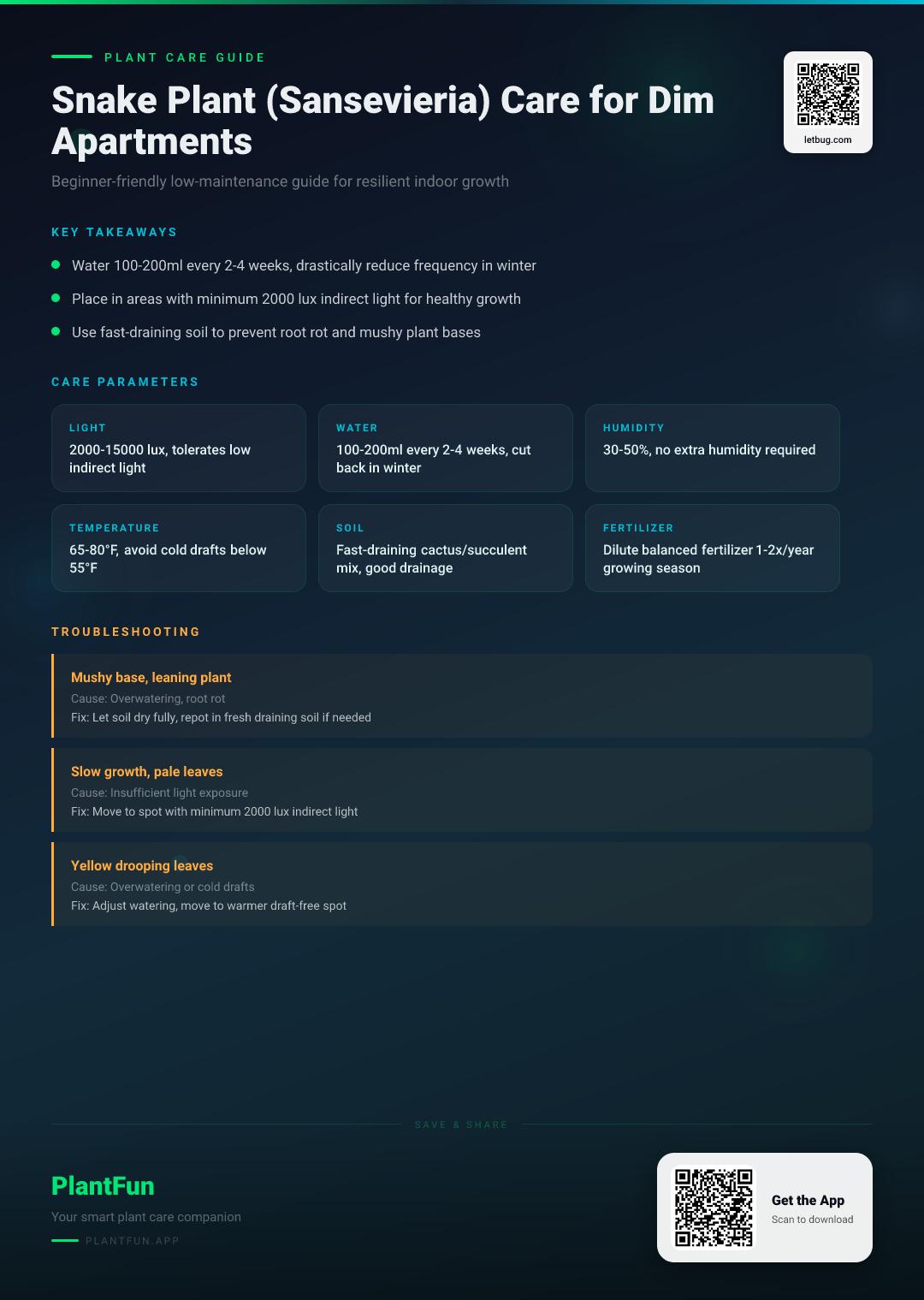
Key Takeaways
- Check soil moisture before watering — overwatering is the #1 killer of houseplants.
- Ensure your plant gets the right amount of light for its species.
- Be patient with recovery — most plants need 2–4 weeks to bounce back.
Quick Care Card: The Sansevieria Baseline
| Feature | Requirement |
|---|---|
| Light | 2,000–15,000 Lux |
| Water | 100–200ml every 2–4 weeks |
| Humidity | 30–50% |
| Temperature | 65–80°F (18–27°C) |
| Soil | Well-draining, succulent-specific mix |
| Fertilizer | Low-nitrogen, once per season |
| Toxicity | Toxic to cats and dogs (ASPCA, 2026) |
TL;DR: The Apartment Reality Check
The Snake Plant (Sansevieria or Dracaena trifasciata) is not indestructible. While it tolerates low-light apartments, it doesn’t thrive in them. The most common cause of death is “over-love”—specifically, watering on a schedule rather than by moisture need. Keep it in a fast-draining, succulent-heavy soil mix, provide moderate indirect light, and let it dry out completely between waterings to prevent root rot.
Why Your Snake Plant is Struggling in Low Light
When I first started collecting plants for my dim studio apartment, I assumed the Snake Plant would happily live in the darkest corner of my bedroom. I made the mistake of ignoring it for months, only to return to a mushy, yellow mess at the base. My experience taught me that “low light tolerant” does not mean “shade loving.”
In dim apartments, metabolic rates drop significantly. The plant cannot transpire water efficiently, meaning if you keep your watering schedule the same as a plant in a bright window, you are essentially drowning the root system (Halawa & Aisuwarya, 2023).
Step 1: The Potting Soil Audit (Drainage vs. Moisture Retention)
If your plant is still in the original nursery soil, it is likely peat-heavy and retains far too much water. For apartments, you need a mix that mimics the arid environments these plants originate from.
- Use a mix of 50% high-quality potting soil and 50% perlite or pumice.
- Ensure your pot has drainage holes—no exceptions.
- If using a decorative pot without drainage, place the plant in a plastic nursery liner pot inside the decorative one to allow for easy water removal.
Step 2: The Water Discipline (Why 200ml is the Danger Zone)
In an apartment with limited light, 200ml of water is often too much for a 6-inch pot.
- The Finger Test: Before watering, stick your finger 2 inches into the soil. If it feels cool or damp, stop.
- The Weight Test: Lift the pot. If it feels significantly lighter than when it was wet, it is ready for water.
- The Pour: Use roughly 100ml for a standard 6-inch pot during winter, and increase to 200ml only in peak summer if the soil dries in under 14 days.
Step 3: Finding the ‘Resiliency Threshold’ in Dim Corners
To keep your plant resilient, you must find the “Resiliency Threshold.” This is the point where the plant receives at least 2,000 lux of indirect light. If you cannot read a book comfortably in the spot where the plant sits, it is likely too dark. Consider placing it on a bookshelf near a window or using a mirror to reflect available light into the room.
Step 4: Seasonal Adjustments: Why Winter Means Near-Total Drought
During the shorter days of winter, the plant enters a period of dormancy. I reduce my watering to once every 6–8 weeks during this phase. Overwatering during dormancy is the primary cause of root failure (Ravindran & Thomas, 2025).
Step 5: Recognizing the ‘Silent’ Distress Signals
Monitor your plant for these symptoms:
- Leaf wrinkling: The plant is thirsty.
- Yellow, mushy base: The plant is waterlogged and may have root rot.
- Leaning: The plant is desperately reaching for light.
FAQ: Commonly Asked Questions
Can I put my Snake Plant in a windowless bathroom?
While it can survive for a few months in very dim light, a windowless room is not sustainable. Without photosynthesis, the plant will eventually exhaust its stored energy. Move it to a brighter room periodically to let it “recharge.”
Why is my Snake Plant leaning over and getting mushy at the base?
This is a classic sign of root rot caused by stagnant water (Ravindran & Thomas, 2025). Stop watering immediately, remove the plant from the pot, trim away black or mushy roots, and repot in fresh, dry soil.
How do I know if my Snake Plant is getting enough light?
Observe the leaf growth. Healthy Snake Plants grow vertically and maintain tight variegation. If yours becomes spindly, “stretches” out, or loses its color, it needs to move closer to a window.
Common Mistakes to Avoid: The Over-Love Cycle
- Mistake: Watering on a calendar schedule.
- What happens: The soil remains wet too long, causing root death.
- Instead: Water only when the soil is 100% dry throughout the container.
- Mistake: Using a pot without holes.
- What happens: Water pools at the bottom, creating an anaerobic environment.
- Instead: Use a nursery pot with drainage holes inside your decorative planter.
- Mistake: Ignoring pet safety.
- What happens: Your cat or dog ingests the leaves.
- Instead: Keep the plant elevated on a stand or shelf out of reach (ASPCA, 2026).
References
- ASPCA. (2026). Toxic and Non-Toxic Plants List — ASPCA. https://www.aspca.org/pet-care/animal-poison-control/toxic-and-non-toxic-plants. Accessed 2026-03-17.
- Halawa, H.; Aisuwarya, R. (2023). Smart Plant Pot Robot with IoT Integration for Indoor Ornamental Plants Care. JITCE (Journal of Information Technology and Computer Engineering). https://doi.org/10.25077/jitce.7.2.97-106.2023. Accessed 2026-03-17.
- Ravindran, A.; Thomas, P. (2025). Flora Care: A Smart AI-Based System for Plant Disease Diagnosis and Plant Growth Identification. International Journal of Science and Research (IJSR). https://doi.org/10.21275/mr25425182032. Accessed 2026-03-17.
Optional Helper: Plantfun.App
Plantfun.App identifies your plants by photo, diagnoses pests and diseases with clear fixes, and creates personalised watering and light schedules that adapt to your home conditions — a handy companion for putting this guide into daily practice.
Found an error or have suggestions? We'd love your feedback.
Need help identifying this problem?
Get instant identification, personalized care schedules, and effective pest treatment plans directly on your phone.
Sponsored • We may earn a commission from app downloads
Related Guides
Snake Plant Care in Apartments: The Ultimate Guide to Thriving in Low-Light Corners
Master your Snake Plant care in any apartment. Discover exact light-to-water ratios, 4 essential growth thresholds, and a layout plan for small-space success.
Care GuideSnake Plant Care in Dim Apartments: The 5-Step Resilience Guide for Busy Owners
Transform your dim apartment into a green oasis. Master exact Snake Plant light and water needs with our 5-step resilience guide designed for busy owners.
Care GuideSnake Plant Care for Apartment Living: A Resilient Growth Guide for Low-Light Homes
Master your Snake Plant care with 4 proven benchmarks. Learn exact light levels, watering schedules, and soil hacks to keep your foliage vibrant in any apartment.
Pest ControlAnts on Plants: What They Mean and What to Do
Ants usually aren't eating your plant. They are farming other pests.