
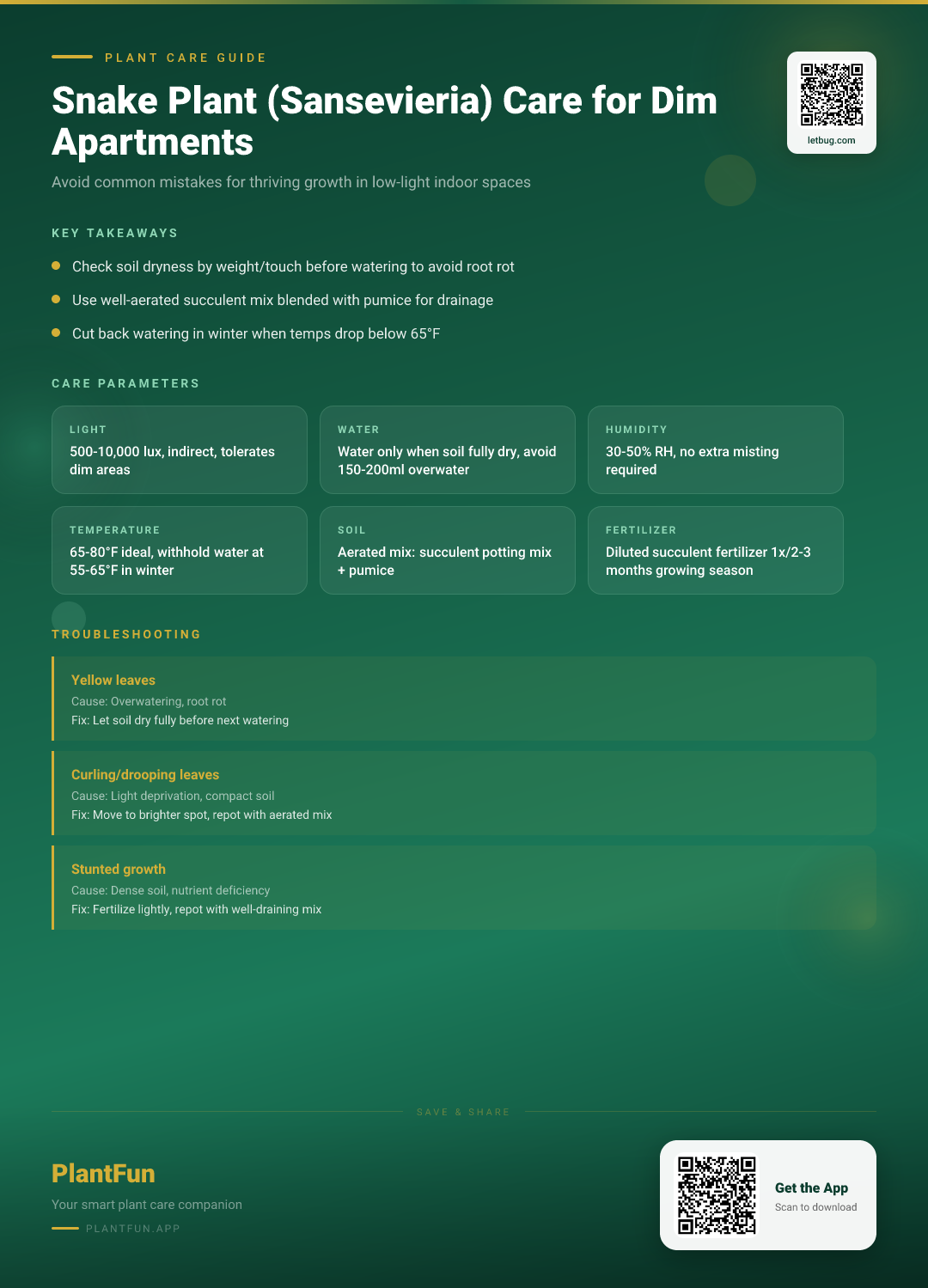
Key Takeaways
- Check soil moisture before watering — overwatering is the #1 killer of houseplants.
- Ensure your plant gets the right amount of light for its species.
- Be patient with recovery — most plants need 2–4 weeks to bounce back.
Quick Care Card: The Gold Standard for Sansevieria
| Feature | Requirement |
|---|---|
| Light | 500–10,000 Lux (Bright, indirect to moderate shade) |
| Water | Only when substrate is 100% dry |
| Humidity | 30–50% (Standard apartment levels) |
| Temperature | 65–80°F (18–27°C) |
| Soil | Highly aerated, well-draining succulent mix |
| Fertilizer | Balanced liquid feed, monthly during summer |
| Toxicity | Toxic to cats and dogs (ASPCA, 2026) |
TL;DR: The Reality of Apartment Snake Plants
The “indestructible” label is the most dangerous myth in houseplant care. While Dracaena trifasciata (formerly Sansevieria) is remarkably resilient, it is not a plastic decoration. It requires specific moisture management and light levels to thrive rather than just survive. In my years of apartment gardening, I have learned that most deaths are caused by “kindness”—specifically overwatering in low-light conditions. To help your plant grow, you must focus on soil drainage and patience.
My Experience: Avoiding the “Indestructible” Trap
When I first started living in a basement-level apartment, I brought home a massive Sansevieria. I assumed its reputation meant it could handle the dim corner behind my TV. I watered it every week out of habit, and within two months, the base of the leaves turned mushy and yellow. I had suffocated the roots. I realized then that my indoor apartment environment required a strict, observation-based care routine rather than a calendar-based one.
The 7 Biggest Mistakes That Stall Sansevieria Growth
- Overwatering: The primary cause of root death (NC State Extension, 2026).
- Using Non-Draining Pots: If your pot lacks a drainage hole, water pools at the bottom, creating a death trap for roots.
- Low-Light Neglect: Thinking it survives in the dark means it thrives there. It actually requires light to perform photosynthesis (Halawa & Aisuwarya, 2023).
- Compact Soil: Garden soil holds too much water, suffocating the roots.
- Excessive Temperature Fluctuations: Placing plants near drafty windows or heating vents.
- Over-Fertilizing: Forcing growth when the plant is dormant.
- Ignoring Dust: Thick dust layers on leaves block light intake.
Understanding Your Apartment Light
There is a massive difference between a dim corner and actual low light. A plant in a dark corner isn’t “doing fine”; it is consuming its stored energy reserves. To verify if your plant is getting enough light, use a simple mobile light meter app. If your spot measures below 500 Lux, your plant will eventually decline. Move it closer to a window or add a supplemental grow light to maintain metabolic function (Ravindran & Thomas, 2025).
Step-by-Step Watering Protocol: Avoiding the 150ml-200ml ‘Drowning’ Trap
Never pour a fixed amount of water into your plant. Instead, rely on weight and moisture testing.
- The Finger Test: Insert your finger 2–3 inches into the soil. If it feels cool or damp, do not water.
- The Weight Test: Lift the pot. If it feels light as a feather, the plant is ready for water.
- The Flush: When dry, water thoroughly until liquid exits the drainage hole. Discard all excess water in the saucer immediately (NC State Extension, 2026).
Seasonal Adjustments for Interior Spaces
During winter, when indoor temperatures drop to 55–65°F, the plant enters a semi-dormant state. I reduce my watering frequency by 50%. If the air is dry from central heating, keep the plant away from heat sources, as dry air combined with high heat can stress the succulent tissues.
Soil Science: Creating the Ideal Aerated Mix
For container-grown Sansevieria, you need rapid drainage to prevent root rot. My go-to mix is 60% high-quality potting mix and 40% perlite or pumice. This ensures high porosity and air circulation, which are critical for healthy root systems (NC State Extension, 2026).
Frequently Asked Questions
Why is my Snake Plant drooping in the corner of my living room? It is likely suffering from “stretching” due to lack of light (etiolation) or early-stage root rot. Check the soil moisture first.
How do I know if my Sansevieria is getting too little light? Watch for the leaves leaning significantly toward the light source or becoming thin and pale. If they lose their structural rigidity, they are starving for energy.
Can I leave my Snake Plant in a windowless bathroom? I do not recommend it. Without natural or artificial light, the plant cannot photosynthesize and will eventually die, regardless of the humidity.
The 12-Month Maintenance Calendar
- Spring: Resume monthly fertilizing; repot if root-bound.
- Summer: Keep in brightest available spot; monitor moisture weekly.
- Fall: Begin to decrease water frequency as temperatures cool.
- Winter: Withhold fertilizer; water only when completely dehydrated.
Troubleshooting Guide
[Yellowing Leaves]
Symptom: Leaves turn yellow or translucent at the base.
Likely cause: Overwatering leading to rot.
Fix:
- Remove the plant from the pot and inspect roots.
- Trim away mushy, brown roots with sterilized shears.
- Repot in fresh, dry, well-draining soil.
[Drooping or Curling Leaves]
Symptom: Leaves lose their upright, sword-like posture.
Likely cause: Underwatering or severe light deficiency.
Fix:
- If soil is bone dry, give a thorough soak.
- If soil is moist, move the plant to a brighter location immediately.
[Stunted Growth]
Symptom: The plant has not produced a new leaf in 12+ months.
Likely cause: Pot is too large, or light is insufficient for photosynthesis (Halawa & Aisuwarya, 2023).
Fix:
- Downsize the pot to just slightly larger than the root ball.
- Increase light exposure gradually.
References
- ASPCA. (2026). Toxic and Non-Toxic Plants List — ASPCA. https://www.aspca.org/pet-care/animal-poison-control/toxic-and-non-toxic-plants. Accessed 2026-03-11.
- Halawa, H.; Aisuwarya, R. (2023). Smart Plant Pot Robot with IoT Integration for Indoor Ornamental Plants Care. JITCE (Journal of Information Technology and Computer Engineering). https://doi.org/10.25077/jitce.7.2.97-106.2023. Accessed 2026-03-11.
- NC State Extension. (2026). Snake Plant Care — NC State Extension Gardener Plant Toolbox. https://plants.ces.ncsu.edu/plants/snake-plant/. Accessed 2026-03-11.
- Ravindran, A.; Thomas, P. (2025). Flora Care: A Smart AI-Based System for Plant Disease Diagnosis and Plant Growth Identification. International Journal of Science and Research (IJSR). https://doi.org/10.21275/mr25425182032. Accessed 2026-03-11.
Optional Helper: Plantfun.App
Plantfun.App identifies your plants by photo, diagnoses pests and diseases with clear fixes, and creates personalised watering and light schedules that adapt to your home conditions — a handy companion for putting this guide into daily practice.
Found an error or have suggestions? We'd love your feedback.
Need help identifying this problem?
Get instant identification, personalized care schedules, and effective pest treatment plans directly on your phone.
Sponsored • We may earn a commission from app downloads
Related Guides
The Budget-Friendly Sansevieria (Snake Plant) Care Checklist for Low-Effort Resilient Apartment Growth
Grow lush, unkillable snake plants in your apartment on a $5 monthly budget. Get exact light levels, watering schedules, and a free printable checklist to avoid common beginner mistakes.
Care GuideSnake Plant Care in Apartments: The Ultimate Guide to Thriving in Low-Light Corners
Master your Snake Plant care in any apartment. Discover exact light-to-water ratios, 4 essential growth thresholds, and a layout plan for small-space success.
Care GuideSnake Plant Care for Apartment Living: A Resilient Growth Guide for Low-Light Homes
Master your Snake Plant care with 4 proven benchmarks. Learn exact light levels, watering schedules, and soil hacks to keep your foliage vibrant in any apartment.
Pest ControlAnts on Plants: What They Mean and What to Do
Ants usually aren't eating your plant. They are farming other pests.