
Key Takeaways
- Check soil moisture before watering — overwatering is the #1 killer of houseplants.
- Ensure your plant gets the right amount of light for its species.
- Be patient with recovery — most plants need 2–4 weeks to bounce back.
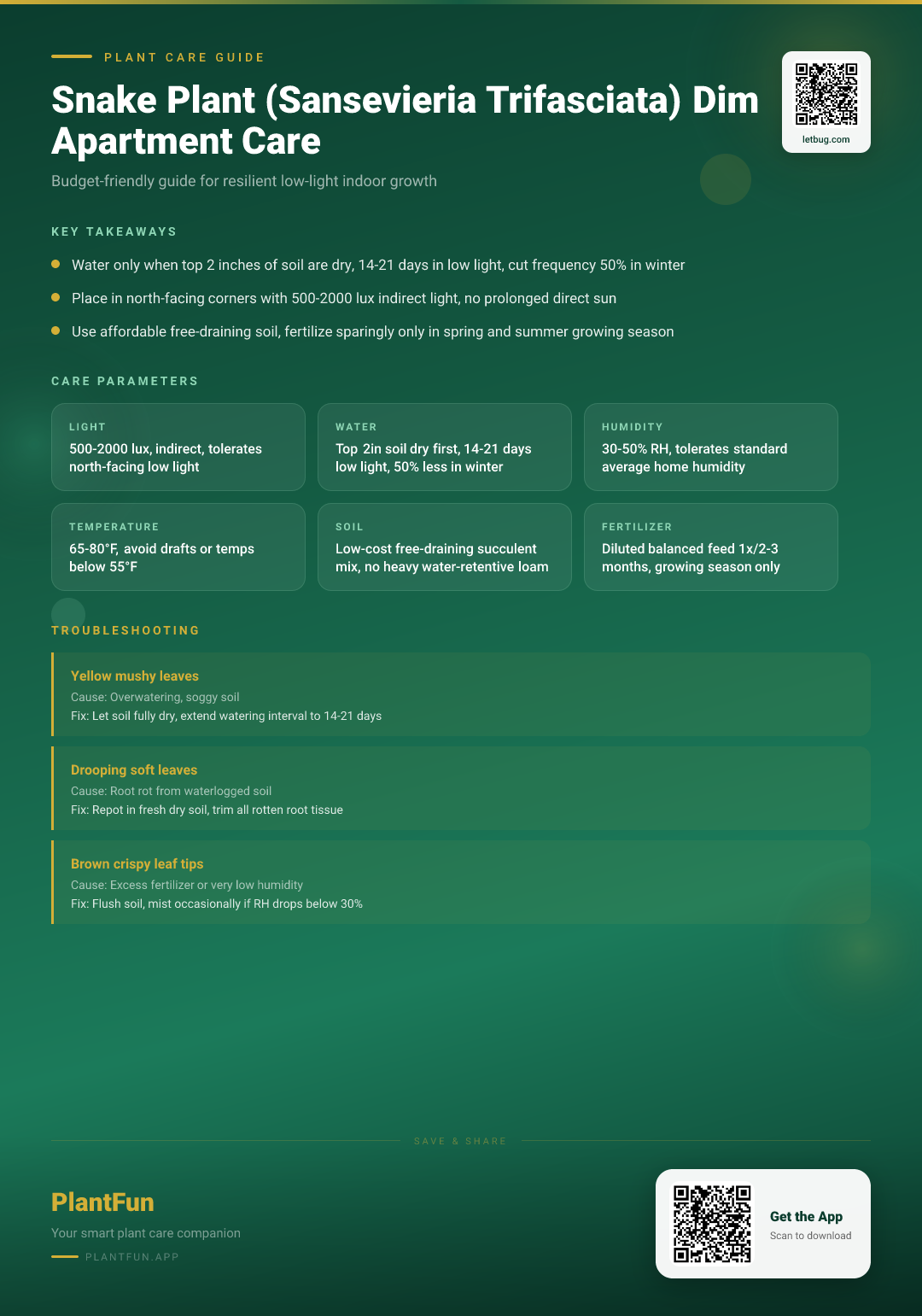
Quick Care Card: Essential thresholds for Sansevieria trifasciata
| Feature | Requirement |
|---|---|
| Light | Bright, indirect to low light (500–2,000 lux) |
| Water | Allow top 2 inches to dry completely (14–21 days) |
| Humidity | Tolerates low indoor humidity (30–50%) |
| Temperature | 65–80°F (18–27°C) |
| Soil | Well-draining, cactus-based mix |
| Fertilizer | Balanced liquid 10-10-10 (diluted half-strength) |
| Toxicity | Toxic to cats and dogs (ASPCA, 2026) |
TL;DR: Why your apartment needs a tailored Snake Plant schedule
Snake plants are resilient, but they are not immortal. In dim apartments, lower light levels slow the plant’s metabolism, meaning it consumes water far slower than in a greenhouse setting. To keep yours thriving, ignore the ‘set it and forget it’ advice. Instead, wait for the top two inches of soil to dry out completely before watering, and ensure your soil composition is porous enough to prevent root rot, which is the leading cause of death in apartment-grown Sansevieria trifasciata (NC State Extension, 2026).
My Experience: The ‘Apartment Reality’
When I first bought my ‘Laurentii’ Snake Plant years ago, I placed it in a dark corner of my studio apartment, thinking it truly needed no light. I watered it every week out of habit. Within a month, the base turned yellow and mushy. I had fallen into the ‘over-love’ trap. I learned that in lower light, the plant’s photosynthetic rate drops significantly, requiring a total reset of my care habits to match the environment rather than my desire to ‘nurture’ it.
Understanding Light: Maximizing 500-2,000 lux in north-facing corners
While these plants tolerate low light, they grow best when they receive at least some ambient brightness (NC State Extension, 2026). In an apartment, 500 to 2,000 lux is typical for north-facing windows or spots a few feet away from a window. If you aren’t sure how much light your plant gets, check if you can easily read a book in that spot; if you can’t, your plant is likely struggling to maintain its structural integrity (Halawa & Aisuwarya, 2023).
Watering Mastery: The 2-inch dry-out rule
The most common mistake I see is watering on a calendar schedule rather than a biological one. Because light levels dictate water uptake, your plant in a dim apartment needs less water than one in a sun-drenched lobby.
- Use your finger or a wooden skewer to check the soil depth.
- Insert it 2 inches down; if the tip comes out moist, wait another 3 days.
- Water only when the top 2 inches are completely dry to the touch.
- Use tepid water to avoid shocking the roots.
Soil Science: Creating a budget-friendly, free-draining substrate at home
You don’t need expensive pre-mixed bags. You can create a high-performance substrate by mixing standard indoor potting soil with perlite or pumice at a 2:1 ratio. This ensures that the soil remains aerated, allowing oxygen to reach the roots while preventing the stagnant moisture that leads to decay (Ravindran & Thomas, 2025).
Temperature & Humidity: Keeping your plant comfortable at 65-80°F
Sansevieria prefers standard room temperatures. Avoid placing your pot near drafty vents or radiators. While they are adaptable, extreme fluctuations can stress the plant, making it more susceptible to pests (NC State Extension, 2026).
Voice FAQ
Why is my Snake Plant drooping in my apartment?
This is typically a symptom of either extreme overwatering causing root rot, or the plant reaching for light because it is placed in a space that is too dark. Check the roots; if they are firm, move the plant closer to a window.
Can I really keep a Snake Plant in a windowless bathroom?
While it can survive for a period, it will eventually enter a state of dormancy and may lose its vibrant color. If you must keep it in a windowless room, I suggest moving it to a brighter spot for one week every month to allow it to recharge.
Is it safe for my pets?
No. The ASPCA (2026) classifies Sansevieria trifasciata as toxic to cats and dogs. It contains saponins which can cause nausea, vomiting, and diarrhea if ingested. Keep it on a high shelf or in a room your pets cannot access.
Seasonal Adjustments: Why your winter watering must drop by 50%
As natural light levels decrease in the winter, the plant’s metabolism slows significantly. I reduce my watering frequency by half during the darker months to prevent the roots from sitting in cold, wet soil, which is a death sentence for succulents.
Common Mistakes: Avoiding the ‘over-love’ cycle
- Mistake: Watering because it’s ‘Monday.’
- What happens: Root rot and yellowing leaves.
- Instead: Check soil moisture first.
- Mistake: Using a pot without drainage holes.
- What happens: Water pools at the bottom, suffocating the roots.
- Instead: Ensure your decorative cachepot has a nursery liner with holes.
Long-Term Maintenance: When to repot and how to fertilize on a budget
Only repot when the roots are visibly pushing against the edges of the container. These plants actually prefer being slightly root-bound. Fertilize sparingly—only once in the spring and once in the summer—using a balanced 10-10-10 liquid fertilizer diluted to half-strength. Over-fertilizing in low-light conditions causes weak, spindly growth that cannot support the weight of the leaves.
References
- ASPCA. (2026). Toxic and Non-Toxic Plants List — ASPCA. https://www.aspca.org/pet-care/animal-poison-control/toxic-and-non-toxic-plants. Accessed 2026-03-18.
- Halawa, H.; Aisuwarya, R. (2023). Smart Plant Pot Robot with IoT Integration for Indoor Ornamental Plants Care. JITCE (Journal of Information Technology and Computer Engineering). https://doi.org/10.25077/jitce.7.2.97-106.2023. Accessed 2026-03-18.
- NC State Extension. (2026). Snake Plant Care — NC State Extension Gardener Plant Toolbox. https://plants.ces.ncsu.edu/plants/snake-plant/. Accessed 2026-03-18.
- Ravindran, A.; Thomas, P. (2025). Flora Care: A Smart AI-Based System for Plant Disease Diagnosis and Plant Growth Identification. International Journal of Science and Research (IJSR). https://doi.org/10.21275/mr25425182032. Accessed 2026-03-18.
Optional Helper: Plantfun.App
Plantfun.App identifies your plants by photo, diagnoses pests and diseases with clear fixes, and creates personalised watering and light schedules that adapt to your home conditions — a handy companion for putting this guide into daily practice.
Found an error or have suggestions? We'd love your feedback.
Need help identifying this problem?
Get instant identification, personalized care schedules, and effective pest treatment plans directly on your phone.
Sponsored • We may earn a commission from app downloads
Related Guides
Snake Plant Care for Apartment Living: A Resilient Growth Guide for Low-Light Homes
Master your Snake Plant care with 4 proven benchmarks. Learn exact light levels, watering schedules, and soil hacks to keep your foliage vibrant in any apartment.
Care GuideSnake Plant Care in Apartments: The Ultimate Guide to Thriving in Low-Light Corners
Master your Snake Plant care in any apartment. Discover exact light-to-water ratios, 4 essential growth thresholds, and a layout plan for small-space success.
Care GuideSnake Plant Care for North-Facing Studio Apartments: 7 Steps for Resilient Lush Growth
Keep your snake plant thriving even in dim north-facing studio apartments. Get exact light thresholds, watering amounts, and 7 actionable steps for resilient, lush growth year-round.
Pest ControlAnts on Plants: What They Mean and What to Do
Ants usually aren't eating your plant. They are farming other pests.