
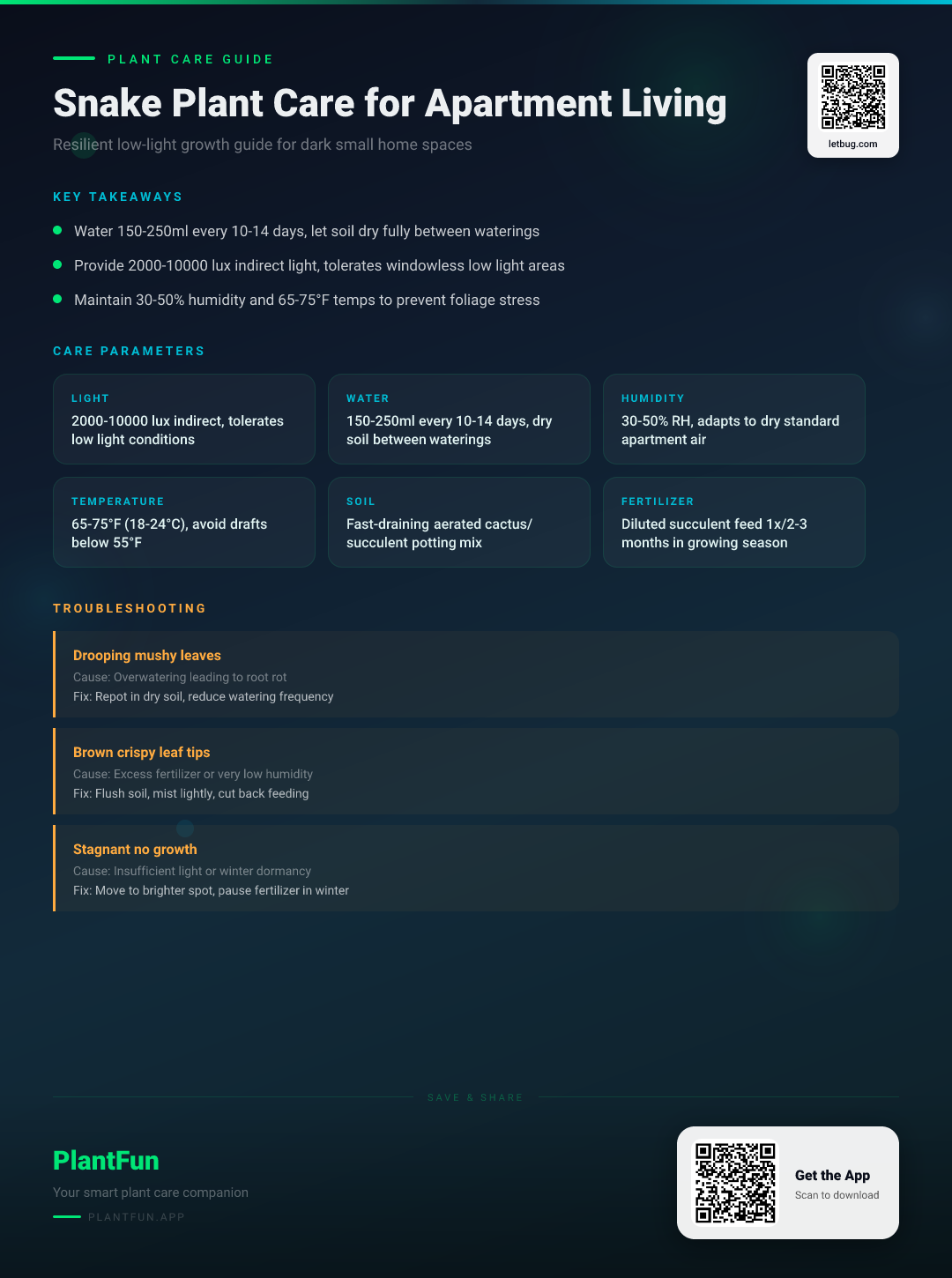
Key Takeaways
- Check soil moisture before watering — overwatering is the #1 killer of houseplants.
- Ensure your plant gets the right amount of light for its species.
- Be patient with recovery — most plants need 2–4 weeks to bounce back.
TL;DR: The Snake Plant (Dracaena trifasciata) thrives in apartments by mimicking its native arid, rocky habitats. To succeed, provide 2,000–10,000 lux of indirect light, water only when the soil is completely dry (roughly 150–250ml every 14 days), and use a high-drainage, grit-heavy potting mix. Avoid overwatering at all costs, as root rot is the leading cause of plant death in indoor environments.
Quick Care Card: Essential Data
| Category | Requirement |
|---|---|
| Light | 2,000–10,000 lux (Bright indirect to low light) |
| Water | 150–250ml per 10–14 days (Seasonal adjustment required) |
| Soil | Well-draining, cactus-grade mix with 30% perlite |
| Temperature | 65–75°F (18–24°C) |
| Humidity | 30–50% (Standard apartment levels) |
| Fertilizer | Balanced liquid feed at half-strength (Monthly, Summer) |
| Toxicity | Toxic to cats and dogs (ASPCA, 2026) |
Why Your Apartment is Actually a Perfect Snake Plant Habitat
When I first got my apartment, I struggled with “plant guilt”—the feeling that I wasn’t doing enough for my greenery. I made the mistake of over-nurturing my first Snake Plant, watering it like a tropical fern. It didn’t take long for the base to go mushy.
Modern apartments are actually ideal for Sansevieria (now reclassified as Dracaena). Their ability to survive in varying light conditions and lower humidity makes them the ultimate resilient houseplant for apartments (NC State Extension, 2026). Once you stop treating them like rainforest plants, they thrive.
Section 1: The Light Science (Optimal 2,000-10,000 lux)
While often labeled as “low-light” plants, Snake Plants are simply shade-tolerant. They evolved to grow in forest understories where they receive filtered light. In a home setting, providing 2,000 to 10,000 lux ensures the plant stays compact and vibrant. If you notice your leaves leaning, it is searching for better light (Halawa & Aisuwarya, 2023). Move it closer to a window, but avoid harsh, direct midday sun, which can scorch the foliage.
Section 2: The Watering Protocol (150-250ml per 10-14 days)
How often to water your Snake Plant is the most critical factor for success. I rely on the “finger test”: push your index finger 2 inches into the soil. If it feels damp, do not water. In my experience, 150-250ml of water every 14 days is sufficient for a 6-inch pot during the growing season. Never let the plant sit in standing water, as this creates a low-oxygen environment that encourages root-rotting pathogens (Halawa & Aisuwarya, 2023).
Section 3: Soil Composition and Aeration Thresholds
If you are keeping your plant in the nursery soil, you are likely holding too much moisture. I always repot immediately into a mixture of 60% standard indoor potting soil and 40% perlite or pumice. This ensures high aeration, preventing the root structure from suffocating. A well-draining substrate is the best soil for a Snake Plant to ensure long-term vigor.
Section 4: Maintaining 30-50% Humidity and 65-75°F (18-24°C) Temps
Snake Plants aren’t picky, but they prefer steady environments. Keep them away from drafty windows or heating vents. They are perfectly comfortable at room temperatures between 65°F and 75°F (NC State Extension, 2026). They do not require added humidity; in fact, standard apartment humidity (30-50%) is ideal.
Common Apartment Pitfalls: Addressing Low Light and Drafts
- Mistake: Putting the plant in a windowless bathroom.
- What happens: The plant enters a state of starvation, becoming leggy and prone to pests.
- Instead: Provide at least 8 hours of ambient light or supplement with a dedicated LED grow light.
- Mistake: Placing the plant directly in front of a radiator.
- What happens: Dehydration and leaf tip browning.
- Instead: Ensure at least 3 feet of distance between the plant and any HVAC vent.
FAQ: Why is my Snake Plant drooping in the corner?
If you are wondering why is my Snake Plant drooping, it is usually a sign of rot at the rhizome level due to overwatering or insufficient light. Check the base—if it’s soft or smells foul, you need to prune the damaged areas and repot into dry, fresh soil.
FAQ: Can I keep my Snake Plant in a windowless room?
Technically, no plant thrives without light. If you must keep it in a dark hallway, use a full-spectrum grow light. Without supplemental light, the plant will exhaust its stored energy reserves and eventually decline (Halawa & Aisuwarya, 2023).
Seasonal Care Calendar: Winter Dormancy vs. Summer Growth
- Spring/Summer: Increase watering to once every 10 days as the plant enters its active growth phase.
- Autumn/Winter: Scale back significantly. During winter, I only water my Snake Plants once a month. The plant is in dormancy and does not process moisture at the same rate (NC State Extension, 2026).
Troubleshooting Guide: When to Repot and When to Wait
Root-Bound Stress
Symptom: Roots are growing out of the drainage holes.
Likely cause: The pot is too small for the plant’s root mass.
Fix:
- Choose a pot only 1–2 inches wider than the current one.
- Use a terracotta container for better breathability.
Yellowing Leaves
Symptom: Leaves turn yellow from the bottom up.
Likely cause: Excess moisture trapped in the soil.
Fix:
- Cease all watering immediately.
- Carefully remove the plant to inspect the roots; cut away any mushy, brown sections.
Leaf Tip Browning
Symptom: Dry, crispy tips on the leaf edges.
Likely cause: Water quality or low humidity.
Fix:
- Use filtered or distilled water if your tap water has high mineral content.
- Ensure consistent watering to prevent extreme wet-dry cycles.
References and Further Botanical Reading
- Halawa, H.; Aisuwarya, R. (2023). Smart Plant Pot Robot with IoT Integration for Indoor Ornamental Plants Care. JITCE. https://doi.org/10.25077/jitce.7.2.97-106.2023. Accessed 2026-03-13.
- Henny, R.; Chen, J. (2013). Florida Foliage House Plant Care: ZZ Plant. EDIS. https://doi.org/10.32473/edis-ep480-2013. Accessed 2026-03-13.
- ASPCA. (2026). Toxic and Non-Toxic Plants List — ASPCA. https://www.aspca.org/pet-care/animal-poison-control/toxic-and-non-toxic-plants. Accessed 2026-03-13.
- NC State Extension. (2026). Snake Plant Care — NC State Extension Gardener Plant Toolbox. https://plants.ces.ncsu.edu/plants/plant-care/. Accessed 2026-03-13.
Optional Helper: Plantfun.App
Plantfun.App identifies your plants by photo, diagnoses pests and diseases with clear fixes, and creates personalised watering and light schedules that adapt to your home conditions — a handy companion for putting this guide into daily practice.
Found an error or have suggestions? We'd love your feedback.
Need help identifying this problem?
Get instant identification, personalized care schedules, and effective pest treatment plans directly on your phone.
Sponsored • We may earn a commission from app downloads
Related Guides
Snake Plant Care in Apartments: The Ultimate Guide to Thriving in Low-Light Corners
Master your Snake Plant care in any apartment. Discover exact light-to-water ratios, 4 essential growth thresholds, and a layout plan for small-space success.
Care GuideThe Complete Snake Plant Care Checklist for Small Urban Apartments: No-Fuss Resilient Growth
Skip generic snake plant care tips. Grab our free budget-friendly 7-point checklist, exact light, water, and soil specs to grow a hardy, resilient snake plant in your small urban apartment.
Care GuideSnake Plant in Budget Urban Apartments: The Only Care Checklist for Resilient Growth You’ll Ever Need
Stop neglecting your snake plant in your small urban apartment. Grab our free 7-step budget checklist, exact light, water, and temperature parameters for lush, resilient growth year-round.
Pest ControlAnts on Plants: What They Mean and What to Do
Ants usually aren't eating your plant. They are farming other pests.