
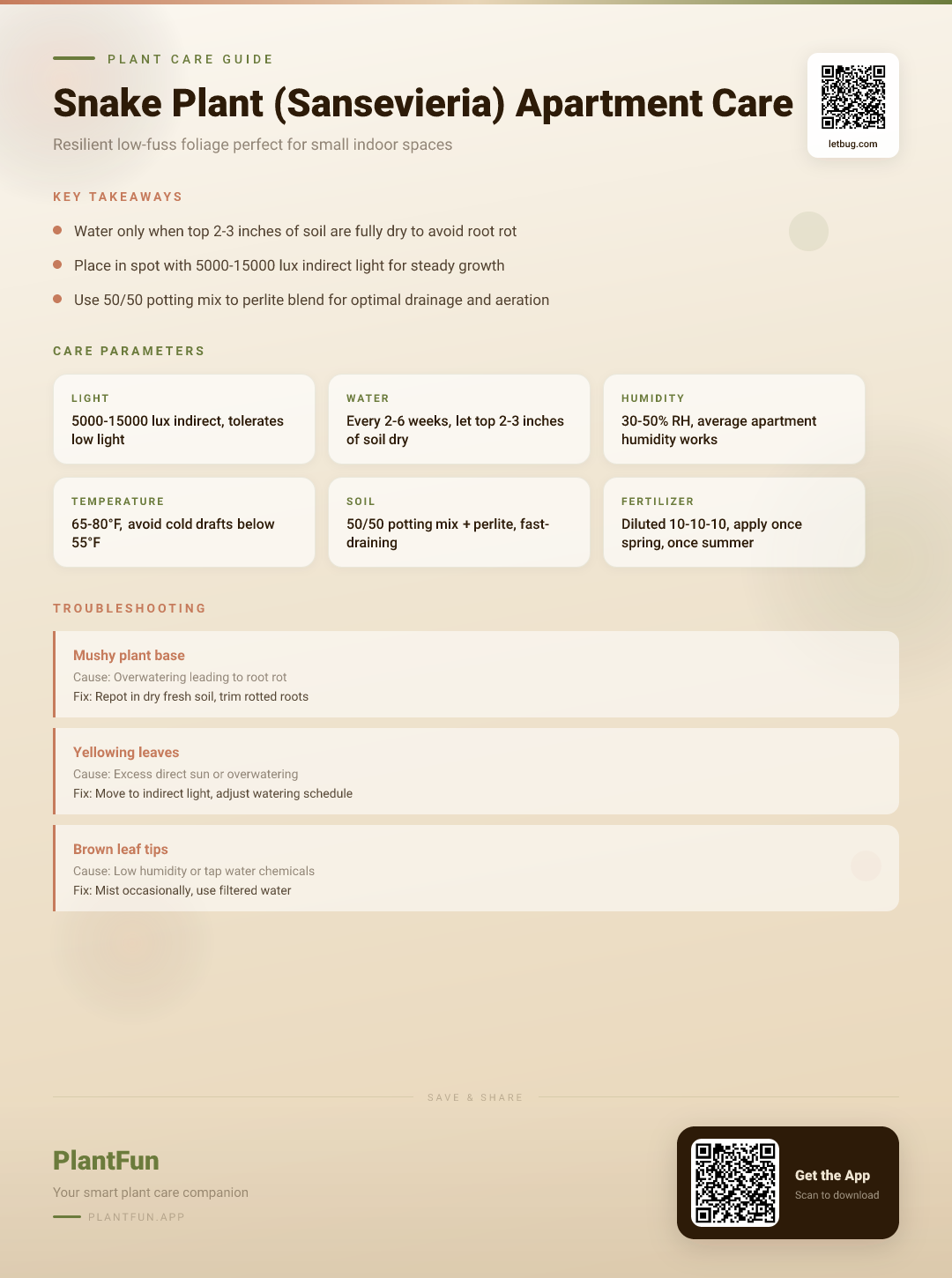
Key Takeaways
- Check soil moisture before watering — overwatering is the #1 killer of houseplants.
- Ensure your plant gets the right amount of light for its species.
- Be patient with recovery — most plants need 2–4 weeks to bounce back.
Quick Care Card: Essential Metrics for Resilient Snake Plants
| Metric | Requirement |
|---|---|
| Light | 5,000–15,000 lux (Bright, indirect preferred) |
| Water | Allow soil to dry 100% between waterings |
| Humidity | 30–50% RH (Average apartment levels) |
| Temperature | 65°F–80°F (18°C–27°C) |
| Soil | Fast-draining succulent mix (50/50 potting soil to perlite) |
| Toxicity | Toxic to cats and dogs (ASPCA, 2026) |
TL;DR: Why Your Apartment Snake Plant Needs More Than Just Neglect
Your Snake Plant (Sansevieria) is resilient, but not immortal. Most deaths occur from chronic overwatering in low-light conditions. To thrive, it needs high-aeration soil, light levels between 5,000 and 15,000 lux, and a strict “bone-dry” watering schedule. When I first started my indoor garden, I lost two plants by assuming they required zero attention; the secret is active observation, not total neglect.
Understanding the Sansevieria: Natural Habitat vs. The Typical Apartment
In their native environments across arid regions of Africa and Asia, these plants evolved to store water in fleshy, succulent leaves to survive prolonged drought. When we place them in our homes, we often trap them in “pot swamps.” By mimicking their natural drainage requirements, we prevent the root rot typically diagnosed in indoor settings (Halawa & Aisuwarya, 2023). Keep in mind that while they are highly adaptable, they are also categorized as toxic to household pets (ASPCA, 2026).
Mistake #1: The Overwatering Trap (How to measure moisture correctly)
Many beginners follow a weekly snake plant watering schedule, but this is a fatal error. Your plant’s metabolic rate changes based on light and temperature.
The Fix: Before you reach for the watering can, perform the “Finger Depth Test.” Stick your index finger at least 2 inches into the soil. If you feel any dampness, wait another 3-4 days. Using IoT-enabled moisture sensors can also help monitor soil health to avoid the conditions that lead to pathogen-induced rot (Halawa & Aisuwarya, 2023).
Mistake #2: Misinterpreting ‘Low Light’ (The 5,000–15,000 lux threshold)
“Low light” does not mean a windowless room. While Sansevieria survives in shadows, it thrives when receiving 5,000–15,000 lux of light (Ravindran & Thomas, 2025).
The Fix: Place your plant near an east-facing window or a few feet back from a south-facing one. If your leaves are curling or stretching, this is a clear signal that your plant is reaching for more intensity to support its photosynthetic processes.
Mistake #3: Poor Soil Aeration and Drainage (The 50/50 mix rule)
Standard potting soil retains too much moisture for a succulent. I personally use a 50/50 mix: 50% high-quality potting soil and 50% perlite or pumice to ensure the roots have access to oxygen.
Mistake #4: Ignoring Humidity and Air Circulation (Maintaining 30-50% RH)
High humidity in poorly ventilated apartments can lead to fungal growth at the leaf base. Aim for 30–50% relative humidity. Ensure your plant isn’t shoved into a dark, stagnant corner.
Mistake #5: Cold Drafts and Temperature Stress (Keeping it 65-80°F)
Sansevieria prefers 65°F–80°F. Placing them near AC units or drafty winter windows causes cellular stress. If the temperature drops below 55°F, growth halts entirely.
Voice Search FAQ: Why is my Snake Plant getting mushy at the base?
This is a classic sign of sansevieria root rot signs. Your soil is likely staying wet for too long. Remove the plant, trim away any black, slimy roots, and repot into fresh, dry, well-aerated soil. You can learn more about identifying plant disease symptoms to catch this earlier next time.
Voice Search FAQ: How do I know if my apartment has enough light for a Sansevieria?
If you can read a book comfortably in the spot where the plant sits without turning on an artificial light, it likely meets the minimum requirements. If the plant stops growing or the leaf color fades significantly, move it closer to a natural light source.
Seasonal Care Calendar: Adjusting for Winter Heating vs. Summer Growth
- Spring/Summer: This is the growth phase. Water once every 2–3 weeks, ensuring the soil dries out completely.
- Fall/Winter: Growth slows down. Reduce watering to once every 4–6 weeks. During winter, indoor heating can dry out the ambient air, but your soil moisture will remain higher for longer due to reduced light levels.
References
- ASPCA. (2026). Toxic and Non-Toxic Plants List — ASPCA. https://www.aspca.org/pet-care/animal-poison-control/toxic-and-non-toxic-plants. Accessed 2026-03-11.
- Halawa, H.; Aisuwarya, R. (2023). Smart Plant Pot Robot with IoT Integration for Indoor Ornamental Plants Care. JITCE (Journal of Information Technology and Computer Engineering). https://doi.org/10.25077/jitce.7.2.97-106.2023. Accessed 2026-03-11.
- Ravindran, A.; Thomas, P. (2025). Flora Care: A Smart AI-Based System for Plant Disease Diagnosis and Plant Growth Identification. International Journal of Science and Research (IJSR). https://doi.org/10.21275/mr25425182032. Accessed 2026-03-11.
Optional Helper: Plantfun.App
Plantfun.App identifies your plants by photo, diagnoses pests and diseases with clear fixes, and creates personalised watering and light schedules that adapt to your home conditions — a handy companion for putting this guide into daily practice.
Found an error or have suggestions? We'd love your feedback.
Need help identifying this problem?
Get instant identification, personalized care schedules, and effective pest treatment plans directly on your phone.
Sponsored • We may earn a commission from app downloads
Related Guides
The Budget-Friendly Sansevieria (Snake Plant) Care Checklist for Low-Effort Resilient Apartment Growth
Grow lush, unkillable snake plants in your apartment on a $5 monthly budget. Get exact light levels, watering schedules, and a free printable checklist to avoid common beginner mistakes.
Care GuideSnake Plant Care in Drafty Apartments: The Complete Seasonal Routine for Resilient Growth
Master Snake Plant care in your apartment with our 12-month routine. Get exact light, watering schedules, and draft-proofing tips to ensure lush, hardy growth.
Care GuideThe Complete Snake Plant Care Checklist for Small Urban Apartments: No-Fuss Resilient Growth
Skip generic snake plant care tips. Grab our free budget-friendly 7-point checklist, exact light, water, and soil specs to grow a hardy, resilient snake plant in your small urban apartment.
Pest ControlAnts on Plants: What They Mean and What to Do
Ants usually aren't eating your plant. They are farming other pests.