
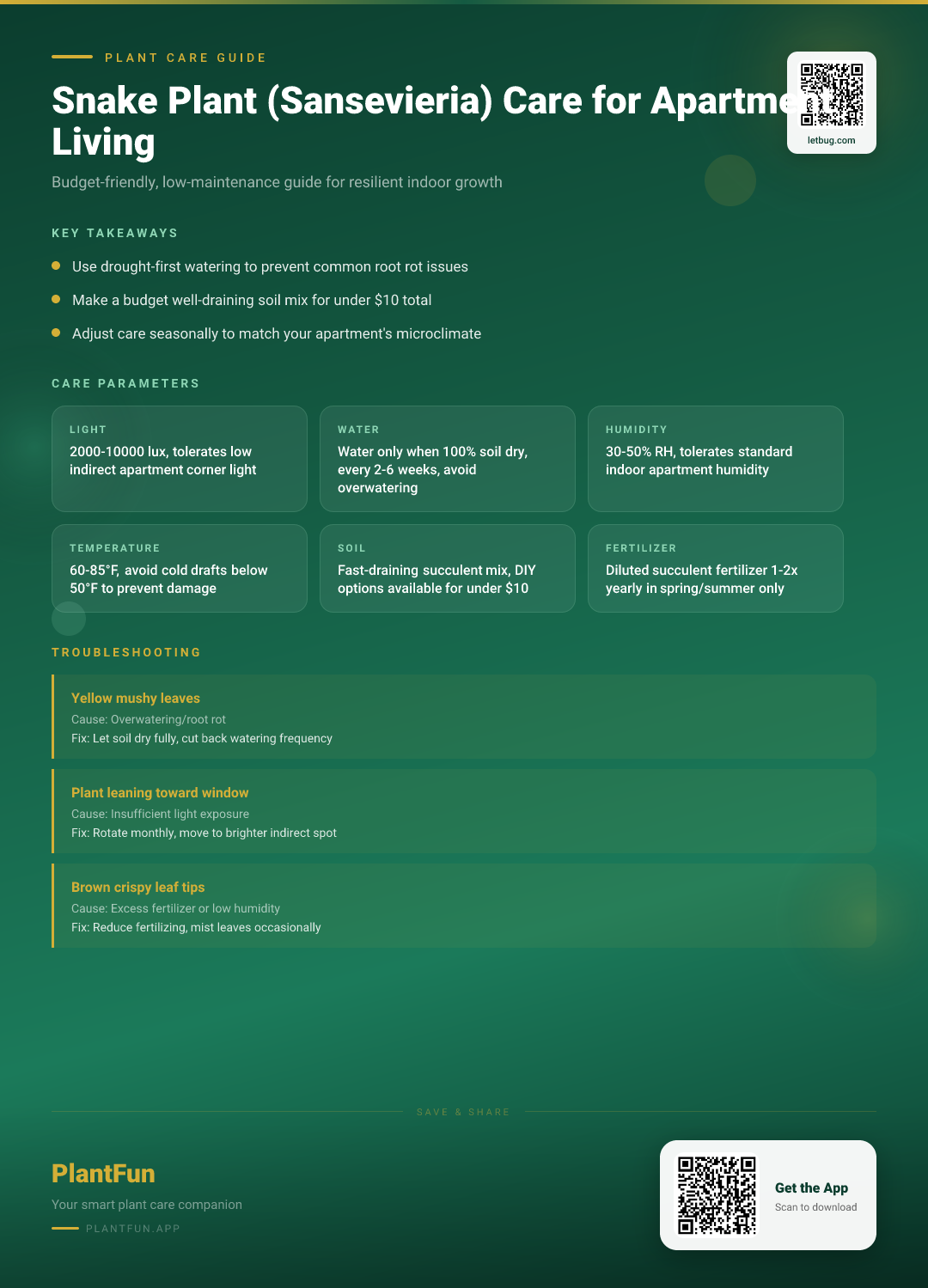
Key Takeaways
- Check soil moisture before watering — overwatering is the #1 killer of houseplants.
- Ensure your plant gets the right amount of light for its species.
- Be patient with recovery — most plants need 2–4 weeks to bounce back.
TL;DR: The Apartment Sansevieria Protocol
Snake plants are not “indestructible” objects; they are CAM-photosynthesizing organisms that require specific conditions to thrive. To succeed in an apartment: provide bright, indirect light, use a fast-draining succulent soil mix, and wait until the soil is 100% dry before deep watering. Never let the plant sit in standing water. When I first started growing Sansevieria in my tiny urban studio, I made the mistake of keeping it in a dark corner and watering on a rigid weekly schedule, which led to premature rot. This guide fixes those common pitfalls.
Quick Care Card: Essential Thresholds for Apartment Success
| Feature | Requirement |
|---|---|
| Light | 2,000–10,000 Lux (Bright, indirect) |
| Water | Only when soil is 100% dry |
| Humidity | Low to moderate (30-50%) |
| Temperature | 60°F–85°F (15°C–29°C) |
| Soil | Well-draining, coarse mix |
| Fertilizer | Balanced 10-10-10, diluted, monthly (Spring/Summer) |
| Toxicity | Toxic to pets (ASPCA, 2026) |
Why Your Apartment’s Microclimate Matters for Sansevieria
Most apartment dwellers treat the Snake Plant (Sansevieria/Dracaena trifasciata) as a low-light decorative piece. However, in my experience, the microclimate of your living room—specifically airflow and ambient heat—dictates how fast the plant processes water. Modern apartments often feature HVAC systems that create artificial temperature swings, which can stress the plant. Unlike plants in a greenhouse, your indoor plants rely on your intervention to mimic their native arid environments (NC State Extension, 2026).
Light Requirements: Managing 2,000-10,000 Lux in Typical Apartment Corners
Many hobbyists think these are “low light” plants, but that is a myth. While they survive in low light, they do not thrive. To achieve structural integrity and prevent drooping, aim for 2,000 to 10,000 lux. In practical terms, this means placing your plant within 3-5 feet of an east-facing window. If your plant is leaning, it is a biological response to seek more photons; rotate the pot every time you water to ensure even growth.
Watering Mastery: Why the ‘Drought-First’ Strategy Prevents Root Rot
Watering frequency is the most common point of failure. My golden rule: treat your finger like a moisture probe. Before adding even a drop of water, stick your finger two inches into the soil. If you feel any dampness, wait. Overwatering is the primary driver of root rot, a condition often exacerbated by poor drainage and limited light (Ravindran & Thomas, 2025). When it is time, soak the soil completely until water runs out the bottom, then discard that excess immediately.
Budget-Friendly Soil Hacks: Creating the Perfect Drainage Mix for Under $10
You do not need expensive boutique potting mixes. For a resilient plant, I create my own “apartment-proof” mix using standard cactus/succulent potting soil and perlite.
- The Formula: 70% cactus mix to 30% perlite.
- The Benefit: The perlite increases soil porosity, allowing oxygen to reach the roots, which is crucial for preventing the hypoxic conditions that favor rot (Halawa & Aisuwarya, 2023).
Step-by-Step Care Calendar: Adjusting for Seasonal Indoor Shifts
- Spring: Growth initiates. Increase light and apply a balanced, water-soluble fertilizer at half-strength once per month.
- Summer: The peak growth phase. Monitor for faster drying times. Keep the plant away from direct harsh sun that might bleach the leaves.
- Autumn: Growth slows. Reduce watering frequency by half as the plant enters dormancy.
- Winter: Snake plant winter care is all about patience. Your plant will use very little water. Let it go bone-dry for weeks at a time to prevent fungal pathogens.
FAQ: Why is my Snake Plant leaning toward the window?
This is a classic case of phototropism. The plant is elongating its cells on the shaded side to “reach” for light. Simply rotate the pot 180 degrees every time you water. If it remains dangerously limp, move it closer to your light source.
FAQ: How do I know if I’m watering my Snake Plant too much?
Look for yellowing at the leaf base or a “mushy” texture near the soil line. These are primary snake plant root rot symptoms. If you notice a foul odor, the roots are likely already compromised (Ravindran & Thomas, 2025).
Common Mistakes: The Top 3 Reasons Most Apartment Snake Plants Fail
- Mistake: Using a decorative pot without drainage holes. What happens: Water pools at the bottom, rotting the root crown. Instead: Use a plastic nursery pot inside a decorative cachepot.
- Mistake: Watering on a calendar date (e.g., “every Monday”). What happens: You ignore the plant’s actual moisture needs, leading to overwatering. Instead: Only water when the soil is 100% dry throughout the container.
- Mistake: Wiping leaves with heavy oils. What happens: This clogs the stomata, preventing gas exchange. Instead: Use a damp microfiber cloth to gently remove dust.
Troubleshooting Guide: Identifying Chlorosis vs. Physical Damage
Chlorosis (Yellowing Leaves)
Symptom: Leaves turn pale yellow, often starting from the edges or base.
Likely cause: Nitrogen deficiency or chronic overwatering leading to root failure.
Fix:
- Check roots for brown/mushy rot.
- If roots are healthy, apply a balanced, dilute fertilizer.
Mechanical Damage (Brown Scars)
Symptom: Rigid brown or dry spots on leaves.
Likely cause: Physical injury or sunscorch.
Fix:
- Assess the plant’s location for high-traffic areas.
- If in direct sun, move the plant back 1 foot.
Wrinkled, Puckered Leaves
Symptom: Leaves look thin or shriveled.
Likely cause: Severe underwatering.
Fix:
- Perform a deep soak, ensuring all soil is saturated.
- Resume a more consistent (but still dry-first) schedule.
Advanced Care: When and How to Fertilize for Optimal Leaf Vigor
To make your snake plant grow faster, you need to align fertilization with its natural growth cycle. Use a balanced 10-10-10 fertilizer, but dilute it to 25% of the recommended strength. I only fertilize during the peak light months (May through August). Over-fertilizing during low-light winter months causes weak, etiolated (stretched and thin) growth that is prone to collapse.
References and Botanical Sources
- Halawa, H.; Aisuwarya, R. (2023). Smart Plant Pot Robot with IoT Integration for Indoor Ornamental Plants Care. JITCE (Journal of Information Technology and Computer Engineering). https://doi.org/10.25077/jitce.7.2.97-106.2023. Accessed 2026-03-18.
- Ravindran, A.; Thomas, P. (2025). Flora Care: A Smart AI-Based System for Plant Disease Diagnosis and Plant Growth Identification. International Journal of Science and Research (IJSR). https://doi.org/10.21275/mr25425182032. Accessed 2026-03-18.
- ASPCA. (2026). Toxic and Non-Toxic Plants List — ASPCA. https://www.aspca.org/pet-care/animal-poison-control/toxic-and-non-toxic-plants. Accessed 2026-03-18.
- NC State Extension. (2026). Snake Plant Care — NC State Extension Gardener Plant Toolbox. https://plants.ces.ncsu.edu/plants/snake-plant/. Accessed 2026-03-18.
Optional Helper: Plantfun.App
Plantfun.App identifies your plants by photo, diagnoses pests and diseases with clear fixes, and creates personalised watering and light schedules that adapt to your home conditions — a handy companion for putting this guide into daily practice.
Found an error or have suggestions? We'd love your feedback.
Need help identifying this problem?
Get instant identification, personalized care schedules, and effective pest treatment plans directly on your phone.
Sponsored • We may earn a commission from app downloads
Related Guides
The Complete Snake Plant Care Checklist for Small Urban Apartments: No-Fuss Resilient Growth
Skip generic snake plant care tips. Grab our free budget-friendly 7-point checklist, exact light, water, and soil specs to grow a hardy, resilient snake plant in your small urban apartment.
Care GuideSnake Plant Care in Apartments: The Ultimate Guide to Thriving in Low-Light Corners
Master your Snake Plant care in any apartment. Discover exact light-to-water ratios, 4 essential growth thresholds, and a layout plan for small-space success.
Care GuideSnake Plant Care for Apartment Living: A Resilient Growth Guide for Low-Light Homes
Master your Snake Plant care with 4 proven benchmarks. Learn exact light levels, watering schedules, and soil hacks to keep your foliage vibrant in any apartment.
Pest ControlAnts on Plants: What They Mean and What to Do
Ants usually aren't eating your plant. They are farming other pests.