
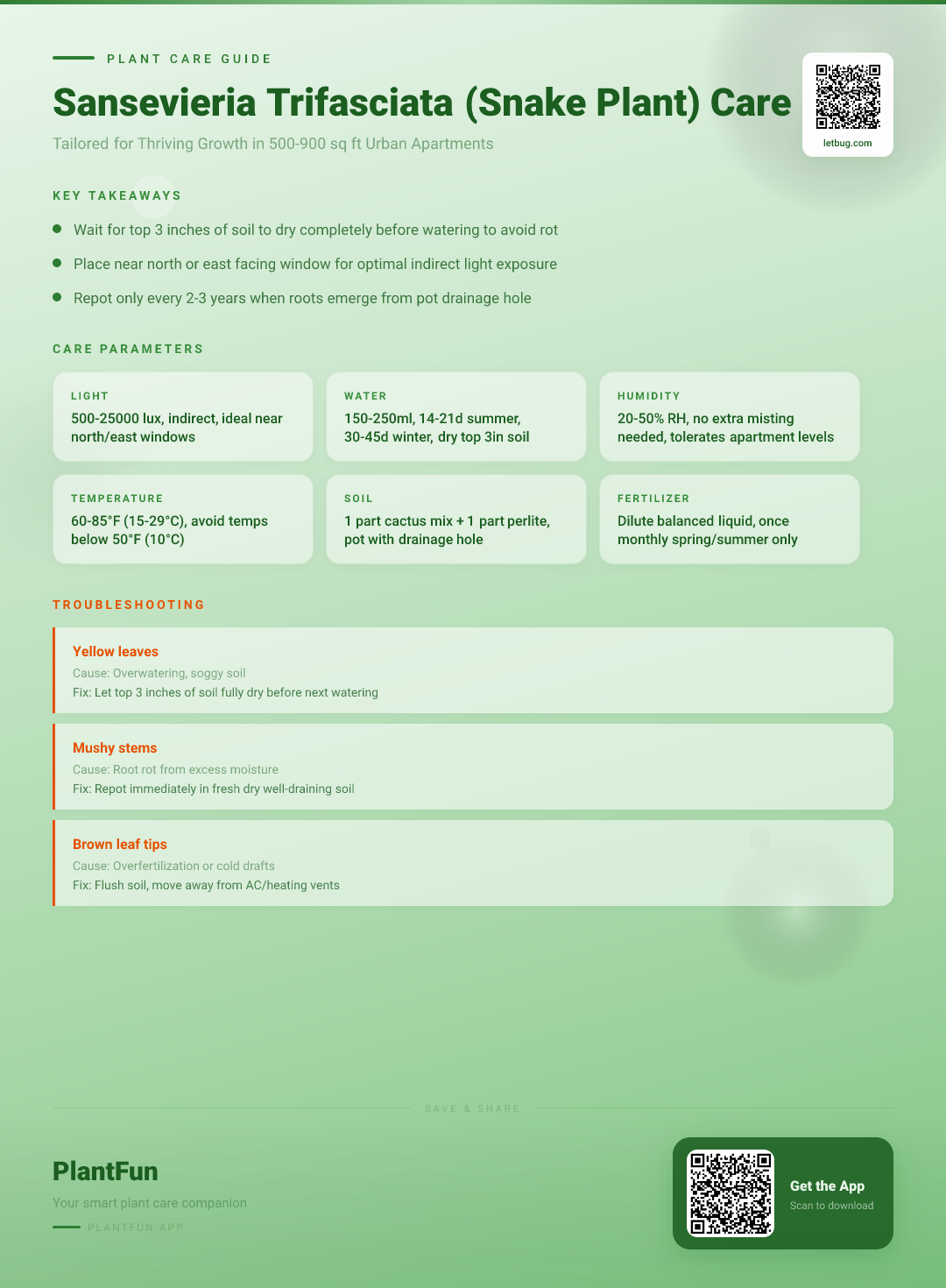
Key Takeaways
- Check soil moisture before watering — overwatering is the #1 killer of houseplants.
- Ensure your plant gets the right amount of light for its species.
- Be patient with recovery — most plants need 2–4 weeks to bounce back.
Quick Care Card
Below is your printable, at-a-glance cheat sheet of all core measurable care thresholds for busy apartment dwellers:
| Parameter | Measurable Threshold |
|---|---|
| Light | 500-25,000 lux (NC State Extension, 2026) |
| Water | 150-250ml only when top 3 inches of soil are fully dry |
| Humidity | 20-50% RH (no misting required) |
| Temperature | 60-85°F (15-29°C), minimum 50°F (10°C) (NC State Extension, 2026) |
| Soil | 1 part cactus mix + 1 part perlite, well-draining |
| Fertilizer | ¼ strength succulent fertilizer once per spring, only if actively growing |
| Toxicity | Toxic to cats, dogs, and horses if ingested (ASPCA, 2026) |
Why This Guide Is Different
Most generic snake plant care guides assume you have full sun access, consistent free time, and unlimited space — none of which are true for most 500-900 sq ft urban apartment dwellers. This guide uses a diagnosis-first framing: you’ll first assess your plant’s current health to prioritize fixes, rather than following one-size-fits-all steps that don’t account for common apartment pain points like low light, irregular work schedules, drafty HVAC vents, and limited counter space. All guidance is grounded in horticultural research, with no vague advice like “water when the soil feels dry” — every threshold has a measurable number to eliminate guesswork for snake plant care for beginners and intermediate owners alike.
Sansevieria trifasciata’s natural tolerance for harsh, low-water conditions makes it perfectly suited for apartment life, per research on its native arid West African adaptations (International Journal of Agriculture and Biosciences, 2025). Its thick, waxy leaf cuticle reduces moisture loss even in dry, heated indoor spaces (Fitria et al., 2024), so it’s far more forgiving than most houseplants.
First: Diagnose Your Snake Plant’s Current Health
Spend 2 minutes doing this visual check first to prioritize your care steps, no fancy tools required:
- Inspect all leaves: Are any pale, yellow, or squishy?
- Gently squeeze the base of 2-3 stems: Are they soft or mushy?
- Check leaf tips: Are they brown and crispy?
- Note new growth: Have no new leaves emerged in the past 6 months?
If you find any of these symptoms, address the corresponding fix first (see the Troubleshooting section later) before adjusting routine care.
Key Care Threshold 1: Light Requirements
Snake plant light requirements indoor fall in a wide, forgiving range of 500-25,000 lux (NC State Extension, 2026). That’s 10x lower than the minimum light needed for most succulents, making it ideal for dim apartment spaces.
- Ideal placement: 1-3ft from a north or east-facing window, where it gets bright indirect light with no harsh midday sun.
- Dark corner adjustment: If you’re wondering “can I keep a snake plant in a dark apartment,” the answer is yes! Supplement with a 10W full-spectrum grow light run 12 hours per day to hit the 500 lux minimum. It won’t grow as fast as it would in brighter light, but it will stay healthy.
- Avoid: Direct midday sun from west or south-facing windows, which can scorch leaves and cause brown patches.
Key Care Threshold 2: Watering Schedule
Myth: Snake plants need weekly waterings. Reality: Overwatering is the #1 killer of snake plants in apartments, so this measurable guide eliminates guesswork for how often to water snake plant in apartment:
- Give 150-250ml of room temperature water only when the top 3 inches of soil are fully dry (do the 2-second finger test: poke your index finger 3 inches into the soil, if any moisture sticks to your finger, wait to water).
- Snake plant summer watering schedule: Every 14-21 days, when soil dries out faster due to warmer temps and more light.
- Winter schedule: Every 30-45 days, when growth slows and light levels drop. This is a core rule for snake plant winter care apartment success.
Key Care Threshold 3: Temperature & Humidity
Snake plant temperature tolerance indoor is also extremely forgiving for standard apartment conditions:
- Ideal range: 60-85°F (15-29°C) (NC State Extension, 2026)
- Never expose to temperatures below 50°F (10°C), which can cause permanent leaf damage.
- Humidity: Tolerates 20-50% RH, the standard range for heated and cooled apartments. No extra misting is required, making it perfect for busy owners who forget regular humidity adjustments.
Key Care Threshold 4: Soil & Potting
The best soil for snake plant indoor is a fast-draining blend that mimics its native rocky, arid soil:
- Soil mix: 1 part cactus potting mix + 1 part perlite, to ensure excess water drains quickly and prevents root rot.
- Pot requirement: Must have at least 1 drainage hole to let excess water escape.
- Repotting rule: Only repot every 2-3 years, when you see roots emerging from the drainage hole. Snake plants prefer being root bound, and repotting too often causes stress. If you’re wondering how to make snake plant grow faster, repotting only when root bound and giving adequate light is far more effective than frequent repotting.
Step-by-Step Weekly/Monthly Care Checklist
This snake plant care checklist printable takes less than 15 minutes total per month to maintain resilient growth:
Weekly (2-minute check)
- Scan for yellow or brown leaves to catch issues early
- Do the 3-inch finger test to check soil dryness (no need to water if still damp)
- Ensure the plant is not blocked by furniture from its light source
Monthly (10-minute task)
- Wipe leaves with a damp microfiber cloth to remove dust, which improves light absorption
- If soil is fully dry, give 150-250ml of room temperature water
- Check the drainage hole for emerging roots to see if repotting is needed soon
- Rotate the pot ¼ turn to encourage even, straight growth
Apartment-Specific Seasonal Care Calendar
Adjust your routine based on common indoor apartment seasonal changes:
- Spring (Mar-May): Active growth period. Shift to the 14-21 day watering schedule, and apply ¼ strength succulent fertilizer once in April if you want faster growth.
- Summer (Jun-Aug): Keep the plant 3ft away from AC vents to avoid draft stress. Move 2ft back from west/south windows if midday sun hits the leaves directly.
- Fall (Sep-Nov): Gradually extend time between waterings as light levels drop. Move away from drafty window sills if nighttime temps drop below 50°F.
- Winter (Dec-Feb): Stick to the 30-45 day watering schedule, keep 3ft away from heating vents to avoid brown tips, and add 2 extra hours of grow light per day if your apartment gets very dim.
Common Apartment-Specific Mistakes to Avoid
- Mistake: Placing within 1ft of forced air HVAC vents (heating or AC) What happens: Rapid moisture loss from leaves leading to brown tips, or temperature stress that stunts growth. Instead: Keep your snake plant at least 3ft away from all vents, or use a small draft blocker if placement is limited.
- Mistake: Overwatering during busy work weeks by sticking to a rigid calendar instead of checking soil dryness What happens: Root rot, which causes yellow leaves and mushy stems, the #1 killer of snake plants in apartments. Instead: Do the 2-second finger test before watering, even if your calendar says it’s time.
- Mistake: Using decorative pots without drainage holes for aesthetic reasons What happens: Excess water pools at the bottom of the pot, leading to root rot even if you water the correct amount. Instead: Keep your snake plant in its nursery pot with drainage, and slip it inside the decorative pot, removing it to drain excess water after every watering.
- Mistake: Repotting every year to “give it more space” What happens: Disturbs the root system, causes stress, and excess soil holds extra moisture leading to rot. Snake plants prefer being root bound. Instead: Only repot every 2-3 years, when you see roots emerging from the drainage hole, and only size up 1-2 inches in pot diameter.
Voice Search FAQ
Answers to the most common conversational questions apartment dwellers ask their smart assistants about snake plant care:
- Can I keep a snake plant in a dark apartment with no windows? Yes! As long as you supplement with a 10W full-spectrum grow light run for 12 hours per day, you can hit the 500 lux minimum light requirement it needs to survive. It won’t grow as fast as it would in brighter light, but it will stay healthy.
- How often to water snake plant in apartment? The exact frequency depends on season and light, but generally every 14-21 days in summer, and 30-45 days in winter. Always test that the top 3 inches of soil are fully dry before watering to avoid overwatering.
- Why is my snake plant turning yellow? 90% of the time, yellow snake plant leaves are caused by overwatering leading to root rot. Check the soil moisture immediately, and if it’s soggy, hold off on watering until it’s fully dry. If the stem is mushy, you may need to repot into fresh, dry soil.
- Are snake plants safe for my cat and dog? No, Sansevieria trifasciata is toxic to cats, dogs, and horses if ingested, causing vomiting and diarrhea (ASPCA, 2026). Keep it on a high shelf or out of reach of curious pets.
Troubleshooting Quick Fixes
1-minute solutions for the 3 most common snake plant issues in apartments:
Yellow Leaves
Symptom: Pale, squishy yellow leaves, often starting at the base of the plant.
Likely cause: Overwatering leading to early root rot, the most common issue for snake plants in apartments.
Fix:
- Poke 3 inches into the soil; if soggy, stop watering immediately and let the entire pot dry out completely for 2-3 weeks.
- If multiple leaves are yellow, remove the plant from its pot, cut off any mushy brown roots, and repot into fresh, dry cactus mix + perlite blend.
Brown Tips
Symptom: Dry, crispy brown tips on the ends of otherwise healthy green leaves.
Likely cause: Exposure to drafty HVAC vents, or occasional overfertilization leading to salt buildup in soil (one of the top snake plant brown tips causes).
Fix:
- Move the plant at least 3ft away from all heating or AC vents, and avoid placing it directly next to drafty window sills in winter.
- Flush the soil with 3x the pot volume of room temperature water once every 6 months to remove excess salt buildup.
Mushy Stems
Symptom: Soft, squishy stems that fall over easily, often with a foul odor coming from the soil.
Likely cause: Advanced root rot from prolonged overwatering, often caused by using pots without drainage holes.
Fix:
- Remove the plant from its pot immediately, cut away all mushy stems and brown, rotting roots with clean, sterilized shears.
- Repot the remaining healthy root and leaf sections into fresh, dry well-draining soil in a pot with at least one drainage hole, and do not water for 4 weeks after repotting.
References
- NC State Extension. (2026). Sansevieria Trifasciata (Snake — NC State Extension Gardener Plant Toolbox. https://plants.ces.ncsu.edu/plants/sansevieria-trifasciata/. Accessed 2026-02-24.
- ASPCA. (2026). Toxic and Non-Toxic Plants List — ASPCA. https://www.aspca.org/pet-care/animal-poison-control/toxic-and-non-toxic-plants. Accessed 2026-02-24.
- International Journal of Agriculture and Biosciences. (2025). Evaluation of Snake Plant (Sansevieria trifasciata) Extracts as Lead Biosorbents: Maceration vs Microwave-Assisted Extraction. International Journal of Agriculture and Biosciences. https://doi.org/10.47278/journal.ijab/2025.079. Accessed 2026-02-24.
- Fitria, L.; Gunawan, I.; Sanjaya, W. (2024). Safety Evaluation of Snake Plant (Sansevieria trifasciata) Leaves Extract as Potential Herbal Medicine. Jurnal Biota. https://doi.org/10.19109/biota.v10i2.20109. Accessed 2026-02-24.
Optional Helper: Plantfun.App
Plantfun.App identifies your plants by photo, diagnoses pests and diseases with clear fixes, and creates personalised watering and light schedules that adapt to your home conditions — a handy companion for putting this guide into daily practice.
Found an error or have suggestions? We'd love your feedback.
Need help identifying this problem?
Get instant identification, personalized care schedules, and effective pest treatment plans directly on your phone.
Sponsored • We may earn a commission from app downloads
Related Guides
The Complete Snake Plant Care Checklist for Resilient Growth in Typical Apartments
Stop guessing at snake plant care for your typical apartment. Get 8 actionable checklist steps, measurable care thresholds, and a seasonal schedule to keep your plant thriving for decades.
Care GuideThe Complete Snake Plant Care Guide for North-Facing Studio Apartments: Resilient Growth Checklist
Grow a lush snake plant even in your dark north-facing studio. Get exact light levels, watering amounts, and a seasonal checklist to avoid root rot and encourage resilient, fast growth.
Care GuideThe Budget-Friendly Sansevieria (Snake Plant) Care Checklist for Low-Effort Resilient Apartment Growth
Grow lush, unkillable snake plants in your apartment on a $5 monthly budget. Get exact light levels, watering schedules, and a free printable checklist to avoid common beginner mistakes.
Pest ControlAnts on Plants: What They Mean and What to Do
Ants usually aren't eating your plant. They are farming other pests.