
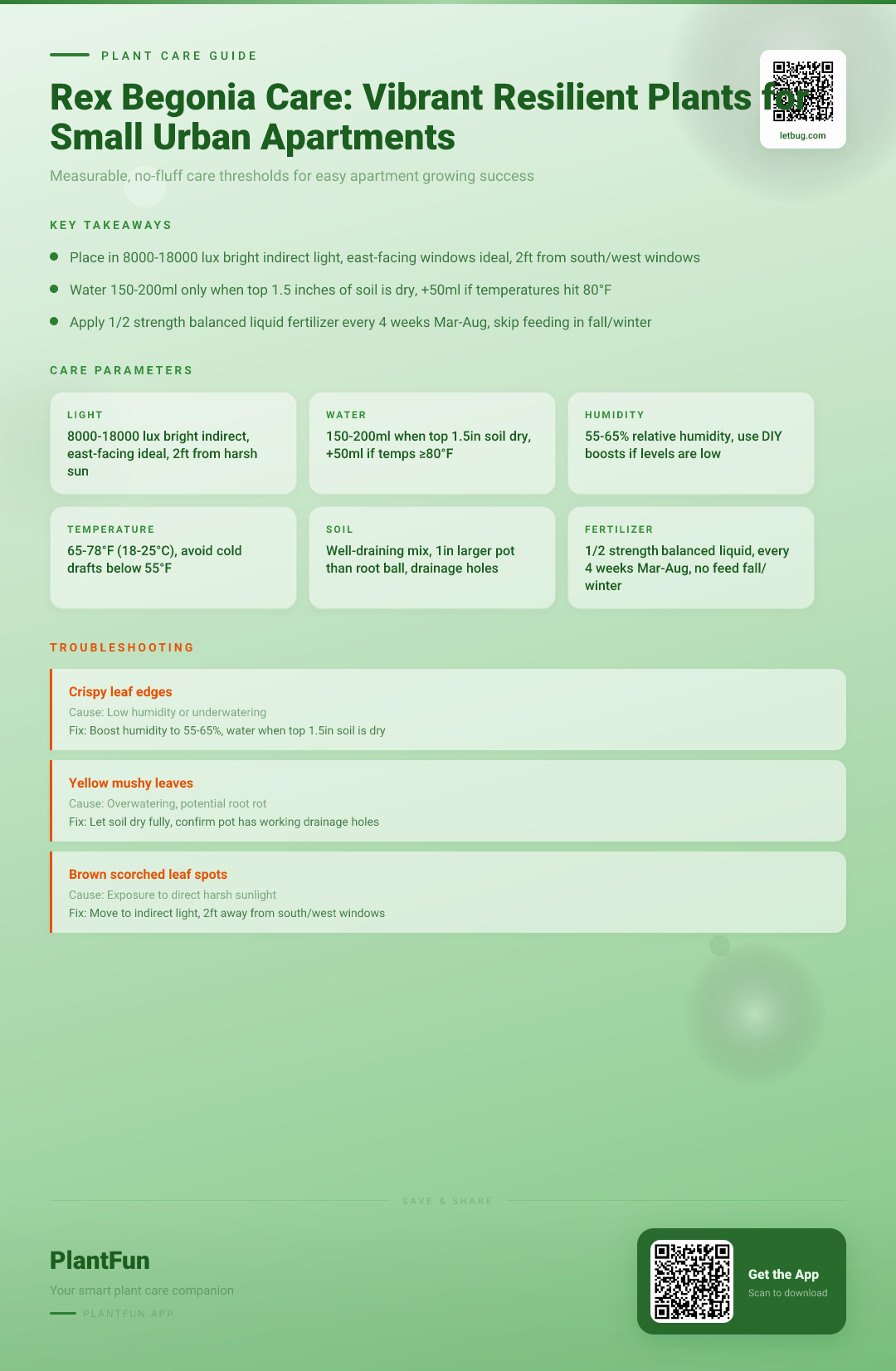
Key Takeaways
- Check soil moisture before watering — overwatering is the #1 killer of houseplants.
- Ensure your plant gets the right amount of light for its species.
- Be patient with recovery — most plants need 2–4 weeks to bounce back.
Quick Care Card
| Care Parameter | Exact Threshold for Small Apartments |
|---|---|
| Light | 8,000–18,000 lux bright indirect light |
| Water | 150–200ml only when top 1.5 inches of soil is dry |
| Humidity | 55–65% relative humidity |
| Temperature | 65–78°F (18–25°C) |
| Soil | 3 parts potting mix + 1 part perlite + 1 part fine orchid bark |
| Fertilizer | 1/2 strength balanced liquid fertilizer every 4 weeks (March–August only) |
| Toxicity | Toxic to cats, dogs, and humans if ingested (ASPCA, 2026) |
Why Rex Begonias Thrive (or Fail) in Typical Urban Apartments
Rex begonias are native to subtropical understory habitats, where they receive dappled light, consistent warm temperatures, and moderate humidity. These traits make them surprisingly well-suited to 500–800 sq ft urban apartments, where direct full sun is rare and counter space is limited. The biggest points of conflict are standard apartment stressors: dry forced air in winter, variable light blocked by adjacent buildings, and limited airflow that increases root rot risk.
Myth vs Reality: Myth: Rex begonias require greenhouse conditions to grow indoors. Reality: They adapt extremely well to apartment settings if you hit their core measurable thresholds, no specialty equipment required. A quick pre-placement test: Hold your palm up at your intended plant spot at midday. A soft, diffused shadow means light levels are ideal to start; a sharp dark shadow means too much direct sun, and no shadow means you’ll need supplemental light.
Step 1: Light Placement for Consistent, Even Growth
Rex begonia light needs fall exactly between 8,000–18,000 lux of bright indirect light (Latifah et al, 2024). Follow these placement rules for small apartments:
- Ideal spot: 1ft away from an east-facing window, which delivers gentle morning sun with no harsh afternoon rays that cause scorch.
- South/west windows: Place 2ft away from the glass, and hang a sheer curtain to filter midday sun to avoid leaf burn.
- North-facing windows: Most north-facing spots only deliver 2,000–6,000 lux, which is too low for consistent growth. Add a 10W full-spectrum grow light 12 inches above the plant, run for 10 hours a day during the growing season to hit the required lux range.
Step 2: Exact Watering Routine to Avoid Root Rot & Crispy Edges
Wondering how often to water rex begonia? Follow this science-backed rule: Apply 150–200ml of room-temperature water only when the top 1.5 inches of soil is completely dry (Osborne, 1987).
Quick soil moisture test: Stick your index finger 1.5 inches into the soil. If no moisture sticks to your finger, it’s time to water. If any dampness remains, wait 2–3 days and test again. Always drain excess water from the saucer under the pot after 10 minutes, never let roots sit in standing water.
Winter adjustment: If your apartment stays below 68°F in cold months, cut water volume by 30% to avoid overwatering, which is the top cause of root rot in cool, low-light apartment conditions. If you do spot mushy stems or yellow wilting leaves, follow our overwatered rex begonia fix steps in the common mistakes section below.
Step 3: Humidity & Temperature Settings for Lush Leaf Growth
Rex begonia humidity requirements are 55–65% relative humidity, paired with a consistent 65–78°F (18–25°C) temperature range (Latifah et al, 2024). You don’t need an expensive humidifier to hit these thresholds in dry apartments: Try these cheap DIY hacks:
- Pebble tray: Fill a shallow tray with pebbles and water, set the pot on top of the pebbles (make sure the pot base is not sitting directly in water to avoid root rot).
- Group your begonia with 2–3 other houseplants to create a shared humid microclimate.
- Mist the leaves 2x a week with distilled or left-out tap water.
Avoid placing your plant within 3ft of heating vents, air conditioning units, or drafty windows, as sudden temperature swings cause leaf drop and crispy edges.
Step 4: Soil & Potting Requirements for Resilient Root Systems
The best rex begonia soil mix for apartments is a fast-draining blend of 3 parts general-purpose potting mix, 1 part perlite, and 1 part fine orchid bark (Osborne, 1987). This blend retains just enough moisture without staying soggy, which is critical for small apartments with limited airflow.
Pot rules: Always choose a pot that is only 1 inch larger than the current root ball, with mandatory drainage holes. If your apartment is very dry, use a plastic or glazed ceramic pot to retain moisture longer; terracotta is fine if you remember to check soil moisture more frequently.
Step 5: Fertilizing Routine for Steady, Colorful Growth
To support bright, vibrant leaf color without causing salt buildup or leaf burn, follow this exact schedule: Apply 1/2 strength balanced (10-10-10 NPK) liquid fertilizer once every 4 weeks from March to August (Latifah et al, 2024). Stop all fertilizing from September to February, when your plant enters dormancy and does not need extra nutrients.
Seasonal Care Calendar for Year-Round Health
Adjust your routine month-by-month to match changing apartment conditions:
- March: Resume fertilizing, move plant back to its summer spot if you relocated it away from windows in winter.
- June–August (summer): For rex begonia summer watering, increase volume by 50ml when indoor temperatures hit 80°F, mist leaves more frequently if humidity drops below 50%.
- September: Stop all fertilizing, start reducing water volume by 10% each week as days get shorter.
- December–February (winter): For rex begonia winter care, cut watering volume in half, move the plant at least 3ft away from heating vents, avoid placing near drafty window sills.
The 7 Most Common Rex Begonia Apartment Care Mistakes (And Fast Fixes)
- Mistake: Placing within 1ft of a heating vent in winter. What happens: Crispy leaf edges, wilting even with regular watering. Instead: Move 3ft away immediately, set up a pebble tray under the pot to boost local humidity within 24 hours.
- Mistake: Using unfiltered tap water with high fluoride or chlorine. What happens: Brown leaf tips, stunted growth. Instead: Switch to distilled, rain, or tap water left out for 24 hours to off-gas chlorine for all future waterings, trim brown tips with clean scissors.
- Mistake: Overfertilizing, especially in winter. What happens: Salt buildup in soil, leaf scorch, root damage. Instead: Flush soil with 3x the pot volume of water to remove salt buildup, skip fertilizing for 8 weeks.
- Mistake: Potting in a pot more than 2 inches larger than the root ball. What happens: Excess soil holds too much moisture, leading to root rot (Osborne, 1987). Instead: Repot into a properly sized pot with drainage holes, use the recommended well-draining soil mix.
- Mistake: Placing in direct unfiltered south/west sun for more than 1 hour a day. What happens: Scorched brown spots on leaves, faded leaf color. Instead: Move 2ft back from the window or add a sheer curtain, trim severely damaged leaves to encourage new growth.
- Mistake: Watering on a fixed schedule instead of checking soil moisture. What happens: Over or underwatering, crispy leaves or root rot. Instead: Do the 1.5-inch finger soil test every 3 days to decide when to water.
- Mistake: Ignoring low humidity in winter. What happens: Crispy leaf edges, leaf drop. Instead: Group your begonia with 2-3 other plants to create a microclimate, use a pebble tray if you don’t have a humidifier.
FAQ: Can I keep my rex begonia in my north-facing apartment bedroom?
Absolutely, as long as you supplement light if natural levels are below 8,000 lux. Most north-facing apartment windows only deliver 2,000–6,000 lux, which is too low for consistent growth, answering the common question of can rex begonias grow in low light apartments. Add a 10W full-spectrum grow light 12 inches above the plant, run it 10 hours a day during the growing season, and you’ll see healthy new leaves form within 2–3 weeks.
FAQ: Why is my rex begonia getting brown crispy edges even when I water it regularly?
This is the most common complaint for apartment-grown rex begonias, and it has two primary causes. First, check your humidity levels: if relative humidity is below 50%, dry air is pulling moisture out of leaf edges faster than roots can replace it. Second, your tap water may have high levels of fluoride or chlorine, which build up in soil and burn leaf tips. First, test your humidity with a cheap hygrometer—if it’s below 55%, set up a pebble tray immediately. If humidity is fine, switch to distilled or left-out tap water for future waterings for a fast rex begonia leaf crispy edges fix.
FAQ: How often should I fertilize my rex begonia in a small apartment?
During the active growing season (March to August), fertilize once every 4 weeks with 1/2 strength balanced liquid fertilizer. Skip all fertilizing from September to February, when your plant is dormant, to avoid salt buildup and leaf burn. Never apply fertilizer to dry soil, as this can burn fine root hairs.
Final Quick Routine Check-In: 60-Second Weekly Checklist
Spend 1 minute a week on these steps to keep your rex begonia thriving, no special tools required:
- Stick your finger 1.5 inches into soil: Water 150–200ml if dry, skip if moist.
- Scan leaf edges for browning: Adjust humidity or water source if you spot crispness.
- Confirm the plant is not directly in front of a heating/cooling vent or drafty window.
- Rotate the pot 1/4 turn to encourage even growth on all sides.
References
- ASPCA. (2026). Toxic and Non-Toxic Plants List — ASPCA. https://www.aspca.org/pet-care/animal-poison-control/toxic-and-non-toxic-plants. Accessed 2026-02-25.
- Osborne, L. (1987). Effects of Chlorpyrifos and Pythium splendens on Growth of Rex Begonia. Plant Disease. https://doi.org/10.1094/pd-71-0525. Accessed 2026-02-25.
- Latifah, Z.; Wurjani, W.; Sutini, S. (2024). Impact of cutting types and commercial plant growth regulators on the propagation of red star begonia (Begonia rex-cultorum). Jurnal Ilmiah Pertanian. https://doi.org/10.31849/jip.v21i2.19126. Accessed 2026-02-25.
Optional Helper: Plantfun.App
Plantfun.App identifies your plants by photo, diagnoses pests and diseases with clear fixes, and creates personalised watering and light schedules that adapt to your home conditions — a handy companion for putting this guide into daily practice.
Found an error or have suggestions? We'd love your feedback.
Need help identifying this problem?
Get instant identification, personalized care schedules, and effective pest treatment plans directly on your phone.
Sponsored • We may earn a commission from app downloads
Related Guides
Rex Begonia Care Checklist for East-Facing Apartments: Grow Lush, Crisp Leaves Year-Round
Stop dealing with crispy Rex Begonia edges in your apartment. Get our 10-point checklist, exact light, water, and humidity parameters to grow lush, vibrant foliage year-round.
Care GuideRex Begonia Care Checklist: Seasonal Routines for Resilient Growth in Typical Apartments
Grow lush, colorful rex begonia leaves without a fancy greenhouse. Get a seasonal checklist, exact light, water, and humidity thresholds for resilient growth in your apartment.
Care GuideRex Begonia Care Checklist for 500 Sq Ft Apartments: Grow Vibrant, Resilient Foliage
Grow lush, colorful Rex Begonia foliage even in a tiny 500 sq ft studio apartment. Get exact light levels, watering amounts, and space-saving hacks to keep your plant thriving year-round.
Pest ControlAnts on Plants: What They Mean and What to Do
Ants usually aren't eating your plant. They are farming other pests.