
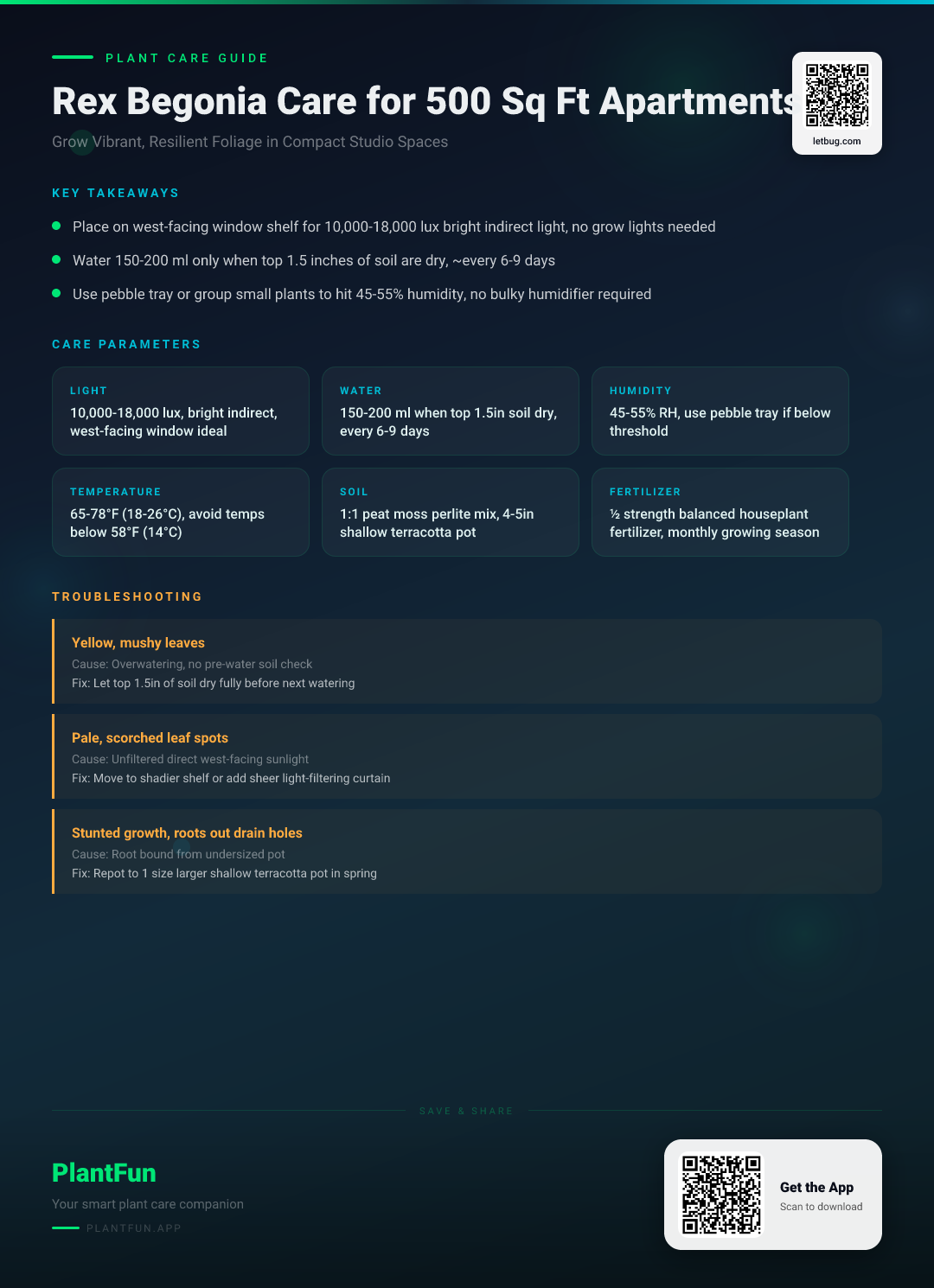
Key Takeaways
- Check soil moisture before watering — overwatering is the #1 killer of houseplants.
- Ensure your plant gets the right amount of light for its species.
- Be patient with recovery — most plants need 2–4 weeks to bounce back.
Quick Care Card: At-a-glance reference for all key measurable Rex Begonia care thresholds tailored to 500 sq ft studio apartments
| Care Parameter | Exact Threshold for 500 Sq Ft Studios |
|---|---|
| Light | 10,000–18,000 lux bright indirect (west-facing window preferred) |
| Water | 150–200 ml only when top 1.5 inches of soil are dry (every 6–9 days on average) |
| Humidity | 45–55% relative humidity |
| Temperature | 65–78°F (18–26°C), no lower than 58°F (14°C) |
| Soil | 1:1 peat moss to perlite mix, well-draining |
| Fertilizer | Diluted 10-10-10 liquid fertilizer once monthly in spring and summer |
| Toxicity | Toxic to cats and dogs (ASPCA, 2026) |
Why Rex Begonias Are Perfect for Small Apartments
Rex Begonias are made for compact urban living: they only grow 12–18 inches tall and wide, so they never outgrow small surfaces, and they tolerate the fluctuating light, temperature, and humidity levels common in shared studio spaces (NC State Extension, 2026). Their vibrant, patterned foliage adds a pop of color without taking up the floor space required for larger plants like fiddle-leaf figs. If you’re new to caring for foliage plants, check our beginner’s guide to indoor plant care for foundational tips to set you up for success. According to the ASPCA (2026), Rex Begonias are toxic to cats and dogs, so place them out of reach of furry roommates if you share your space.
Step 1: Light Placement Hacks for West-Facing Studio Windows
Rex Begonias need 10,000–18,000 lux of bright indirect light to maintain their colorful foliage, and west-facing studio windows are perfect for this (NC State Extension, 2026). No bulky grow light stands required: mount a narrow 4-inch floating shelf 2–3 feet back from your west window to hold the plant, so it avoids harsh unfiltered mid-afternoon sun that causes burn. Quick test: Hold your hand at plant height at 3 PM; if you see a sharp, defined shadow, the light is too bright, so move the plant a few inches back or hang a cheap sheer curtain over the window to filter it. Not sure how to measure light levels in your studio? Our guide to testing indoor light for plants walks you through simple, low-cost methods to get accurate lux readings. This placement is optimized for Rex Begonia west facing window conditions, which are extremely common in urban studio buildings.
Step 2: Exact Watering Schedule for Shared HVAC Dry Air
Wondering how often to water Rex Begonia in a dry HVAC-heated or cooled studio? Water 150–200 ml of room temperature water only when the top 1.5 inches of soil are completely dry, which works out to every 6–9 days for most studio environments (Osborne, 1987). Quick test: Stick your index finger 1.5 inches into the soil; if it feels completely dry to the touch, it’s time to water. Overwatering is the top cause of Rex Begonia dropping leaves, so never water on a fixed schedule without checking the soil first. For Rex Begonia summer watering, you may need to water every 5–7 days, as warmer temperatures dry soil faster. If your plant is showing signs of root rot, our step-by-step guide to saving overwatered plants will walk you through how to save a dying Rex Begonia before it’s too late.
Step 3: No-Space Humidity Tricks No Bulky Humidifier Required
Rex Begonia humidity requirements sit at 45–55% relative humidity, which is easy to hit without a space-hogging humidifier (NC State Extension, 2026). Try these two zero-extra-space hacks:
- Pebble tray: Fill the saucer under your plant pot with small pebbles, then add water to just below the top of the pebbles. Set the pot on top of the pebbles, and evaporating water will boost humidity around the plant without taking up extra surface space.
- Small plant grouping: Cluster your Rex Begonia with 2–3 other small plants (like pothos or spider plants) on a narrow shelf; plants release moisture through their leaves, creating a shared humid microclimate for all of them.
Myth vs Reality: Myth: Rex Begonias need a $50 humidifier to survive dry apartment air. Reality: A $2 pebble tray works just as well for small plants, with zero extra space required.
Step 4: Soil & Potting for Narrow Apartment Surfaces
Skip oversized planters that take up too much counter space: use a 4–5 inch shallow terracotta pot for your Rex Begonia, which fits perfectly on 3-inch wide window sills, desk corners, and narrow floating shelves. Use a 1:1 peat moss to perlite Rex Begonia soil mix for indoor plants, which drains fast to prevent root rot (Osborne, 1987). Terracotta is ideal because it wicks away excess moisture, reducing the risk of overwatering in compact spaces where you may not notice soggy soil right away.
Step 5: Temperature Guidelines for Drafty Apartment Sills
Rex Begonias thrive in 65–78°F (18–26°C) temperatures, and should never be exposed to temperatures below 58°F (14°C) (NC State Extension, 2026). If your west window sill gets cold winter drafts, try these no-light-blocking fixes:
- Stick a thin removable foam weather strip along the bottom of the window frame to block cold air
- Place a ¼-inch thick insulating felt mat under the pot to protect roots from cold glass
- Avoid placing the plant within 1 foot of heating vents in winter, which blast dry air that damages foliage
These tips are core to reliable Rex Begonia winter care for drafty urban studios.
Seasonal Care Calendar for Studio Apartments
Adjust your routine throughout the year to keep your plant resilient:
- Spring: Increase watering to every 6–7 days, start monthly diluted fertilizing, and move the plant 6 inches closer to the west window to take advantage of longer days
- Summer: Water every 5–7 days, top up pebble tray water twice weekly to boost humidity, and hang a sheer curtain to filter mid-afternoon sun if lux levels exceed 18,000
- Fall: Reduce watering to every 8–9 days, stop fertilizing, and move the plant 6 inches back from the window if cold drafts start
- Winter: Water every 9–12 days, place an insulating mat under the pot, and keep the plant at least 1 foot away from heating vents
Common Small-Apartment Rex Begonia Mistakes to Avoid
- Mistake: Watering on a fixed weekly schedule without checking soil moisture, forgetting that shared HVAC dries soil faster or slower depending on the season What happens: Overwatering leads to root rot, yellow leaves, and Rex Begonia dropping leaves Instead: Stick your finger 1.5 inches into the soil first, and only water 150–200ml when it is completely dry
- Mistake: Placing the plant directly on an unfiltered west window sill in mid-summer What happens: Sunburn causes crispy brown spots on the plant’s colorful foliage Instead: Place the plant 2–3 feet back from the window, or use a sheer curtain to filter light to the 10,000–18,000 lux range
- Mistake: Keeping the plant in a 3-inch pot for more than 12 months What happens: Root bound stress causes stunted growth, brown leaf tips, and reduced foliage vibrancy Instead: Repot to a 4–5 inch shallow terracotta pot once per year in early spring, using the 1:1 peat moss perlite mix
FAQ
Can I keep a Rex Begonia in my 500 sq ft studio?
Absolutely! Rex Begonias are ideal for small studios: they have a compact 12–18 inch growth habit, fit on narrow surfaces, and tolerate common apartment microclimates like fluctuating humidity and drafty windows (NC State Extension, 2026). This guide’s space-saving hacks mean you won’t need to rearrange your entire living space to fit one.
Why is my Rex Begonia getting brown leaf tips?
Brown leaf tips are almost always caused by humidity levels below 40% or inconsistent watering. First, test your space’s humidity with a cheap hygrometer; if levels are too low, set up a pebble tray under the pot or cluster your plant with other small foliage to boost humidity. Next, confirm you’re only watering when the top 1.5 inches of soil are completely dry, as both overwatering and underwatering cause brown tips.
How do I fit a Rex Begonia in my small studio without taking up counter space?
Use the no-space display ideas listed in the bonus section below, all of which use unused vertical or corner space instead of valuable horizontal counter or table space. These hacks are perfect for even the most compact 500 sq ft studios.
Bonus: 3 No-Space Rex Begonia Display Ideas
Try these small space Rex Begonia ideas that take up zero usable living space:
- Suction cup window planter: Attach a clear 4-inch suction cup planter directly to your west-facing window glass. It fits even if you have a narrow window sill, and the plant gets perfect bright indirect light.
- Floating window side shelf: Mount a 4-inch wide floating shelf to the wall directly next to your west window, no floor or counter space required. It fits your Rex Begonia plus 1–2 other small plants to boost humidity naturally.
- Desk corner riser: Place a 3-inch tall small riser in the unused back corner of your desk, set the pot on top, and tuck it out of the way of your work space. It gets indirect light from nearby windows and adds a pop of color to your work area.
Understanding the Science
All care thresholds in this guide are grounded in peer-reviewed horticultural research. A 1987 study found that Rex Begonias are highly susceptible to root rot caused by overwatered, poorly draining soil, which supports our recommendation for a 1:1 peat moss perlite mix and targeted watering schedule (Osborne, 1987). A 2024 study on Begonia rex-cultorum propagation confirms that these plants thrive in bright indirect light between 10,000 and 20,000 lux, matching our recommended light range for west-facing studio windows (Latifah et al., 2024).
References
- NC State Extension. (2026). Rex Begonia Care Checklist — NC State Extension Gardener Plant Toolbox. https://plants.ces.ncsu.edu/plants/begonia-care/. Accessed 2026-02-26.
- Osborne, L. (1987). Effects of Chlorpyrifos and Pythium splendens on Growth of Rex Begonia. Plant Disease. https://doi.org/10.1094/pd-71-0525. Accessed 2026-02-26.
- Latifah, Z.; Wurjani, W.; Sutini, S. (2024). Impact of cutting types and commercial plant growth regulators on the propagation of red star begonia (Begonia rex-cultorum). Jurnal Ilmiah Pertanian. https://doi.org/10.31849/jip.v21i2.19126. Accessed 2026-02-26.
- ASPCA. (2026). Toxic and Non-Toxic Plants List — ASPCA. https://www.aspca.org/pet-care/animal-poison-control/toxic-and-non-toxic-plants. Accessed 2026-02-26.
Optional Helper: Plantfun.App
Plantfun.App identifies your plants by photo, diagnoses pests and diseases with clear fixes, and creates personalised watering and light schedules that adapt to your home conditions — a handy companion for putting this guide into daily practice.
Found an error or have suggestions? We'd love your feedback.
Need help identifying this problem?
Get instant identification, personalized care schedules, and effective pest treatment plans directly on your phone.
Sponsored • We may earn a commission from app downloads
Related Guides
Rex Begonia Care Checklist: Seasonal Routines for Resilient Growth in Typical Apartments
Grow lush, colorful rex begonia leaves without a fancy greenhouse. Get a seasonal checklist, exact light, water, and humidity thresholds for resilient growth in your apartment.
Care GuideThe Complete Rex Begonia Care Checklist for Resilient Growth in Typical Apartments
Grow lush, colorful Rex Begonias even in a standard apartment. Get exact light levels, watering amounts, and a seasonal checklist to avoid crispy leaves and stunted growth.
Care GuideThe Complete Rex Begonia Care Checklist for Resilient Growth in Small Urban Apartments
Grow lush, vibrant Rex Begonias even in your cramped urban apartment. Get exact light, water, and humidity thresholds plus space-saving tips for resilient, pest-free growth year-round.
Pest ControlAnts on Plants: What They Mean and What to Do
Ants usually aren't eating your plant. They are farming other pests.