
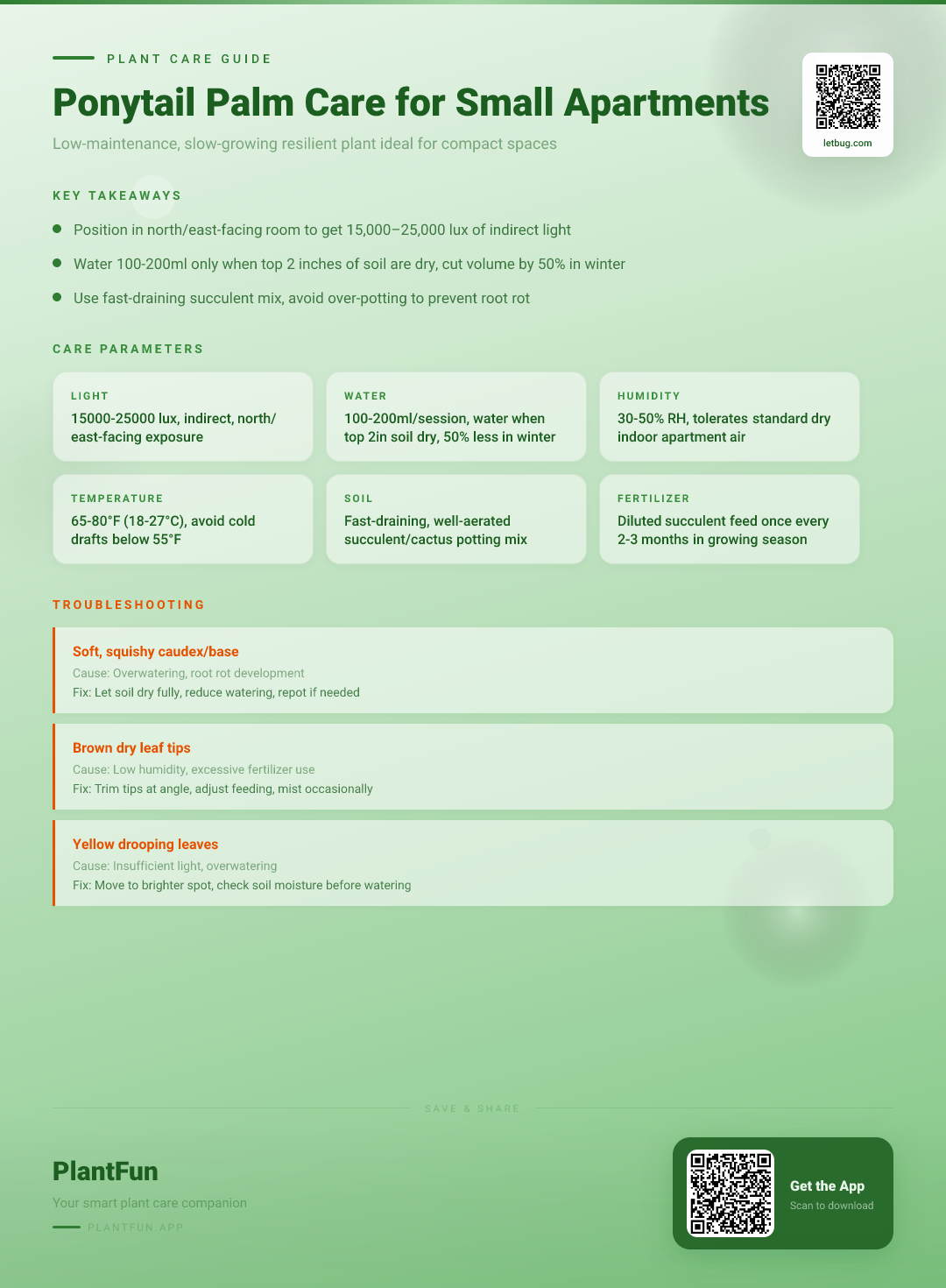
Key Takeaways
- Check soil moisture before watering — overwatering is the #1 killer of houseplants.
- Ensure your plant gets the right amount of light for its species.
- Be patient with recovery — most plants need 2–4 weeks to bounce back.
Quick Care Card: Essential Data
| Requirement | Specification |
|---|---|
| Light | 15,000–25,000 lux (bright, indirect) |
| Water | Every 2–4 weeks; let soil dry completely |
| Humidity | Low to moderate (30-50%) |
| Temperature | 65–80°F (18–27°C) |
| Soil | Fast-draining succulent/cactus mix |
| Fertilizer | Balanced liquid feed, monthly in summer |
| Toxicity | Non-toxic to cats and dogs (ASPCA, 2026) |
TL;DR: Why the Ponytail Palm is the ultimate low-maintenance apartment companion
The Ponytail Palm (Beaucarnea recurvata) is not actually a palm at all—it is a succulent that thrives on neglect. Its most striking feature, the swollen base known as a caudex, acts as an internal reservoir, making it one of the most forgiving apartment plants for busy professionals. If you have a corner with decent light and a tendency to forget to water your plants, this species is your perfect match.
Decoding the caudex: Understanding your plant’s water storage biology
When I first got my own Beaucarnea recurvata, I didn’t fully appreciate the biology of the swollen trunk. The caudex is an evolutionary adaptation that stores water, allowing the plant to survive extended droughts in its native Mexican habitats (NC State Extension, 2026). When caring for one in a small apartment, treat the caudex as your primary diagnostic tool. If the base feels rock-hard, the plant is well-hydrated. If it begins to lose its firmness or feels spongy, you have a critical watering issue.
Light Requirements: Achieving 15,000–25,000 lux in a north or east-facing room
While often sold as a “low-light plant,” this is a common myth. To thrive rather than just survive, these plants need bright, indirect light. In an apartment, I recommend placing your palm within 2–3 feet of an east-facing window or a bright south-facing window with a sheer curtain. If your light levels fall below 10,000 lux, you will notice etiolation—where the leaves stretch thin and pale. Aim for 15,000 to 25,000 lux to keep the growth compact and healthy.
Watering Mastery: Avoiding root rot with the ‘2-inch dryness’ rule (100-200ml per session)
Many owners ask, “How often to water ponytail palm?” The answer is simple: wait until the soil is dry at least two inches down. Using my moisture meter, I confirm the substrate is bone-dry before adding water. For a standard 6-inch pot, I typically use 100-200ml of water, ensuring that excess flows out of the drainage holes. Never let the plant sit in a saucer of standing water; this is the fastest way to trigger crown rot.
Soil Science: Creating a fast-draining succulent mix for small-space pots
To prevent the root rot that plagues many apartment-grown specimens, your soil must be exceptionally porous. I combine two parts standard high-quality potting soil with one part perlite and one part coarse sand or pumice. This mix improves aeration and encourages healthy root growth (Annals of Agricultural Science, Moshtohor, 2014).
The 65-80°F (18-27°C) Rule: Maintaining thermal stability in drafty apartments
Ponytail palms are sensitive to extreme temperature fluctuations. In an apartment, keep your plant away from AC vents, radiators, or drafty doorways. A temperature range of 65–80°F (18–27°C) mimics their natural environment (Gilman & Watson, 2003). Even in winter, avoid letting the room temperature drop below 50°F (10°C) for sustained periods.
Seasonal Adjustments: Why your winter watering schedule should drop by 50%
During the winter months, when growth slows, I reduce my watering frequency by about 50%. If you normally water every two weeks in summer, you may only need to water once a month in December or January. Overwatering during dormancy is the primary cause of decline for indoor small space indoor plants.
Can I keep my Ponytail Palm in a room with no windows?
No. While they are resilient, they are not artificial plants. Without light, the plant will exhaust its stored energy in the caudex, leading to a weak, leggy, and eventually dead plant. If you only have windowless rooms, you must use a supplemental full-spectrum grow light for at least 8-10 hours a day.
Why is my Ponytail Palm base turning soft and squishy?
Symptom: The lower trunk feels soft to the touch rather than firm.
Likely cause: Chronic overwatering leading to internal rot.
Fix:
- Immediately stop all watering.
- Remove the plant from its pot to inspect the roots; cut away any mushy, blackened, or foul-smelling roots.
- Repot in a fresh, dry, fast-draining succulent soil mix.
How do I prune brown leaf tips without damaging the plant crown?
Symptom: Dried, brown leaf tips detracting from the plant’s appearance.
Likely cause: Low humidity or inconsistent watering.
Fix:
- Use sterilized, sharp scissors to trim the brown tip.
- Follow the natural curve of the leaf, leaving a tiny sliver of brown to avoid cutting into healthy, green tissue.
- Do not cut into the base of the crown, as this is where new growth originates.
Common Mistakes: From over-potting to insufficient light exposure
- Mistake: Over-potting.
- What happens: Excess soil holds too much water, leading to root rot.
- Instead: Choose a pot only 1-2 inches wider than the root ball.
- Mistake: Using dense, moisture-retentive peat soil.
- What happens: Suffocates the root system.
- Instead: Use a specialized cactus and succulent soil mix.
References
- ASPCA. (2026). Toxic and Non-Toxic Plants List — ASPCA. https://www.aspca.org/pet-care/animal-poison-control/toxic-and-non-toxic-plants. Accessed 2026-03-13.
- Gilman, E.; Watson, D. (2003). Beaucarnea recurvata: Ponytail palm. EDIS. https://doi.org/10.32473/edis-st093-1993. Accessed 2026-03-13.
- NC State Extension. (2026). Ponytail Palm — NC State Extension Gardener Plant Toolbox. https://plants.ces.ncsu.edu/plants/ponytail-palm/. Accessed 2026-03-13.
- Annals of Agricultural Science, Moshtohor. (2014). Effect of different growing media and chemical fertilization on growth and chemical composition of ponytail palm (Beaucarnea recurvata) plant. Annals of Agricultural Science, Moshtohor. https://doi.org/10.21608/assjm.2014.111131. Accessed 2026-03-13.
Optional Helper: Plantfun.App
Plantfun.App identifies your plants by photo, diagnoses pests and diseases with clear fixes, and creates personalised watering and light schedules that adapt to your home conditions — a handy companion for putting this guide into daily practice.
Found an error or have suggestions? We'd love your feedback.
Need help identifying this problem?
Get instant identification, personalized care schedules, and effective pest treatment plans directly on your phone.
Sponsored • We may earn a commission from app downloads
Related Guides
Ponytail Palm Care for Small Apartment Living: The Only Guide You’ll Ever Need
Transform your small apartment into a desert oasis. Learn the precise watering, light, and soil metrics to keep your Ponytail Palm thriving for years to come.
Care GuideThe Complete Ponytail Palm Care Checklist for Resilient Growth in Small Urban Apartments
Grow a lush, full Ponytail Palm in your small urban apartment without expensive gear. Get exact light levels, water amounts, and a free printable care checklist for resilient, low-fuss growth.
Care GuidePonytail Palm Care Checklist for Resilient Growth in Typical Urban Apartments: Fixes for Common Beginner Mistakes
Stop guessing at Ponytail Palm care. Get our apartment-specific checklist with exact light, water, and soil specs to prevent brown tips and encourage steady, resilient growth all year.
Pest ControlAnts on Plants: What They Mean and What to Do
Ants usually aren't eating your plant. They are farming other pests.