
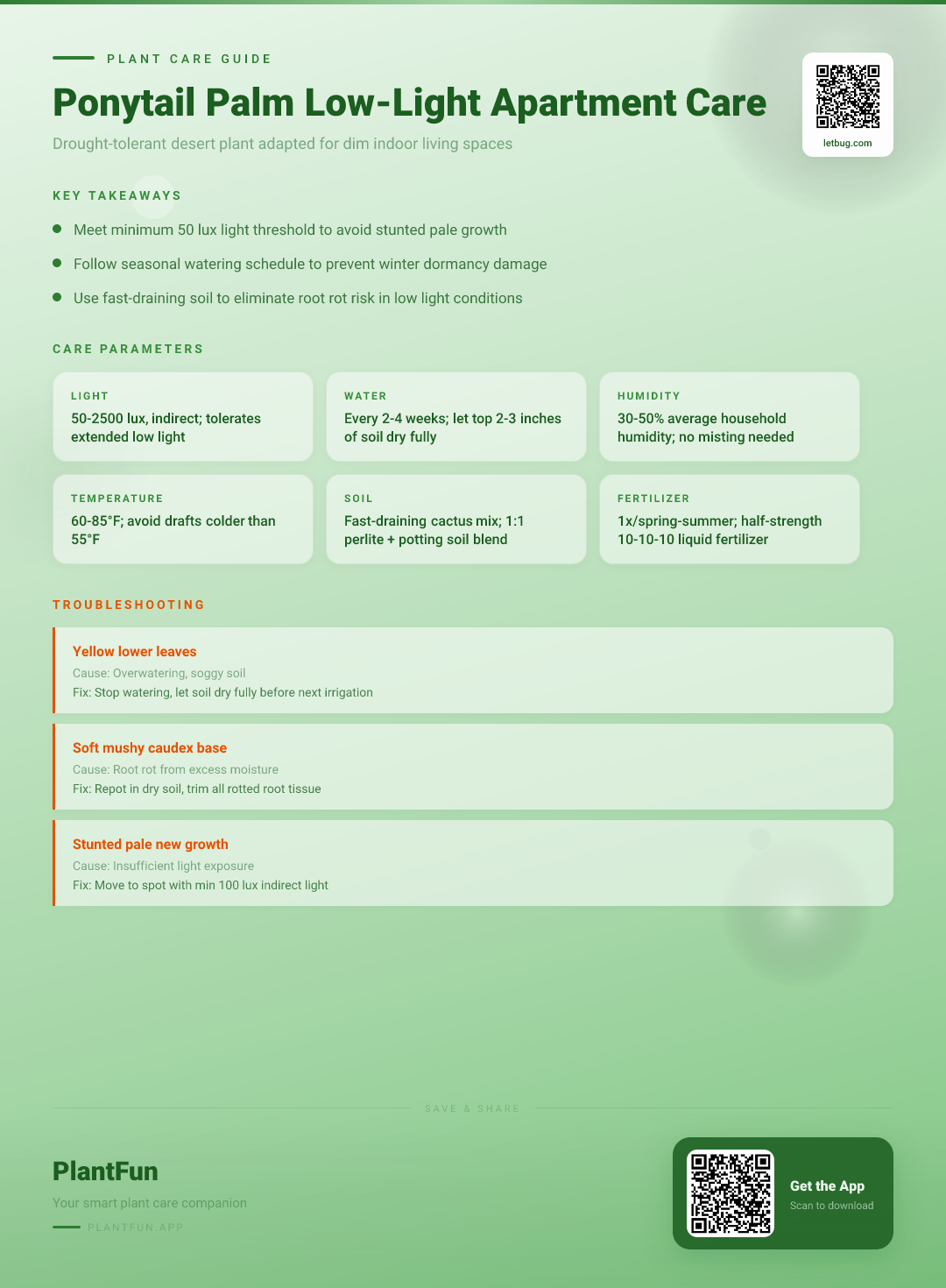
Key Takeaways
- Check soil moisture before watering — overwatering is the #1 killer of houseplants.
- Ensure your plant gets the right amount of light for its species.
- Be patient with recovery — most plants need 2–4 weeks to bounce back.
Quick Care Card: Essential Data for Success
| Feature | Requirement |
|---|---|
| Light | Bright, indirect to direct (minimum 800+ lux) |
| Water | Only when the caudex softens slightly |
| Humidity | Low (30-50%) |
| Temperature | 65°F–80°F (18°C–27°C) |
| Soil | Well-draining cactus/succulent mix |
| Fertilizer | Balanced 10-10-10, twice per growing season |
| Toxicity | Non-toxic to cats and dogs (ASPCA, 2026) |
TL;DR: The Reality of Keeping a Desert Plant in a Dark City Apartment
Ponytail Palms (Beaucarnea recurvata) are not indestructible; they are desert survivors that thrive on solar intensity. In low-light apartments, their metabolism slows down, meaning they cannot process water effectively. If you treat them like a tropical houseplant, you will invite root rot. To succeed, prioritize light over all else, reduce watering frequency to a “drought-first” schedule, and ensure your soil remains porous to allow for rapid drainage (NC State Extension, 2026).
Why Your Ponytail Palm Struggles in Low-Light Environments
When I first brought home my first Beaucarnea recurvata, I tucked it into a cozy, dim corner. Within weeks, the base of the trunk began to pucker, and the tips turned brown. I made the mistake of assuming its “drought-tolerant” reputation meant it could thrive anywhere. In reality, the Ponytail Palm is a succulent that uses its thickened caudex (the swollen base of the stem) to store water for long periods of sun exposure. In a dark room, the plant stops photosynthesizing, stays saturated, and the roots essentially suffocate.
Natural Habitat vs. Your Living Room: Bridging the Gap
Native to the semi-deserts of Mexico, this plant is accustomed to high solar radiation (Gilman & Watson, 2003). In your living room, you must bridge the gap between desert heat and apartment shadows. If you don’t have a south-facing window, you are likely failing to meet its basic light requirements. I recommend using a simple light meter app to ensure your spot hits at least 800-1,000 lux; anything lower and the plant will eventually decline.
Step-by-Step Care Guide: Light, Water, and Soil Parameters
- Check your light: If you are in an apartment, place the plant within 2 feet of your brightest window.
- The Finger Test: Before watering, stick your finger 3 inches deep into the soil. If it feels damp, walk away. Wait until the soil is bone dry.
- Volumetric Watering: Do not “mist” or give small sips. When the soil is dry, drench the plant with 200-300ml of water (depending on pot size) until water drains from the bottom. Discard excess water immediately to prevent root rot in the Ponytail Palm.
- Soil Drainage: Use a mix of 50% potting soil and 50% perlite or pumice to ensure aeration (Annals of Agricultural Science, Moshtohor, 2014).
The 4 Pillars of Resilient Growth: Lux, Humidity, Temperature, and Soil Drainage
- Lux: Aim for high intensity. If natural light is lacking, moving your plant to a shelf with a dedicated grow light is the best way to ensure longevity.
- Humidity: Unlike ferns, this plant hates humidity. Keep it away from bathrooms or steamy kitchens.
- Temperature: Avoid placing it near HVAC vents. Fluctuating drafts cause the foliage to crisp rapidly.
- Soil Drainage: Never allow the pot to sit in a saucer of water. This is the #1 cause of death for indoor desert plants.
Seasonal Watering Calendar: Avoiding the Dormancy Trap
- Spring/Summer: Water every 3-4 weeks once the soil dries completely.
- Autumn/Winter: Enter a dormant phase. During Ponytail Palm winter care, reduce watering to every 6-8 weeks. The caudex should remain firm; if it looks slightly wrinkled, it is just signaling its reserves (NC State Extension, 2026).
Common Mistakes: Identifying and Fixing Yellowing Leaves and Soft Caudex
Yellowing Leaves
Symptom: Lower leaves turning yellow and dropping.
Likely cause: Natural aging or overwatering.
Fix:
- Check the soil moisture; if wet, stop watering.
- If the soil is dry, ensure the plant is getting adequate light to support existing foliage.
Soft Caudex (Stem)
Symptom: The base feels squishy or soft to the touch.
Likely cause: Advanced root rot due to water-logged soil.
Fix:
- Remove the plant from the pot immediately.
- Trim away blackened, mushy roots with sterilized shears.
- Repot in fresh, dry, fast-draining succulent soil.
Voice Search FAQ: How do I know if my Ponytail Palm is getting enough light?
If your Ponytail Palm is getting enough light, the foliage will be stiff, deep green, and grow at a moderate pace. If it is struggling with light, the leaves will become “leggy” (stretching toward the window), pale, and the caudex will begin to lose its firm, circular shape (Gilman & Watson, 2003).
Voice Search FAQ: Why is my Ponytail Palm stem getting soft at the bottom?
A soft stem is a red flag for root rot. This happens when the roots sit in stagnant moisture, leading to decay. This is the most common mistake in Ponytail Palm care for beginners. Immediate repotting into dry, well-draining soil is required to save the plant.
Advanced Care: When and How to Fertilize for Compact Growth
According to studies on Beaucarnea recurvata, chemical fertilization is most effective during the active growth phase in late spring (Annals of Agricultural Science, Moshtohor, 2014). I use a 10-10-10 balanced fertilizer diluted to half-strength only twice between May and August. Over-fertilizing in low-light conditions causes weak, rapid growth that the plant cannot support.
References and Further Reading
- Gilman, E.; Watson, D. (2003). Beaucarnea recurvata: Ponytail palm. https://doi.org/10.32473/edis-st093-1993. Accessed 2026-03-14.
- Annals of Agricultural Science, Moshtohor. (2014). Effect of different growing media and chemical fertilization on growth and chemical composition of ponytail palm (Beaucarnea recurvata) plant. https://doi.org/10.21608/assjm.2014.111131. Accessed 2026-03-14.
- ASPCA. (2026). Toxic and Non-Toxic Plants List — ASPCA. https://www.aspca.org/pet-care/animal-poison-control/toxic-and-non-toxic-plants. Accessed 2026-03-14.
- NC State Extension. (2026). Ponytail Palm — NC State Extension Gardener Plant Toolbox. https://plants.ces.ncsu.edu/plants/palm-care/. Accessed 2026-03-14.
Optional Helper: Plantfun.App
Plantfun.App identifies your plants by photo, diagnoses pests and diseases with clear fixes, and creates personalised watering and light schedules that adapt to your home conditions — a handy companion for putting this guide into daily practice.
Found an error or have suggestions? We'd love your feedback.
Need help identifying this problem?
Get instant identification, personalized care schedules, and effective pest treatment plans directly on your phone.
Sponsored • We may earn a commission from app downloads
Related Guides
The Complete Ponytail Palm Care Guide for Small Urban Apartments: Resilient Growth Made Easy
Grow a thriving ponytail palm even in a tiny urban apartment. Get exact light levels, watering amounts, space-saving tips, and a seasonal care calendar for resilient, low-fuss growth.
Care GuidePonytail Palm in Typical Apartments: The Only Care Checklist You'll Ever Need
Grow a lush, low-fuss ponytail palm even in your small apartment. Get exact light, water, and soil specs plus common mistake fixes to avoid brown tips and stunted growth.
Care GuideThe Complete Ponytail Palm Care Checklist for Small Urban Apartments: Resilient Growth Made Easy
Stop guessing at Ponytail Palm care for your small urban apartment. Get exact light, water, and humidity thresholds plus an actionable checklist to keep your plant growing strong for years.
Pest ControlAnts on Plants: What They Mean and What to Do
Ants usually aren't eating your plant. They are farming other pests.