
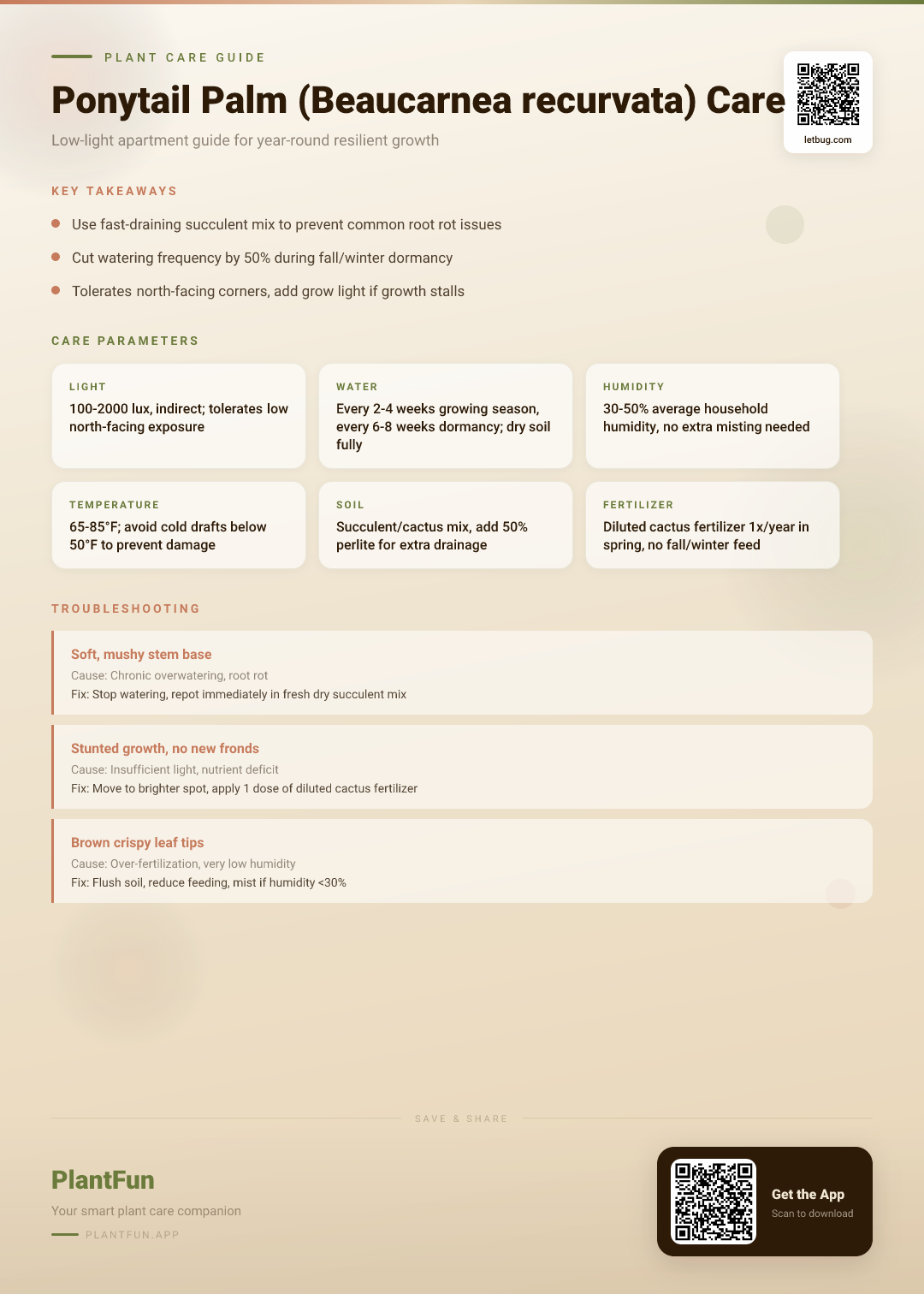
Key Takeaways
- Check soil moisture before watering — overwatering is the #1 killer of houseplants.
- Ensure your plant gets the right amount of light for its species.
- Be patient with recovery — most plants need 2–4 weeks to bounce back.
Quick Care Card: Essential Thresholds for Apartment Success
| Feature | Requirement |
|---|---|
| Light | Bright, indirect to direct light (minimum 1,500 lux) |
| Water | Allow soil to dry out completely between waterings |
| Humidity | Low to moderate (30-50%) |
| Temperature | 65°F to 85°F (18°C - 29°C) |
| Soil | Fast-draining succulent or cactus mix |
| Fertilizer | Balanced liquid feed, sparingly during summer |
| Toxicity | Non-toxic to cats and dogs (ASPCA, 2026) |
TL;DR: Why Your Ponytail Palm Struggles in Low-Light Apartments
Your Beaucarnea recurvata is a drought-tolerant succulent, not a true palm. In low-light apartments, its metabolism slows significantly. Most owners kill these plants by watering on a schedule rather than by environmental demand. To keep yours resilient, prioritize light, use a cactus-specific substrate, and never water until the soil is bone-dry to the bottom of the pot.
Understanding the Beaucarnea recurvata: A Desert Resident in Your Living Room
When I first bought my Beaucarnea recurvata, I treated it like a thirsty tropical fern. I made the mistake of watering it every week, and within a month, the base felt spongy. The Ponytail Palm is natively adapted to arid Mexican climates (Gilman & Watson, 2003). It utilizes its signature swollen base (the caudex) to store water, acting as a biological insurance policy against drought. In your apartment, this storage capacity is your greatest challenge. If you provide it with less light than it craves, it will not process that stored water, leading to rapid root rot (NC State Extension, 2026).
Spring & Summer: Boosting Growth with Peak Light Exposure
During the active growing season, your plant wants as much sun as possible. If your apartment has a south-facing window, this is the premier spot.
- Light: Aim for at least 6-8 hours of bright, indirect light.
- Hydration: Water when the top 3 inches of soil are dry. Use roughly 200-300ml for a standard 6-inch pot, ensuring water drains freely from the bottom.
- Feeding: Use a diluted, balanced fertilizer once in mid-summer (Annals of Agricultural Science, 2014).
Autumn & Winter: The Dormancy Protocol to Prevent Rot
As days shorten, your plant enters a period of dormancy. This is when “Ponytail Palm winter care” becomes critical.
- Watering Frequency: Shift to a “less is more” approach. I only water mine once every 4-6 weeks during winter.
- Temperature: Keep away from drafty windows or heating vents, which can trick the plant into active growth when it needs rest.
Watering Mastery: Why the ‘Bulb’ Stores More Than You Think
The bulbous base is a water-storage organ. If you see the base beginning to wrinkle slightly, it is actually a sign of thirst—do not panic and over-water. Stick your finger 2 inches into the soil; if you feel any moisture at all, wait another week. For those looking for more tips on managing moisture, check out my guide on understanding indoor plant hydration.
Soil Science: Creating the Perfect Succulent-Grade Mix
A heavy potting soil will suffocate the roots. I recommend a mix of 50% high-quality potting soil and 50% inorganic drainage material like perlite or pumice. According to research on growing media, drainage is the most significant factor in maintaining healthy root biomass (Annals of Agricultural Science, 2014).
FAQ: Why is my Ponytail Palm stem getting soft at the base?
Answer: This is a classic symptom of root rot caused by stagnant water. You need to inspect the root ball immediately. If the roots are black and mushy, trim them away and repot in fresh, dry soil. You can learn more about identifying root rot in succulents on our site.
FAQ: Can I keep my Ponytail Palm in a north-facing apartment corner?
Answer: Technically yes, but it will not thrive. It will likely become leggy and lose its characteristic slow growth rate. If you must keep it there, consider a full-spectrum grow light to provide the energy it needs to sustain its foliage.
FAQ: How do I know when it’s time to repot my Ponytail Palm?
Answer: These plants actually prefer being slightly root-bound. Only repot when the roots are physically pushing the plant out of the pot or when the soil has lost its structure and no longer drains freely.
Common Mistakes: Avoiding the Overwatering Trap
- Mistake: Watering on a calendar schedule (e.g., every Monday).
- What happens: The soil stays consistently damp, depriving roots of oxygen.
- Instead: Water only when the soil is dry and the plant shows signs of needing a drink.
- Mistake: Using a pot without drainage holes.
- What happens: Water accumulates at the bottom, leading to silent rot.
- Instead: Use a pot with at least one large drainage hole; I always use a terracotta pot to allow the sides to breathe.
References and Botanical Sources
- Gilman, E.; Watson, D. (2003). Beaucarnea recurvata: Ponytail palm. https://doi.org/10.32473/edis-st093-1993. Accessed 2026-03-18.
- Annals of Agricultural Science, Moshtohor. (2014). Effect of different growing media and chemical fertilization on growth and chemical composition of ponytail palm (Beaucarnea recurvata) plant. https://doi.org/10.21608/assjm.2014.111131. Accessed 2026-03-18.
- American Society for the Prevention of Cruelty to Animals. (2026). Toxic and Non-Toxic Plants List — ASPCA. https://www.aspca.org/pet-care/animal-poison-control/toxic-and-non-toxic-plants. Accessed 2026-03-18.
- North Carolina State University Extension. (2026). Ponytail Palm — NC State Extension Gardener Plant Toolbox. https://plants.ces.ncsu.edu/plants/palm-care/. Accessed 2026-03-18.
Optional Helper: Plantfun.App
Plantfun.App identifies your plants by photo, diagnoses pests and diseases with clear fixes, and creates personalised watering and light schedules that adapt to your home conditions — a handy companion for putting this guide into daily practice.
Found an error or have suggestions? We'd love your feedback.
Need help identifying this problem?
Get instant identification, personalized care schedules, and effective pest treatment plans directly on your phone.
Sponsored • We may earn a commission from app downloads
Related Guides
Ponytail Palm in a Low-Humidity Apartment: The Only Care Guide You’ll Ever Need
Revive your apartment-dwelling Ponytail Palm with precise water-to-pot ratios and light metrics. Stop the cycle of leaf browning today with this expert guide.
Care GuidePonytail Palm Care in a Low-Light Apartment: The Budget-Friendly Resilient Growth Guide
Master Ponytail Palm care with our 0-cost growth strategy. Learn precise watering schedules, light hacks for dark apartments, and 3 steps for lasting health.
Care GuidePonytail Palm in Typical Apartments: The Only Care Checklist You'll Ever Need
Grow a lush, low-fuss ponytail palm even in your small apartment. Get exact light, water, and soil specs plus common mistake fixes to avoid brown tips and stunted growth.
Pest ControlAnts on Plants: What They Mean and What to Do
Ants usually aren't eating your plant. They are farming other pests.