
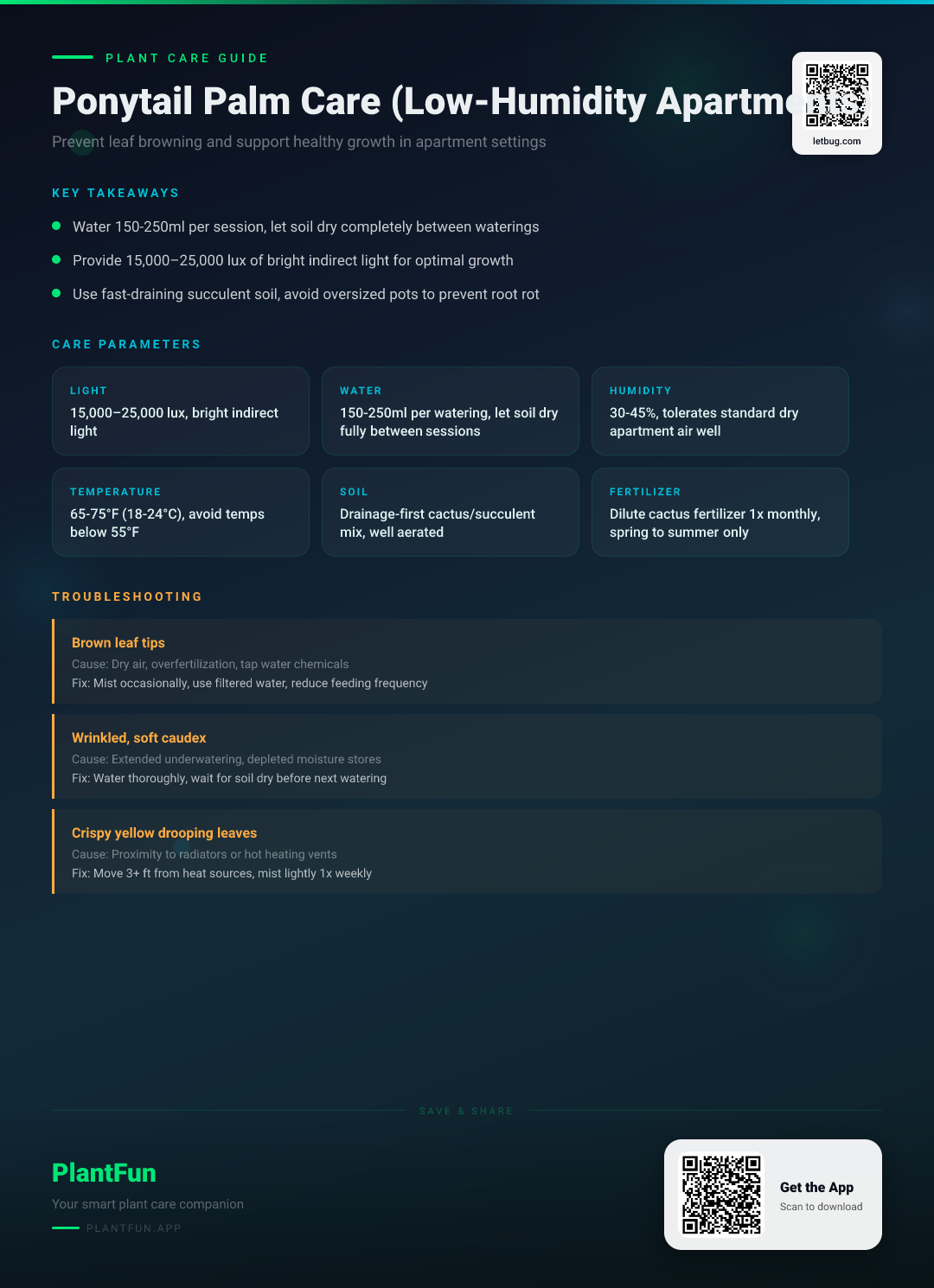
Key Takeaways
- Check soil moisture before watering — overwatering is the #1 killer of houseplants.
- Ensure your plant gets the right amount of light for its species.
- Be patient with recovery — most plants need 2–4 weeks to bounce back.
Quick Care Card: Essential Thresholds for Success
| Requirement | Threshold |
|---|---|
| Light | 15,000–25,000 Lux (Bright, indirect to direct) |
| Watering | 150–250ml (Only when soil is 100% dry) |
| Humidity | 30–45% (Standard apartment range) |
| Temperature | 65–75°F (18–24°C) |
| Soil | Fast-draining succulent/cactus mix |
| Fertilizer | Balanced liquid (10-10-10) in spring only |
| Toxicity | Non-toxic to cats and dogs (ASPCA, 2026) |
TL;DR: The Bottom Line on Apartment Survival
The Ponytail Palm (Beaucarnea recurvata) is not a palm; it is a drought-tolerant succulent. If you treat it like a tropical fern, it will succumb to root rot within months. To succeed in an apartment, focus on high light exposure, minimal watering—only after the soil has completely dried out—and a gritty, fast-draining substrate. When I first got my own specimen, I made the mistake of watering on a schedule; shifting to a “check-the-caudex” approach saved my plant.
Why Your Apartment Environment Challenges the Ponytail Palm
Many apartment dwellers struggle with this plant because modern heating systems drive humidity well below the natural preferences of many houseplants. While the Ponytail Palm is resilient, constant fluctuations in ambient air moisture and the tendency to over-compensate with a watering can create a hostile environment. Unlike tropical species, Beaucarnea recurvata requires a period of dry rest (NC State Extension, 2026).
Understanding the Caudex: The Biological Battery
The most iconic feature of the Ponytail Palm is the swollen base, known as the caudex. This is not just for show; it is a biological battery designed to store water for long periods of drought. When the caudex feels firm, the plant is hydrated. If you notice it softening or wrinkling significantly, it is drawing on its reserves. Treating this structure as a water reservoir is essential for long-term health (Gilman & Watson, 2003).
Lighting Requirements: Achieving 15,000–25,000 Lux Indoors
In their native habitat, these plants thrive in high-intensity sun. In your apartment, place your plant within 2-3 feet of your brightest south or west-facing window. If your leaves are stretching (etiolation), your light levels are likely below 10,000 lux. Using a light meter or phone-based app, aim for 15,000–25,000 lux for optimal photosynthetic performance (Annals of Agricultural Science, 2014).
Watering Mastery: Why ‘Less Is More’ (150-250ml per watering)
Never water based on a calendar. Instead, use the “weight-check” method. Pick up the pot; if it feels exceptionally light, it is ready for 150-250ml of water, depending on pot size. If you see brown tips, you are likely overwatering, not underwatering. Ensure the water drains completely from the bottom saucer to prevent root asphyxiation.
Humidity & Temperature Control: Managing 30-45% Humidity and 65-75°F (18-24°C)
Fortunately, the Ponytail Palm is perfectly happy in standard 30-45% indoor humidity. Keep your plant away from direct drafts, such as air conditioning vents or radiators, which can cause erratic desiccation of the leaf tips. Consistent temperatures between 65-75°F (18-24°C) are ideal for maintaining metabolic stability (NC State Extension, 2026).
Step-by-Step Soil Selection: Drainage-First Substrates
- Select a pot with at least one large drainage hole.
- Mix 50% high-quality potting soil with 50% inorganic material, such as perlite or pumice.
- Avoid heavy peat-based soils that retain moisture for too long (Annals of Agricultural Science, 2014).
- Ensure the root ball fits snugly; avoid “potting up” into a container that is too large, as excess soil volume invites rot.
Voice Search FAQ: Why is my Ponytail Palm turning brown at the tips?
This is almost always a sign of overwatering or fluoride/mineral buildup in the soil. Before watering, ensure the soil is 100% dry. If it is, consider flushing the soil with filtered water.
Voice Search FAQ: How do I know if my Ponytail Palm is thirsty?
The caudex is your guide. A firm, plump base means the plant is happy. If the base starts to feel slightly soft or looks wrinkled, it is time for a deep drink.
Voice Search FAQ: Can I leave my Ponytail Palm near a radiator?
No. Radiators create extreme localized heat and dryness that can dehydrate the leaf tips and accelerate water loss in the root system faster than the plant can replenish it.
Seasonal Care Calendar: Adjusting for Winter Dormancy
During winter, growth slows significantly. Reduce watering to the absolute minimum—perhaps once every 4-6 weeks—and stop fertilizing entirely until the spring equinox (NC State Extension, 2026).
Common Mistakes: The Perils of Oversized Pots
- Mistake: Using a pot that is too large.
- What happens: Excess soil holds moisture long after the roots have taken what they need, causing root rot.
- Instead: Always use a pot only 1-2 inches larger than the root ball.
References
- Gilman, E.; Watson, D. (2003). Beaucarnea recurvata: Ponytail palm. https://doi.org/10.32473/edis-st093-1993. Accessed 2026-03-11.
- Annals of Agricultural Science, Moshtohor. (2014). Effect of different growing media and chemical fertilization on growth and chemical composition of ponytail palm (Beaucarnea recurvata) plant. https://doi.org/10.21608/assjm.2014.111131. Accessed 2026-03-11.
- ASPCA. (2026). Toxic and Non-Toxic Plants List — ASPCA. https://www.aspca.org/pet-care/animal-poison-control/toxic-and-non-toxic-plants. Accessed 2026-03-11.
- NC State Extension. (2026). Ponytail Palm — NC State Extension Gardener Plant Toolbox. https://plants.ces.ncsu.edu/plants/palm-care/. Accessed 2026-03-11.
Optional Helper: Plantfun.App
Plantfun.App identifies your plants by photo, diagnoses pests and diseases with clear fixes, and creates personalised watering and light schedules that adapt to your home conditions — a handy companion for putting this guide into daily practice.
Found an error or have suggestions? We'd love your feedback.
Need help identifying this problem?
Get instant identification, personalized care schedules, and effective pest treatment plans directly on your phone.
Sponsored • We may earn a commission from app downloads
Related Guides
Ponytail Palm in Typical Apartments: The Only Care Checklist You'll Ever Need
Grow a lush, low-fuss ponytail palm even in your small apartment. Get exact light, water, and soil specs plus common mistake fixes to avoid brown tips and stunted growth.
Care GuidePonytail Palm in Typical Apartments: The Seasonal Care Checklist for Resilient Growth That Lasts Year-Round
Grab our seasonal ponytail palm care checklist tailored for typical apartments, with exact light, water, and humidity thresholds to keep your plant growing resiliently for decades.
Care GuidePonytail Palm Care Checklist for Resilient Growth in Typical Urban Apartments: Fixes for Common Beginner Mistakes
Stop guessing at Ponytail Palm care. Get our apartment-specific checklist with exact light, water, and soil specs to prevent brown tips and encourage steady, resilient growth all year.
Pest ControlAnts on Plants: What They Mean and What to Do
Ants usually aren't eating your plant. They are farming other pests.