
Key Takeaways
- Check soil moisture before watering — overwatering is the #1 killer of houseplants.
- Ensure your plant gets the right amount of light for its species.
- Be patient with recovery — most plants need 2–4 weeks to bounce back.
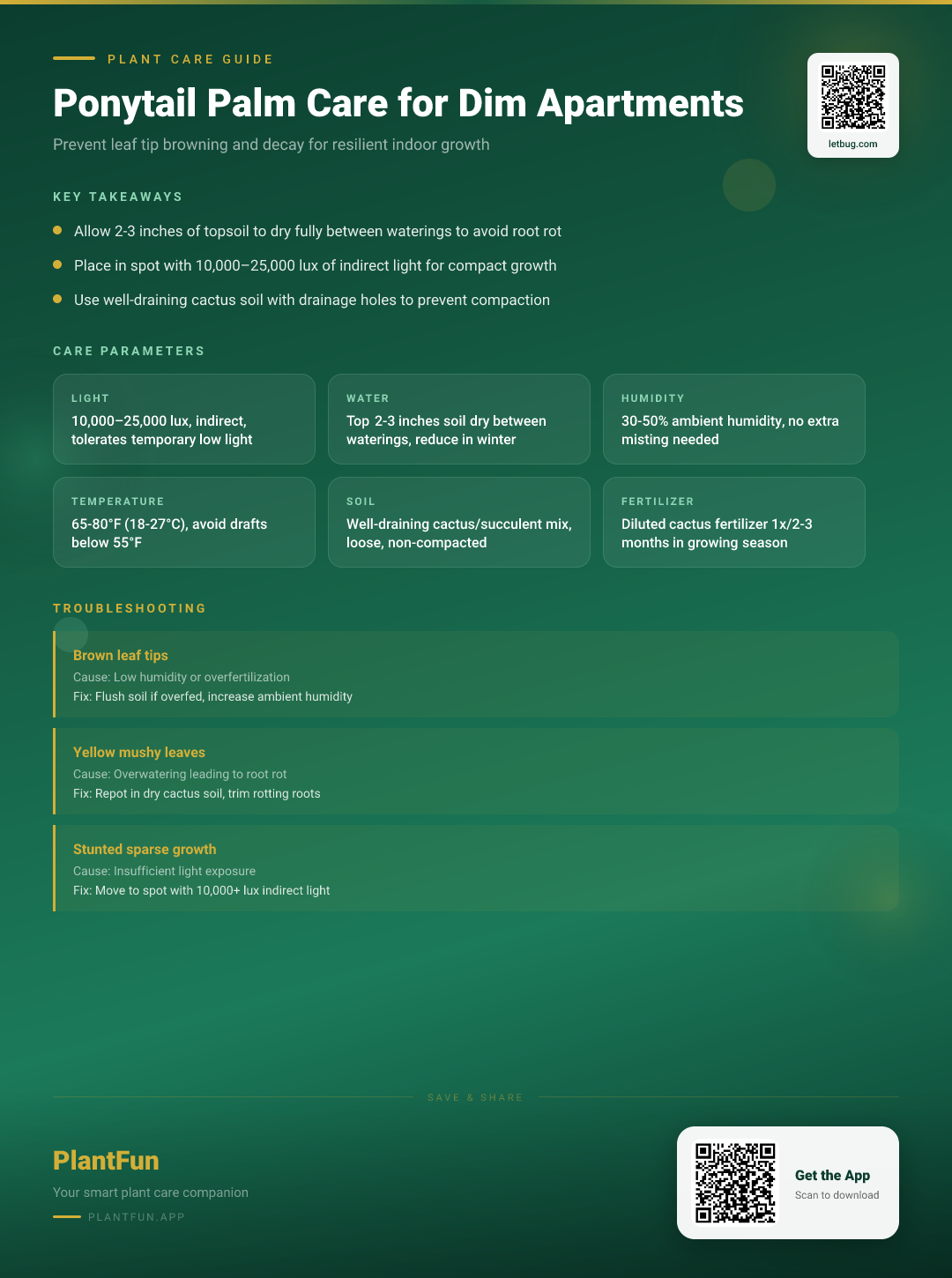
Quick Care Card: Essential Thresholds for Apartment Resiliency
| Feature | Requirement |
|---|---|
| Light | 10,000–25,000 Lux (Bright, indirect light) |
| Watering | Dry completely between waterings |
| Humidity | 30–50% (Standard apartment levels) |
| Temperature | 65–80°F (18–27°C) |
| Soil | Fast-draining succulent mix (pH 6.0–7.5) |
| Fertilizer | Balanced liquid feed, monthly in summer |
| Toxicity | Non-toxic to cats and dogs (ASPCA, 2026) |
TL;DR: The Truth About Ponytail Palms in Low-Light Apartments
Ponytail palms (Beaucarnea recurvata) are not true palms; they are succulent members of the Asparagaceae family. In a dim apartment, they struggle because their metabolic rate drops, but owners often continue watering them as if they are actively growing. To keep yours alive, allow the soil to dehydrate entirely before even considering a drink. Prioritize maximum light exposure and avoid keeping the roots in damp, stagnant soil. If your plant is showing brown tips, it is almost always a result of inconsistent moisture or soil compaction rather than a lack of humidity.
Understanding the Caudex: Why This Plant Stores Its Own Water
When I first started collecting plants, I viewed the swollen base of the Beaucarnea recurvata—the caudex—as merely a decorative trunk. I quickly learned that this is actually a survival mechanism evolved for arid environments. The plant stores water here to survive long droughts (Gilman & Watson, 2003). In your apartment, this means that even if the soil feels dry, the plant may still have ample reserves. Watering while the caudex is firm and the soil is damp is the fastest path to decay.
Lighting Requirements: Targeting 10,000–25,000 Lux for Compact Growth
Many beginners place their ponytail palm in a dark corner, assuming it is a “low-light plant.” While it can survive in lower light, it will not thrive. Aim for 10,000 to 25,000 lux. If you live in a dark apartment, use a light meter app or keep the plant within 2 feet of your brightest window. Lack of light causes the fronds to stretch and become spindly, which weakens the plant’s structural integrity.
The Watering Protocol: Measuring Soil Moisture vs. Fixed Schedules
Stop using a calendar to water your plant. Instead, perform the ‘finger test.’ Push your index finger into the soil at least 2 inches deep. If you feel any moisture, do not water. In my experience, most apartments stay cool enough that a ponytail palm only needs water once every 3 to 4 weeks during winter. In summer, this may increase to once every 10–14 days depending on heat (Annals of Agricultural Science, 2014).
Temperature & Humidity: Maintaining 65-80°F (18-27°C) and 30-50% Humidity
These plants are resilient to standard home conditions. They prefer 65-80°F (18-27°C). While they are tropical-origin plants, they do not require high humidity. In fact, keeping them in high-humidity bathrooms can lead to fungal issues if there is poor airflow. Keep them in a well-ventilated room to ensure the soil surface dries quickly.
Step-by-Step Recovery: Fixing Root Rot and Persistent Tip Browning
- Inspect the Roots: Gently remove the plant from its pot. Healthy roots are firm and light-colored; mushy or black roots indicate rot.
- Prune: Use sterile scissors to trim back any dark or slimy root tissue.
- Repot: Move the plant to a terra cotta pot with a drainage hole. Use a mix of 50% potting soil and 50% pumice or perlite for maximum aeration.
- Hydrate Sparingly: Water lightly just to settle the soil, then wait until the pot feels significantly lighter before watering again.
Seasonal Care: Adjusting Care Cycles for Winter Dormancy in apartments
As the days shorten, the plant enters a semi-dormant state. Its growth slows, and its water demand plummets. I reduce my watering frequency by 50% during the months of November through February. If you keep the plant too warm and well-watered in winter, it will attempt to grow in low light, resulting in weak, etiolated (stretched) stems.
Why is my Ponytail Palm turning brown at the tips?
Symptom: Dry, crispy brown leaf tips.
Likely cause: Inconsistent watering intervals or mineral buildup from tap water.
Fix:
- Check your watering consistency; let the soil dry out completely.
- Switch to filtered or distilled water to avoid fluoride or chlorine damage.
- Do not trim the entire leaf; just snip the brown part while leaving a tiny sliver of brown to avoid further wounding the plant.
How do I know if I have overwatered my Ponytail Palm?
Symptom: Softening of the trunk or brown, mushy leaf bases.
Likely cause: Waterlogged soil preventing root respiration.
Fix:
- Immediately cease watering.
- Increase light exposure to encourage evaporation.
- If the trunk feels soft, unpot to check for root rot.
Can I keep my Ponytail Palm in a north-facing apartment room?
Symptom: Plant is stagnant or leaning heavily.
Likely cause: Insufficient photosynthetically active radiation (PAR).
Fix:
- Rotate the pot 90 degrees every week to maintain a straight trunk.
- Move the plant to an east or west-facing window.
- Supplement with a full-spectrum LED grow light if natural light is insufficient.
Common Mistakes to Avoid
-
Mistake: Using a pot without drainage holes.
What happens: Water collects at the bottom, leading to hypoxia (lack of oxygen) for the roots.
Instead: Always use a container with bottom holes and a saucer. -
Mistake: Using heavy, peat-based soil.
What happens: Soil compacts and holds too much moisture for too long.
Instead: Use a specialized, porous cactus and succulent mix to encourage drainage.
References and Botanical Guidelines
- Gilman, E.; Watson, D. (2003). Beaucarnea recurvata: Ponytail palm. https://doi.org/10.32473/edis-st093-1993. Accessed 2026-03-14.
- Annals of Agricultural Science, Moshtohor. (2014). Effect of different growing media and chemical fertilization on growth and chemical composition of ponytail palm (Beaucarnea recurvata) plant. https://doi.org/10.21608/assjm.2014.111131. Accessed 2026-03-14.
- American Society for the Prevention of Cruelty to Animals. (2026). Toxic and Non-Toxic Plants List — ASPCA. https://www.aspca.org/pet-care/animal-poison-control/toxic-and-non-toxic-plants. Accessed 2026-03-14.
Optional Helper: Plantfun.App
Plantfun.App identifies your plants by photo, diagnoses pests and diseases with clear fixes, and creates personalised watering and light schedules that adapt to your home conditions — a handy companion for putting this guide into daily practice.
Found an error or have suggestions? We'd love your feedback.
Need help identifying this problem?
Get instant identification, personalized care schedules, and effective pest treatment plans directly on your phone.
Sponsored • We may earn a commission from app downloads
Related Guides
Ponytail Palm Care Checklist for Resilient Growth in Typical Urban Apartments: Fixes for Common Beginner Mistakes
Stop guessing at Ponytail Palm care. Get our apartment-specific checklist with exact light, water, and soil specs to prevent brown tips and encourage steady, resilient growth all year.
Care GuidePonytail Palm in Typical Apartments: The Only Care Checklist You'll Ever Need
Grow a lush, low-fuss ponytail palm even in your small apartment. Get exact light, water, and soil specs plus common mistake fixes to avoid brown tips and stunted growth.
Care GuidePonytail Palm in Typical Apartments: The Seasonal Care Checklist for Resilient Growth That Lasts Year-Round
Grab our seasonal ponytail palm care checklist tailored for typical apartments, with exact light, water, and humidity thresholds to keep your plant growing resiliently for decades.
Pest ControlAnts on Plants: What They Mean and What to Do
Ants usually aren't eating your plant. They are farming other pests.