
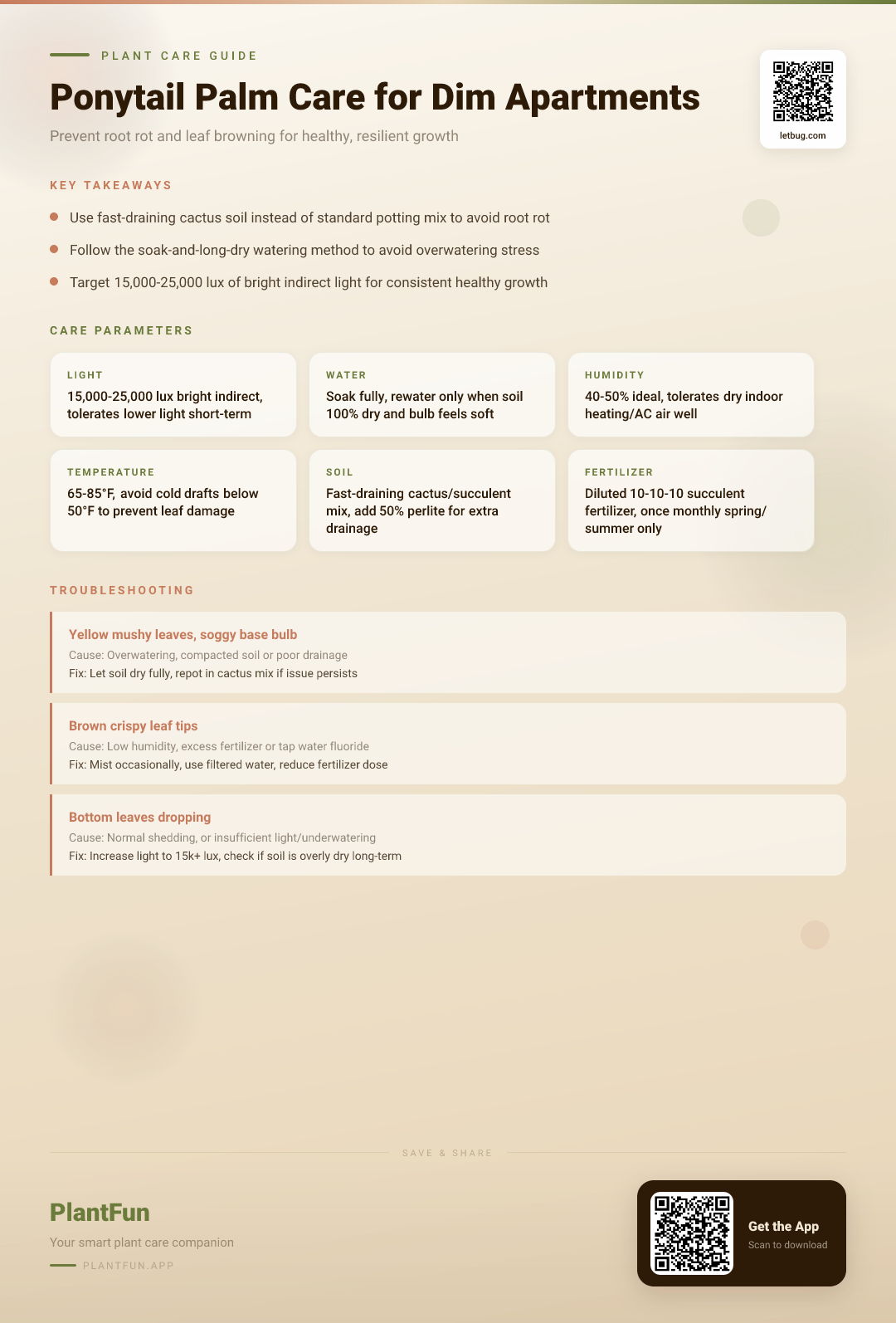
Key Takeaways
- Check soil moisture before watering — overwatering is the #1 killer of houseplants.
- Ensure your plant gets the right amount of light for its species.
- Be patient with recovery — most plants need 2–4 weeks to bounce back.
Quick Care Card: Essential metrics for Beaucarnea recurvata
| Feature | Requirement |
|---|---|
| Light | 15,000–25,000 lux (bright, indirect) |
| Water | Only when bulb feels slightly soft; soak completely |
| Humidity | Low to moderate (30-50%) |
| Temperature | 65°F–80°F (18°C–27°C) |
| Soil | Highly porous, cactus-grade substrate |
| Fertilizer | Balanced liquid feed, monthly in summer only |
| Toxicity | Non-toxic to cats and dogs (ASPCA, 2026) |
TL;DR: The golden rule for apartment-grown Ponytail Palms
If you want your Beaucarnea recurvata to thrive in an apartment, stop treating it like a tropical foliage plant. It is a succulent that stores water in its bulbous caudex. The golden rule: When in doubt, don’t water. Most apartment owners kill these plants through over-watering in low light. If the soil is damp, the roots are suffocating. Keep it dry, give it the brightest spot you have, and it will forgive your occasional neglect.
Why your Ponytail Palm struggles in standard apartment conditions
When I first brought home my Beaucarnea recurvata, I tucked it into a corner of my living room, assuming it was a “low-light plant” because of its palm-like appearance. Within three months, the leaves were turning brown, and the base felt mushy. The reality is that these plants are adapted to arid, high-light environments (Gilman & Watson, 2003). In an apartment, common issues like poor airflow, heavy potting soils, and insufficient window light create a stagnant environment that triggers root decay.
The 4 measurable care thresholds for resilient growth
To move from surviving to thriving, you must manage these four thresholds:
- Lux Threshold: Aim for 15,000–25,000 lux. If you cannot read a book comfortably in the spot, it is too dim for a Ponytail Palm.
- Hydration Threshold: Wait until 90-100% of the soil volume is dry before re-watering (NC State Extension, 2026).
- Soil Porosity: Substrate must be composed of at least 40% inorganic material like pumice or perlite to facilitate rapid drainage (Annals of Agricultural Science, Moshtohor, 2014).
- Thermal Stability: Keep temperatures above 50°F (10°C). Cold drafts near balcony doors are a common, often overlooked stressor.
Step 1: Identifying signs of distress (soggy bulb vs. shriveled leaves)
The Soggy Bulb
Symptom: The base feels soft or squishy like a ripe peach.
Likely cause: Persistent moisture in the root zone leading to fungal decay.
Fix:
- Remove the plant from the pot immediately.
- Trim away dark, mushy roots using sterilized scissors.
- Repot into fresh, dry, fast-draining substrate.
The Shriveled Leaves
Symptom: Leaf tips are turning brown and crispy; outer leaves are shedding rapidly.
Likely cause: Either severe dehydration or, ironically, root rot that prevents the plant from uptaking water.
Fix:
- Check the bulb firmness. If firm, perform a thorough soak-and-drain.
- If the bulb is soft, follow the “Soggy Bulb” fix.
Step 2: Soil composition: Why standard potting mix is a death sentence
Standard peat-based potting mixes hold too much water, which causes the dense, fleshy roots of the Beaucarnea to rot (Annals of Agricultural Science, Moshtohor, 2014). I recommend creating a custom mix: 60% standard succulent/cactus soil and 40% pumice or coarse grit. This ensures oxygen reaches the roots, which is vital for preventing the pathogens that thrive in dense, wet soil.
Step 3: Managing light: Achieving the 15,000-25,000 lux requirement indoors
Many apartment dwellers struggle with low light. If you don’t have a south-facing window, I recommend using a full-spectrum LED grow light placed 12-18 inches from the crown. Without adequate light, the plant will become “leggy”—stretching its stems out—and will lose the ability to regulate its water intake, making it significantly more prone to rot.
Step 4: Watering mechanics: The ‘soak and long dry’ technique
Never water on a schedule (e.g., “every Monday”). Instead, use the “Soak and Dry” method. Water until liquid runs freely from the drainage hole. Allow the pot to sit for 15 minutes, then dump the excess from the saucer. Wait until the soil is completely dry to the touch—test by inserting a wooden skewer deep into the pot—before watering again. If the wood comes out damp or dark, wait longer.
FAQ: Why is my Ponytail Palm dropping its bottom leaves?
It is normal for the oldest, lowest leaves to yellow and drop as the plant focuses energy on new growth. However, if multiple rows of leaves are dropping, it often indicates overwatering or light deficiency (NC State Extension, 2026). Check if your plant is receiving enough light to sustain its current leaf count.
FAQ: Can I keep my Ponytail Palm in a room without windows?
Can I put my Ponytail Palm in a bathroom or interior hallway? Not without a dedicated grow light. These plants require high intensity to maintain their metabolism. Without a light source, they will eventually starve and become susceptible to pests like scale or spider mites.
Seasonal care adjustments for central heating and air conditioning
In winter, our apartments become dry due to heating. While the Ponytail Palm handles low humidity well, heat vents can cause rapid water evaporation at the soil surface while the deeper roots remain wet. Always check deep into the soil before watering in winter. Conversely, in summer, increased light levels may increase the plant’s water needs, so keep a closer watch on the firmness of the bulb.
Common mistakes: Pot size and drainage myths
- Mistake: Using a pot that is too large. What happens: The extra soil holds too much water, inviting rot. Instead: Keep the plant in a snug pot with drainage holes.
- Mistake: Adding rocks to the bottom of the pot. What happens: This creates a “perched water table,” trapping water right at the root zone. Instead: Use a pot with a single, large drainage hole and no added debris at the bottom.
References and scientific resources
- Gilman, E.; Watson, D. (2003). Beaucarnea recurvata: Ponytail palm. https://doi.org/10.32473/edis-st093-1993. Accessed 2026-03-16.
- Annals of Agricultural Science, Moshtohor. (2014). Effect of different growing media and chemical fertilization on growth and chemical composition of ponytail palm (Beaucarnea recurvata) plant. https://doi.org/10.21608/assjm.2014.111131. Accessed 2026-03-16.
- ASPCA. (2026). Toxic and Non-Toxic Plants List — ASPCA. https://www.aspca.org/pet-care/animal-poison-control/toxic-and-non-toxic-plants. Accessed 2026-03-16.
- NC State Extension. (2026). Ponytail Palm Care — NC State Extension Gardener Plant Toolbox. https://plants.ces.ncsu.edu/plants/palm-care/. Accessed 2026-03-16.
Optional Helper: Plantfun.App
Plantfun.App identifies your plants by photo, diagnoses pests and diseases with clear fixes, and creates personalised watering and light schedules that adapt to your home conditions — a handy companion for putting this guide into daily practice.
Found an error or have suggestions? We'd love your feedback.
Need help identifying this problem?
Get instant identification, personalized care schedules, and effective pest treatment plans directly on your phone.
Sponsored • We may earn a commission from app downloads
Related Guides
Ponytail Palm in a Low-Humidity Apartment: The Only Care Guide You’ll Ever Need
Revive your apartment-dwelling Ponytail Palm with precise water-to-pot ratios and light metrics. Stop the cycle of leaf browning today with this expert guide.
Care GuidePonytail Palm Care in a Low-Light Apartment: The Budget-Friendly Resilient Growth Guide
Master Ponytail Palm care with our 0-cost growth strategy. Learn precise watering schedules, light hacks for dark apartments, and 3 steps for lasting health.
Care GuidePonytail Palm in Typical Apartments: The Only Care Checklist You'll Ever Need
Grow a lush, low-fuss ponytail palm even in your small apartment. Get exact light, water, and soil specs plus common mistake fixes to avoid brown tips and stunted growth.
Pest ControlAnts on Plants: What They Mean and What to Do
Ants usually aren't eating your plant. They are farming other pests.