
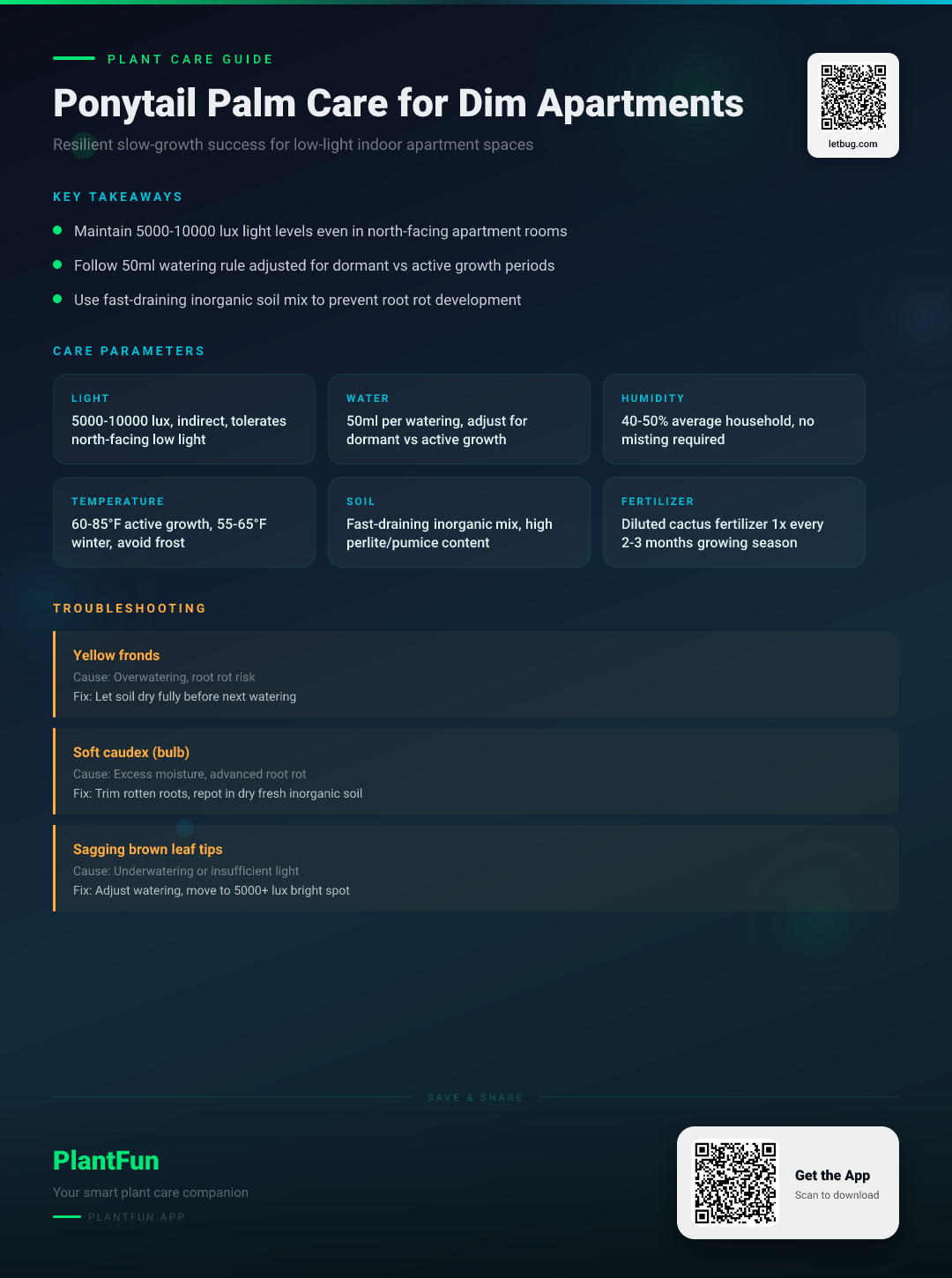
Key Takeaways
- Check soil moisture before watering — overwatering is the #1 killer of houseplants.
- Ensure your plant gets the right amount of light for its species.
- Be patient with recovery — most plants need 2–4 weeks to bounce back.
Quick Care Card: Essential Thresholds for Apartment Survival
| Feature | Requirement |
|---|---|
| Light | 5,000–10,000 lux (bright, indirect) |
| Water | Allow soil to dry completely; 50ml for small pots |
| Humidity | Low to Moderate (30-50%) |
| Temperature | 55-75°F (13-24°C) |
| Soil | Highly inorganic, grit-heavy cactus mix |
| Fertilizer | Balanced succulent feed in spring only |
| Toxicity | Non-toxic to cats and dogs (ASPCA, 2026) |
TL;DR: The Succulent Secret of the Beaucarnea recurvata
Despite the name, the Ponytail Palm is not a palm at all—it is a succulent member of the Asparagaceae family. Its swollen base, or caudex, acts as a water storage reservoir. In a low-light apartment, the biggest threat is overwatering, not underwatering. Treat it like a desert plant, keep it in a gritty soil mix, and provide the brightest spot in your home to prevent rot and maintain structural health.
Why Your Apartment Isn’t a Desert: Understanding Natural Habitat vs. Home Life
When I first brought home my Beaucarnea recurvata, I made the classic mistake of treating it like a tropical fern, placing it in a humid bathroom. It nearly succumbed to root rot within three weeks. While native to the semi-arid regions of Mexico (Gilman & Watson, 2003), your apartment environment is controlled. Even in a sunny apartment, you cannot replicate the intense solar radiation of the Mexican desert. Understanding that the caudex is an evolutionary adaptation for drought is the first step toward successful indoor plant care that lasts for decades.
The 3-Step Diagnosis: Identifying Root Rot, Dehydration, and Light Stress
- Root Rot: The caudex feels squishy or soft. The soil remains damp for more than 10 days after watering.
- Dehydration: The trunk wrinkles significantly. The fronds lose their rigidity and start drooping toward the floor.
- Light Stress: The plant stops producing new growth for months, or the stems grow thin and etiolated (stretched).
Light Requirements: Achieving 5,000-10,000 Lux in North-Facing Living Rooms
Many owners ask, “Can I put my ponytail palm in a dark corner?” The answer is a firm no. While it is tolerant of lower light than many desert succulents, it requires at least 5,000 lux to maintain metabolic function (NC State Extension, 2026). If you are in a north-facing apartment, place your palm directly on the windowsill. Do not place it more than two feet away from the glass, as light intensity drops exponentially with distance.
Watering Discipline: The 50ml Rule for Dormant vs. Active Growth Periods
In my experience, watering frequency is the most common cause of failure. During active growth (late spring to summer), I water only when the pot feels noticeably light. For an average 6-inch pot, I use no more than 50ml of water to ensure the soil doesn’t stay sodden. During winter, I reduce this to once every 6–8 weeks, as low metabolic rates make the plant susceptible to fungal pathogens (Annals of Agricultural Science, 2014).
Soil Science: Crafting the Perfect Inorganic Mix for Fast Drainage
Standard potting soil retains too much water, which causes the base to rot. I recommend creating a custom mix: 50% high-quality potting soil, 25% perlite, and 25% poultry grit or pumice. This inorganic composition ensures the roots have access to oxygen, which is vital for healthy root development.
Seasonal Shifts: Why Your Palm Needs 55-65°F (13-18°C) During Winter
Temperature regulation is a secret weapon for seasonal plant management. During winter, the Ponytail Palm enters a semi-dormant state. Keeping it in a slightly cooler room (55-65°F) mimics its natural cycle, preventing the plant from attempting to grow in low-light conditions, which often results in weak, thin fronds.
Can I keep my Ponytail Palm in a dark corner of my bedroom?
No. A dark corner will cause the plant to etiolate. If you must keep it in a bedroom, use a dedicated full-spectrum LED grow light positioned within 12 inches of the fronds for 8–10 hours a day.
Why is my Ponytail Palm’s bulb feeling soft to the touch?
Softness indicates potential root rot (NC State Extension, 2026). You must immediately unpot the plant, trim away mushy black roots with a sterile blade, and repot into fresh, dry, gritty soil.
How do I prune the tips without damaging the main caudex?
Use clean, sharp shears to trim only the brown, dry portion of the leaf. Do not cut into the green tissue, as this creates an entry point for pathogens and leaves unsightly scars.
Common Mistakes: Stop Misting Your Palm Immediately
- Mistake: Misting the fronds. What happens: Fungal spots and water accumulation in the crown. Instead: Keep the foliage dry and rely on ambient room humidity (ASPCA, 2026).
- Mistake: Using a pot without drainage holes. What happens: Water pools at the bottom, rotting the roots. Instead: Always use a pot with at least one large drainage hole.
Troubleshooting Guide: Quick fixes for yellowing fronds and sagging tips
Yellowing Leaves
Symptom: Lower fronds turning yellow and dropping.
Likely cause: Overwatering or inconsistent soil moisture levels.
Fix:
- Check the soil moisture with a probe.
- Increase the duration between waterings.
Brown, Crispy Leaf Tips
Symptom: The very ends of the leaves turn brown and brittle.
Likely cause: Low humidity or salt buildup from tap water.
Fix:
- Use filtered or distilled water.
- Flush the soil with fresh water once every six months.
Drooping Fronds
Symptom: The entire canopy loses its characteristic arch.
Likely cause: Severe light starvation.
Fix:
- Move the plant to a brighter location.
- Ensure it receives at least 4 hours of indirect sunlight daily.
References
- Gilman, E.; Watson, D. (2003). Beaucarnea recurvata: Ponytail palm. https://doi.org/10.32473/edis-st093-1993. Accessed 2026-03-17.
- Annals of Agricultural Science, Moshtohor. (2014). Effect of different growing media and chemical fertilization on growth and chemical composition of ponytail palm (Beaucarnea recurvata) plant. https://doi.org/10.21608/assjm.2014.111131. Accessed 2026-03-17.
- ASPCA. (2026). Toxic and Non-Toxic Plants List — ASPCA. https://www.aspca.org/pet-care/animal-poison-control/toxic-and-non-toxic-plants. Accessed 2026-03-17.
- North Carolina State University Extension. (2026). Ponytail Palm Care — NC State Extension Gardener Plant Toolbox. https://plants.ces.ncsu.edu/plants/ponytail-palm/. Accessed 2026-03-17.
Optional Helper: Plantfun.App
Plantfun.App identifies your plants by photo, diagnoses pests and diseases with clear fixes, and creates personalised watering and light schedules that adapt to your home conditions — a handy companion for putting this guide into daily practice.
Found an error or have suggestions? We'd love your feedback.
Need help identifying this problem?
Get instant identification, personalized care schedules, and effective pest treatment plans directly on your phone.
Sponsored • We may earn a commission from app downloads
Related Guides
Ponytail Palm Care for Small Apartment Living: The Only Guide You’ll Ever Need
Transform your small apartment into a desert oasis. Learn the precise watering, light, and soil metrics to keep your Ponytail Palm thriving for years to come.
Care GuidePonytail Palm Care in Dim Apartments: How to Stop Leaf Tip Browning and Decay
Stop killing your Ponytail Palm with overwatering. Learn the precise lux requirements, soil moisture thresholds, and 3 key fixes for resilient indoor growth.
Care GuideThe Complete Ponytail Palm Care Guide for Small Urban Apartments: Resilient Growth Made Easy
Grow a thriving ponytail palm even in a tiny urban apartment. Get exact light levels, watering amounts, space-saving tips, and a seasonal care calendar for resilient, low-fuss growth.
Pest ControlAnts on Plants: What They Mean and What to Do
Ants usually aren't eating your plant. They are farming other pests.