
Key Takeaways
- Check soil moisture before watering — overwatering is the #1 killer of houseplants.
- Ensure your plant gets the right amount of light for its species.
- Be patient with recovery — most plants need 2–4 weeks to bounce back.
Quick Care Card
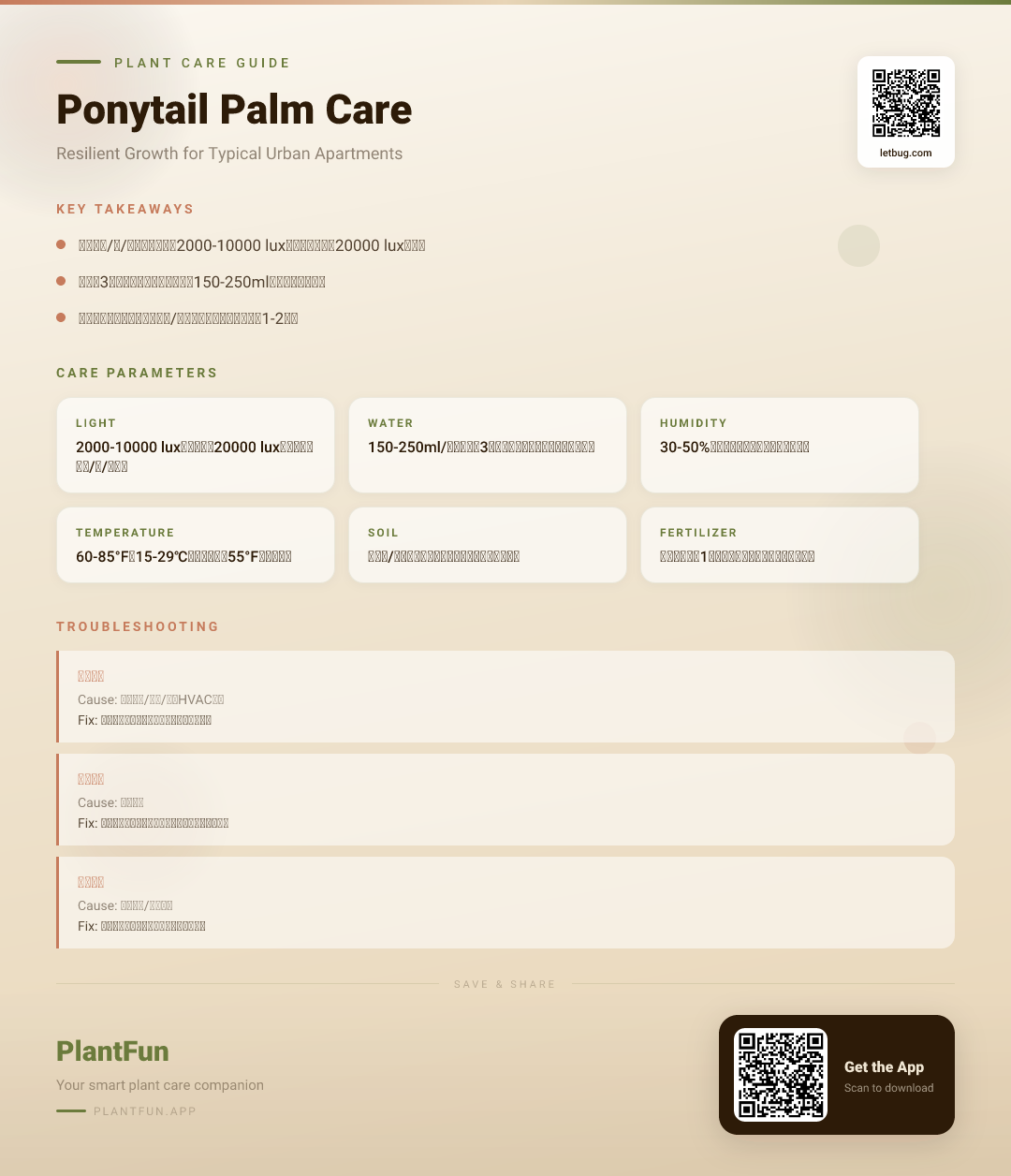
Print this at-a-glance cheat sheet for easy reference next to your plant:
| Care Parameter | Apartment-Specific Threshold |
|---|---|
| Light | 2,000–10,000 lux, tolerates up to 20,000 lux direct sun (NC State Extension, 2026) |
| Water | 150–250ml only when top 3 inches of soil are fully dry, adjust for seasonal humidity (Gilman & Watson, 2003) |
| Humidity | 30–50% (typical apartment humidity, no misting required) |
| Temperature | 60–85°F (15–29°C), avoid drafts below 50°F (10°C) |
| Soil | 70% cactus/succulent mix + 30% perlite for extra drainage (Annals of Agricultural Science, Moshtohor, 2014) |
| Fertilizer | 1x per growing season (spring/summer) with 50% diluted cactus fertilizer, no winter feeding |
| Toxicity | Non-toxic to cats, dogs, and humans (ASPCA, 2026) |
Why This Guide Is Different
Generic Ponytail Palm care guides often assume ideal growing conditions: consistent bright indirect light, 60%+ ambient humidity, and plenty of floor space, none of which match the reality of most urban apartments. Dry HVAC air, fluctuating light blocked by adjacent buildings, limited counter space, and busy, inconsistent care routines from renters mean generic “water every 2 weeks” advice will almost always lead to problems like brown tips or root rot. This guide is built explicitly for apartment conditions, with measurable, testable thresholds that require no fancy equipment to follow, perfect for Ponytail Palm care for beginners.
Step 1: Light Placement for Apartments
Meeting Ponytail Palm light requirements is the easiest way to encourage resilient growth with minimal effort. The ideal range is 2,000–10,000 lux, and it can tolerate up to 20,000 lux of direct sun for short periods (NC State Extension, 2026). Match your placement to your window direction:
- South-facing windows: Place 1–2 feet away from the glass to avoid midday sun scorch (this spot delivers 8,000–20,000 lux)
- East-facing windows: Place directly on the windowsill for gentle morning sun (3,000–7,000 lux, the perfect sweet spot)
- West-facing windows: Place 2 feet away from glass to avoid hot afternoon sun (4,000–9,000 lux)
Quick test: If you can hold your hand in the plant’s spot for 10 seconds at midday without discomfort, it is safe for direct sun exposure. If you only have dimmer spaces, check our FAQ below for guidance on whether can Ponytail Palm live in low light.
Step 2: Exact Watering Schedule for Apartments
The number one question new owners ask is how often to water Ponytail Palm, and the answer depends entirely on your apartment’s conditions: use 150–250ml of room-temperature water only when the top 3 inches of soil are completely dry (Gilman & Watson, 2003). To test, stick a wooden chopstick 3 inches deep into the soil: if it comes out completely clean with no damp soil clumps, it is time to water.
Adjust based on your apartment’s humidity:
- If humidity is below 35% (common in winter with heating), check soil every 10 days
- If humidity is above 45%, check soil every 14 days
Myth vs reality: Underwatering rarely kills Ponytail Palms (they store water in their thick bulbous caudex), but overwatering is the leading cause of death. Watch for Ponytail Palm overwatering signs like yellow leaves or damp, musty-smelling soil to catch issues early.
Step 3: Soil & Pot Requirements
The right Ponytail Palm soil mix and pot prevent 90% of common care issues for apartment growers. Use a mix of 70% commercial cactus/succulent mix and 30% perlite or pumice to boost drainage, a ratio proven to support healthy root growth in indoor conditions (Annals of Agricultural Science, Moshtohor, 2014). You can also follow our tested succulent soil mix recipes for a custom blend.
For pots, use an unglazed terracotta pot that is 1–2 inches larger than the plant’s root ball, with a mandatory drainage hole. Terracotta wicks away excess moisture, making it ideal for forgetful overwaterers. If you’re weighing pot options, check our guide to terracotta vs plastic pots for houseplants for a full breakdown. For small apartment Ponytail Palm care, sticking to a smaller pot will restrict growth so your plant does not outgrow your limited space.
Step 4: Temperature & Humidity for Apartment Environments
Ponytail Palms thrive in the typical temperature range of most urban apartments: 60–85°F (15–29°C) (NC State Extension, 2026). They tolerate the 30–50% humidity common in heated or air-conditioned apartments perfectly, no misting required. Misting is a useless practice for this desert native: it does not raise ambient humidity enough to make a difference, and can lead to leaf rot if water sits on foliage for too long.
12-Month Seasonal Care Calendar
Adjust your routine based on seasonal changes to keep your plant healthy year-round:
- Winter (October–March, Northern Hemisphere): Follow Ponytail Palm winter care rules: reduce watering by 50% (only water when the top 5 inches of soil are dry), avoid placing the plant within 1 foot of drafty windows where temperatures drop below 50°F, and skip all fertilizer applications.
- Summer (April–September, Northern Hemisphere): For Ponytail Palm summer watering, increase water volume by 20% if the soil dries out faster than 10 days. You can move the plant to a covered balcony if temperatures stay above 60°F, and apply one dose of 50% diluted cactus fertilizer in late spring to support new growth.
5 Most Common Ponytail Palm Mistakes in Apartments
Avoid these easy errors to keep your plant resilient with minimal effort:
- Mistake: Overwatering on a fixed schedule regardless of soil moisture What happens: Root rot, soft trunk, and yellow leaves, the top cause of Ponytail Palm death in apartments Instead: Only water when the top 3 inches of soil are completely dry, and use a measured 150–250ml per watering
- Mistake: Using a plastic pot with no drainage hole What happens: Traps excess moisture around roots, leading to rot even if you water correctly Instead: Use an unglazed terracotta pot with a drainage hole, sized 1–2 inches larger than the root ball
- Mistake: Placing the plant in light below 1,500 lux for months at a time What happens: Stunted growth, pale leaves, and increased risk of overwatering Instead: Place the plant within 2 feet of an east, west, or south-facing window, and rotate 1/4 turn every 2 weeks for even growth
- Mistake: Fertilizing more than once per year What happens: Salt buildup in soil leading to Ponytail Palm brown tips and leaf burn Instead: Fertilize only once per growing season with 50% diluted cactus fertilizer, and skip all winter feeding
- Mistake: Placing the plant within 3 feet of HVAC vents, radiators, or air conditioners What happens: Extreme temperature fluctuations and rapid moisture loss from leaves, leading to brown tips Instead: Keep the plant in a spot with consistent temperatures, away from direct airflow from heating or cooling systems
Troubleshooting Common Symptoms
Use these step-by-step fixes to resolve the most common issues, including why is my Ponytail Palm turning brown:
Ponytail Palm Brown Tips
Symptom: Dry, crispy brown edges on the tips of long, strap-like leaves.
Likely cause: Either salt buildup from over-fertilizing, placement near an HVAC vent, or occasional underwatering.
Fix:
- Trim brown tips with clean, sharp scissors, cutting at a 45-degree angle to match the natural leaf shape
- Flush soil with 3x the pot volume of distilled water to remove excess salt buildup
- Move the plant at least 3 feet away from any heating or cooling vents
Yellow Leaves
Symptom: Soft, yellowing lower leaves, often accompanied by damp, musty-smelling soil.
Likely cause: Overwatering leading to early root rot.
Fix:
- Stop watering immediately, let the soil dry completely for 2–4 weeks before watering again
- If the soil is extremely waterlogged, repot into fresh, dry cactus mix
- If you notice slimy black roots, follow our step-by-step guide to fixing root rot to save your plant
Wrinkled Base (Caudex)
Symptom: The thick, bulbous base of the plant feels soft and wrinkled to the touch.
Likely cause: Severe underwatering, as the caudex (water storage organ) has used up all its stored moisture.
Fix:
- Give the plant 250ml of room-temperature water, making sure the soil is evenly moist
- Check the soil every 7 days, and water again only when the top 3 inches are dry
- The caudex will plump back up within 2–3 weeks if caught early
Stunted Growth
Symptom: No new leaf growth for 6+ months during the growing season, with pale or thin leaves.
Likely cause: Insufficient light levels below 2,000 lux, or lack of seasonal nutrients.
Fix:
- Move the plant to a brighter spot within 2 feet of an east or south-facing window to meet Ponytail Palm light requirements
- Apply 1 dose of 50% diluted cactus fertilizer in late spring to boost growth
- Rotate the plant 1/4 turn every 2 weeks to ensure all sides get equal light exposure
Soft Trunk
Symptom: The lower trunk or caudex feels squishy and soft to the touch, often with a foul smell coming from the soil.
Likely cause: Advanced root rot from long-term overwatering.
Fix:
- Remove the plant from its pot immediately, and shake off all wet soil from the roots
- Trim all slimy, black, or rotting roots with sterile pruning shears, and dust the cut ends with cinnamon to prevent infection
- Repot into a completely dry, well-draining cactus mix in a terracotta pot with a drainage hole
- Do not water for 4–6 weeks after repotting to let the roots recover
Voice Search FAQ 1: Can I keep my Ponytail Palm in a dark corner of my apartment?
Ponytail Palms can tolerate low light (down to 1,500 lux) for short periods of 2–3 months, but long-term placement in a dark corner (below 1,000 lux) will lead to stunted growth, pale leaves, and increased risk of overwatering (NC State Extension, 2026). If you only have dim spaces, try rotating your Ponytail Palm with a brighter spot for 2 weeks at a time, or use the advanced growth tip below to boost light levels without expensive gear. If you’re looking for more plants that thrive in dim spaces, check our list of best low-light houseplants for apartments.
Voice Search FAQ 2: Why is my Ponytail Palm getting brown tips even when I water it regularly?
Regular watering doesn’t always equal correct watering! Brown tips are most often caused by salt buildup from over-fertilizing, placement near an HVAC vent that dries out leaf edges, or using tap water with high chlorine or fluoride levels (Gilman & Watson, 2003). Try flushing the soil with distilled water to remove excess salt, moving the plant away from vents, and using rainwater or filtered water for future waterings to see if the issue resolves.
Voice Search FAQ 3: How often should I repot my Ponytail Palm in a small apartment?
Ponytail Palms are slow-growing, so you only need to repot them every 2–3 years, or when you see roots growing out of the drainage hole (Annals of Agricultural Science, Moshtohor, 2014). For small apartment Ponytail Palm care, you can keep them in a smaller pot to restrict their growth, so they don’t get too large for your space. You only need to size up 1–2 inches at a time to avoid excess soil that holds too much moisture.
Advanced Growth Tip: How to encourage new leaf growth in low-light apartment spaces without expensive grow lights
If you want to know how to make Ponytail Palm grow faster in a dim apartment, try this low-cost hack: tape a sheet of aluminum foil to the wall behind your plant, shiny side facing the foliage. This reflects 80–90% of available light back onto the leaves, effectively doubling the light level the plant receives without any electricity or expensive grow lights. Rotate the plant 1/4 turn every 2 weeks to ensure all sides get equal reflected light. You can also move the plant to a bright windowsill for 1 week out of every month to give it a light boost, then move it back to its usual spot.
References
- NC State Extension. (2026). Ponytail Palm Care Checklist — NC State Extension Gardener Plant Toolbox. https://plants.ces.ncsu.edu/plants/palm-care/. Accessed 2026-03-05.
- Gilman, E.; Watson, D. (2003). Beaucarnea recurvata: Ponytail palm. EDIS. https://doi.org/10.32473/edis-st093-1993. Accessed 2026-03-05.
- Annals of Agricultural Science, Moshtohor. (2014). Effect of different growing media and chemical fertilization on growth and chemical composition of ponytail palm (Beaucarnea recurvata) plant. Annals of Agricultural Science, Moshtohor. https://doi.org/10.21608/assjm.2014.111131. Accessed 2026-03-05.
- ASPCA. (2026). Toxic and Non-Toxic Plants List — ASPCA. https://www.aspca.org/pet-care/animal-poison-control/toxic-and-non-toxic-plants. Accessed 2026-03-05.
Optional Helper: Plantfun.App
Plantfun.App identifies your plants by photo, diagnoses pests and diseases with clear fixes, and creates personalised watering and light schedules that adapt to your home conditions — a handy companion for putting this guide into daily practice.
Found an error or have suggestions? We'd love your feedback.
Need help identifying this problem?
Get instant identification, personalized care schedules, and effective pest treatment plans directly on your phone.
Sponsored • We may earn a commission from app downloads
Related Guides
Ponytail Palm in Typical Apartments: The Only Care Checklist You'll Ever Need
Grow a lush, low-fuss ponytail palm even in your small apartment. Get exact light, water, and soil specs plus common mistake fixes to avoid brown tips and stunted growth.
Care GuideThe Complete Ponytail Palm Care Checklist for Resilient Growth in Small Urban Apartments
Grow a lush, full Ponytail Palm in your small urban apartment without expensive gear. Get exact light levels, water amounts, and a free printable care checklist for resilient, low-fuss growth.
Care GuidePonytail Palm in Typical Apartments: The Seasonal Care Checklist for Resilient Growth That Lasts Year-Round
Grab our seasonal ponytail palm care checklist tailored for typical apartments, with exact light, water, and humidity thresholds to keep your plant growing resiliently for decades.
Pest ControlAnts on Plants: What They Mean and What to Do
Ants usually aren't eating your plant. They are farming other pests.