
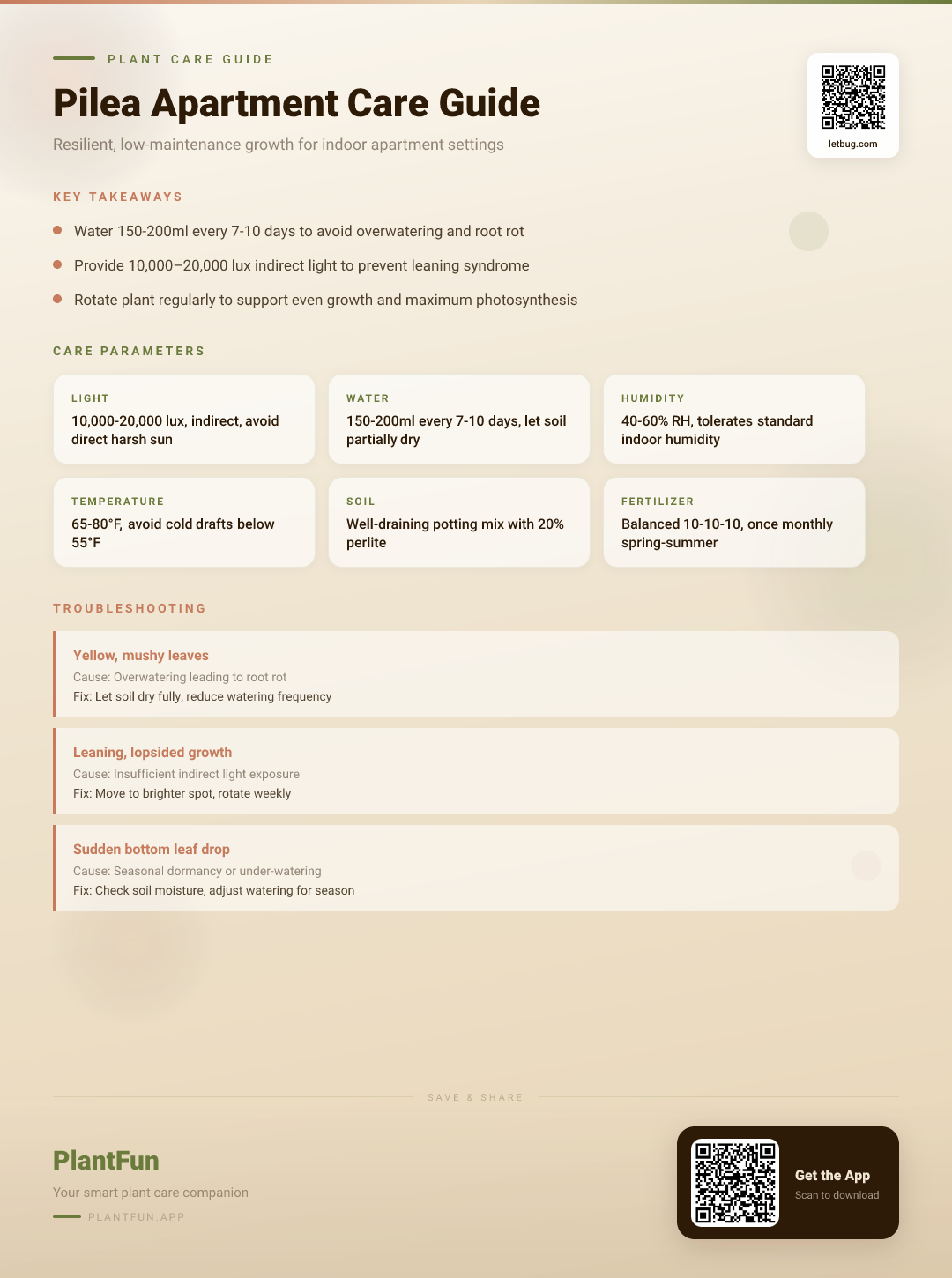
Key Takeaways
- Check soil moisture before watering — overwatering is the #1 killer of houseplants.
- Ensure your plant gets the right amount of light for its species.
- Be patient with recovery — most plants need 2–4 weeks to bounce back.
Quick Care Card: Essential Data for Your Pilea
| Feature | Requirement |
|---|---|
| Light | Bright, indirect (10,000–20,000 lux) |
| Water | 150-200ml when top 2 inches of soil are dry |
| Humidity | 40-60% (average household range) |
| Temperature | 65-80°F (18-27°C) |
| Soil | High-drainage mix with 20% perlite |
| Fertilizer | Balanced liquid feed, diluted by half monthly |
| Toxicity | Non-toxic to cats and dogs (ASPCA, 2026) |
TL;DR: The 30-Second Pilea Survival Checklist
To keep your Pilea peperomioides happy in an apartment, follow these rules: provide bright, indirect light, allow the top two inches of soil to dry out between waterings, and ensure your pot has adequate drainage. Avoid direct afternoon sun to prevent leaf scorch and never let the roots sit in standing water. When I first started collecting indoor plants, I killed my first Pilea by drowning it—now, I strictly use a moisture meter or the “finger test” before adding water.
Why Your Apartment Pilea is Different: Natural Habitat vs. The Living Room
Pilea species in the wild are understory dwellers, receiving dappled sunlight through the canopy (Gilman, 2007). In your apartment, your windows act as the filter. Unlike outdoor specimens, indoor Pilea lack the natural airflow that prevents fungal pathogens in the soil. Maintaining a balance between soil oxygenation and moisture is key to replicating their native, temperate environment (NC State Extension, 2026).
Light Requirements: Achieving 10,000–20,000 lux without burning leaves
Your Pilea thrives on consistent, bright light. If you are tracking light levels, aim for 10,000–20,000 lux. In practical terms, this means placing your plant within 3 feet of an east-facing window. If you only have south or west-facing windows, use a sheer curtain to diffuse the rays. Without sufficient light, your plant will exhibit etiolation—stretching out and losing its compact, circular structure.
The Watering Science: Why 150-200ml every 7-10 days is your target
Watering is not a schedule; it is a response to environmental demand. In a standard 6-inch nursery pot, 150-200ml of water is generally sufficient for the plant to absorb what it needs without saturating the root zone. Always check the soil: stick your finger 2 inches into the medium. If it feels damp, wait two more days. Overwatering causes the roots to suffocate, leading to the dreaded yellowing leaves often seen in Pilea care for beginners articles.
Soil and Drainage: The Non-Negotiable 20% Perlite Mix
I swear by a “chunky” soil mix. Standard potting soil is too dense and retains too much moisture for a Pilea. I mix 80% standard indoor potting mix with 20% perlite. This creates air pockets in the substrate, allowing the roots to breathe and preventing the anaerobic conditions that invite root rot.
Seasonal Shifts: Adjusting care for 65-80°F temperatures and winter dormancy
Your Pilea will slow down during the shorter, darker days of winter. During this time, reduce watering by roughly 30%. Because growth slows, the plant consumes less water. Always keep the plant away from drafty doors or heating vents, which can desiccate the foliage rapidly.
Mistake #1: Overwatering and the Root Rot Cycle
Mistake: Frequent, light watering (the “daily misting” approach). What happens: The soil stays permanently damp, killing root hair cells. Instead: Soak the soil thoroughly once and then wait for the soil to dry out significantly.
Mistake #2: Insufficient Light and the ‘Leaning’ Pilea Syndrome
Mistake: Keeping the plant in a dark corner. What happens: The plant tilts aggressively toward the nearest light source to maximize photosynthesis. Instead: Move the plant closer to a window or use a dedicated grow light setup to ensure even distribution.
Voice FAQ: Why is my Pilea dropping its bottom leaves?
Lower leaf drop is usually a sign of age or moisture stress. If the leaves are yellowing before falling, it is likely an overwatering issue (NC State Extension, 2026). If the leaves are crispy and brown, the plant is likely too thirsty or the humidity is too low.
Voice FAQ: Can I keep my Pilea in a north-facing studio apartment?
Yes, but you must keep it right against the glass. North-facing windows provide the least intensity, so your Pilea might grow slower than normal. If you notice it leaning, supplement with a small LED grow light for 4-6 hours a day.
Voice FAQ: How do I know when it’s time to repot my Pilea?
When you see roots growing out of the drainage holes or the plant dries out within 2-3 days of watering, it is time to move up one pot size (typically 1-2 inches larger in diameter).
Step-by-Step: Rotating and Cleaning Your Pilea for Maximal Photosynthesis
- Rotate: Every time you water, rotate your pot 90 degrees to ensure all sides receive equal light.
- Dust: Every 2 weeks, gently wipe the leaves with a damp microfiber cloth to remove dust that blocks light intake.
- Clean: Remove any dead or decaying foliage from the soil surface to discourage pests.
- Prune: If the plant becomes too heavy, use sterile shears to remove any pups (offsets) growing from the base to redirect energy.
References and Botanical Notes
- Gilman, E. (2007). Pilea cadierei Aluminum Plant. https://doi.org/10.32473/edis-fp478-1999. Accessed 2026-03-15.
- Gilman, E. (2007). Pilea microphylla Artillery Plant. https://doi.org/10.32473/edis-fp479-1999. Accessed 2026-03-15.
- ASPCA. (2026). Toxic and Non-Toxic Plants List — ASPCA. https://www.aspca.org/pet-care/animal-poison-control/toxic-and-non-toxic-plants. Accessed 2026-03-15.
- NC State Extension. (2026). Pilea — NC State Extension Gardener Plant Toolbox. https://plants.ces.ncsu.edu/plants/pilea-care/. Accessed 2026-03-15.
Optional Helper: Plantfun.App
Plantfun.App identifies your plants by photo, diagnoses pests and diseases with clear fixes, and creates personalised watering and light schedules that adapt to your home conditions — a handy companion for putting this guide into daily practice.
Found an error or have suggestions? We'd love your feedback.
Need help identifying this problem?
Get instant identification, personalized care schedules, and effective pest treatment plans directly on your phone.
Sponsored • We may earn a commission from app downloads
Related Guides
The Complete Pilea Peperomioides Care Guide for Small Apartments: Resilient Growth All Year
Grow a lush, happy Pilea in your small apartment with exact care thresholds, a seasonal routine, and a printable checklist that prevents overwatering and yellow leaves all year.
Care GuidePilea peperomioides in a Drafty Apartment: The Complete Resilient Growth Care Guide
Stop losing leaves to drafts. Learn the exact light thresholds, watering schedules, and nutrient hacks to keep your Pilea thriving in any apartment setting.
Care GuidePilea Peperomioides in a Small Apartment: The Ultimate Care Guide for Resilient Year-Round Growth
Transform your Pilea's health with this apartment-tested care guide. Master precise light, watering schedules, and seasonal routines for lush, pancake-leaf growth.
Pest ControlAnts on Plants: What They Mean and What to Do
Ants usually aren't eating your plant. They are farming other pests.