
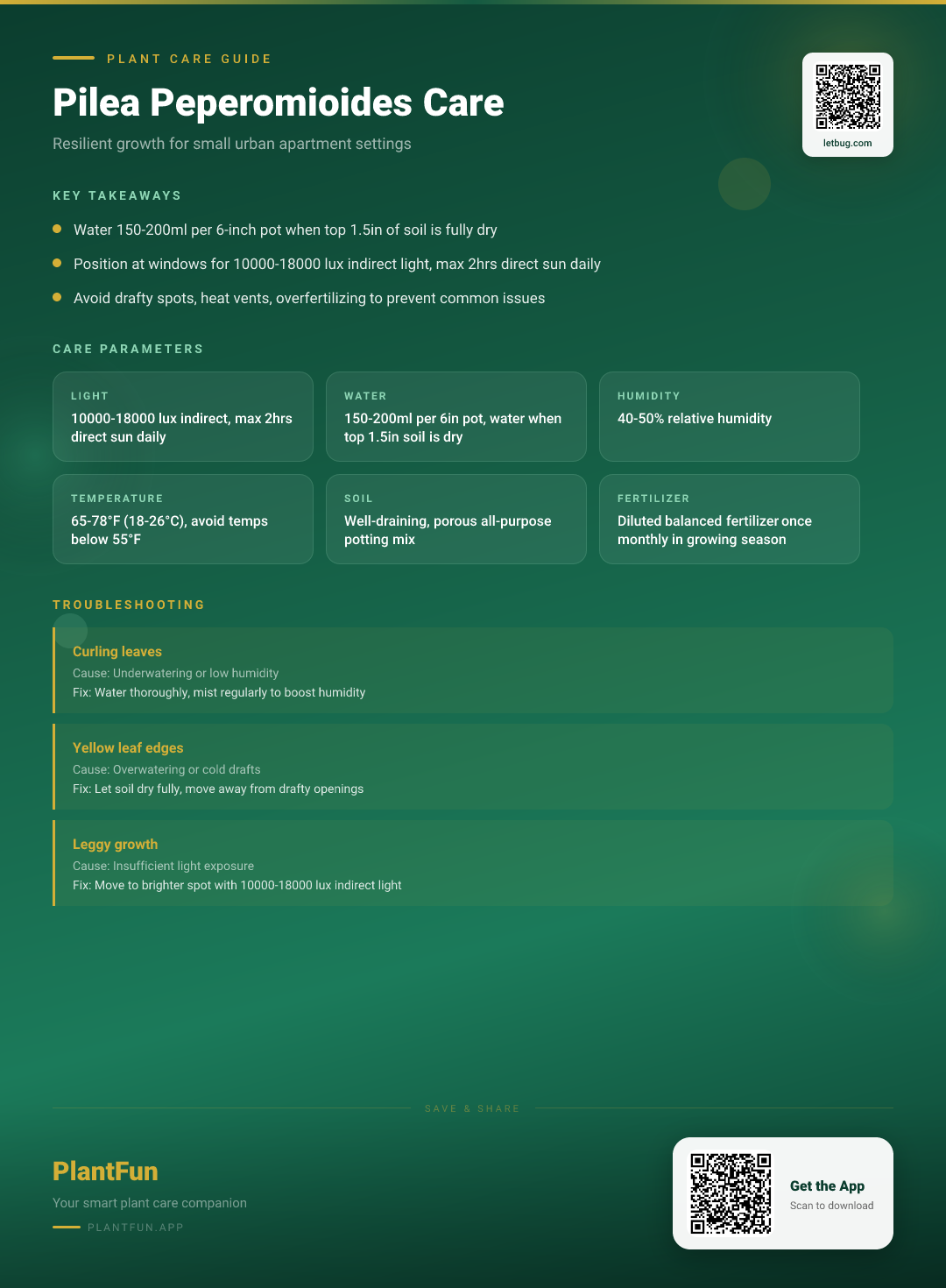
Key Takeaways
- Check soil moisture before watering — overwatering is the #1 killer of houseplants.
- Ensure your plant gets the right amount of light for its species.
- Be patient with recovery — most plants need 2–4 weeks to bounce back.
Quick Care Card
| Parameter | Exact Apartment-Grown Pilea Threshold |
|---|---|
| Light | 10,000–18,000 lux, max 2 hours of direct sun daily (Winter et al., 2021) |
| Water | 150–200 mL of filtered room-temperature water per 6-inch pot when top 1.5 inches of soil is fully dry |
| Humidity | 40–50% relative humidity (NC State Extension, 2026) |
| Temperature | 65–78°F (18–26°C), never expose to temps below 55°F (13°C) |
| Soil | Well-draining potting mix with 20% perlite added for aeration |
| Fertilizer | Half-strength balanced 10-10-10 liquid fertilizer once monthly in spring and summer only |
| Toxicity | Non-toxic to cats, dogs, and humans (ASPCA, 2026) |
Why Pilea Thrives (or Struggles) in Typical Small Urban Apartments
Pilea peperomioides is native to the shaded, mild understory of Yunnan, China’s mountain forests, where it gets consistent bright indirect light, moderate humidity, and well-draining rocky soil (NC State Extension, 2026). Most small urban apartments present three key stressors that conflict with this native habitat: low light from north-facing or obstructed windows, dry air from forced heat or AC, and fluctuating temperatures from drafty entryways or window sills. The good news is that Pilea’s succulent leaves store water, giving it far more resilience than most tropical houseplants (Winter et al., 2021), making it ideal for small apartment Pilea care if you follow the measurable thresholds in this guide. A common myth is that Pilea needs a large, sunlit space to grow: in reality, it will thrive on a 1-foot wide shelf or counter if you meet its core care requirements.
Pilea Symptom-to-Action Quick Reference Table
This table links common visual symptoms to immediate, measurable fixes, no guesswork required:
| Symptom | Likely Cause | Immediate Fix |
|---|---|---|
| Curling leaves | Underwatering or humidity below 30% | Give 150 mL of water, mist leaves thoroughly, check soil moisture every 3 days |
| Yellow leaf edges | Overwatering or fertilizer burn | Let soil dry completely, pause fertilizing for 6 weeks, inspect roots for rot if stems are mushy |
| Leggy growth with spaced leaves | Light levels below 8,000 lux | Move 1 foot closer to an east/west-facing window, add 6 hours of grow light daily if needed |
| Brown leaf tips | Dry hot air from heat/AC vents | Move 3 feet away from heat/AC sources, add a pebble tray under the pot to boost humidity |
| Drooping leaves | Severe underwatering or overwatering | Check soil: if dry, give 200 mL of water; if soggy, let drain completely and repot if needed |
| Tiny brown spots on leaf tops | Sunburn from excess direct sun | Move 2 feet back from the window, use a sheer curtain to filter afternoon sun, trim damaged leaves |
| This table covers the most common questions like why is my Pilea leaves curling and Pilea yellow leaves fix for Pilea care for beginners. |
Step-by-Step Weekly Care Checklist
Follow these 7 actionable tasks each week for consistent, resilient growth:
- Sunday (Water Check): Stick your index finger 1.5 inches into the soil. If no soil sticks to your finger, water 150–200 mL per 6-inch pot, then empty the saucer 15 minutes later to avoid root rot. This answers the common question of how often to water Pilea for apartment environments.
- Monday (Leaf Care): Wipe both sides of leaves with a damp microfiber cloth to remove dust, which blocks light absorption and slows growth.
- Wednesday (Light Check): Use a free phone light meter app to measure lux at the plant’s leaf level. If readings are below 8,000 lux, move the plant 1 foot closer to a bright window.
- Thursday (Humidity Check): Use a $10 hygrometer to measure relative humidity. If below 40%, mist leaves for 2 minutes with room-temperature filtered water.
- Friday (Rotation): Rotate the pot 90 degrees to encourage even, full growth and prevent legginess.
- Weekly (Draft Check): Confirm the plant is not within 1 foot of drafty windows, entry doors, heat vents, or AC units.
- Once monthly (Spring/Summer only): Apply half-strength balanced liquid fertilizer to support new growth, this is how to make Pilea grow faster without causing fertilizer burn.
12-Month Seasonal Care Calendar
Adjust your care routine to match seasonal apartment conditions:
- Spring (March–May): As light levels rise, increase watering frequency by 10%, start monthly fertilizing, and inspect for root bound signs to repot if needed.
- Summer (June–August): Limit direct sun to 2 hours per day to avoid sunburn, mist twice weekly if you run AC regularly, and follow our Pilea summer watering tips by checking soil moisture every 5 days instead of 7. Keep the plant at least 3 feet away from AC vents to avoid cold drafts.
- Fall (September–November): Reduce watering by 20% as growth slows, stop fertilizing completely, and move the plant away from drafty windows as outdoor temperatures drop.
- Winter (December–February): Follow Pilea winter care for apartments guidelines: water only when the top 2 inches of soil is dry, supplement with a full-spectrum grow light for 6 hours daily if lux levels drop below 8,000, and keep the plant 3 feet away from heat vents to avoid dry air damage.
Exact Light Requirements for Apartment Window Placement
Pilea light requirements indoors fall strictly between 10,000 and 18,000 lux, with a maximum of 2 hours of direct gentle sun per day (Winter et al., 2021). Match your window direction to these placement rules:
- East-facing windows: Ideal placement. The plant gets 1–2 hours of gentle morning sun, followed by bright indirect light for the rest of the day, which hits the optimal lux range perfectly.
- West-facing windows: Works if you place the plant 2 feet back from the window and use a sheer curtain to filter harsh afternoon sun. Never leave it in direct west sun for more than 2 hours, as it will cause sunburn.
- North-facing windows: Only suitable if you supplement with a full-spectrum grow light for 6 hours per day. Without supplemental light, north-facing windows only provide 2,000–5,000 lux, which is too low and will cause leggy growth.
- South-facing windows: Avoid unless you place the plant 3+ feet back from the window and use a double sheer curtain to filter intense midday sun.
Watering Rules for Dry Apartment Air
Pilea’s succulent leaves store water, so overwatering is the #1 cause of death for apartment-grown Pilea (Radcliffe-Smith, 1997). Follow these exact rules:
- Base rule: Give 150–200 mL of filtered room-temperature water per 6-inch pot only when the top 1.5 inches of soil is completely dry. Quick test: stick your index finger up to the second knuckle into the soil, if no soil sticks, it’s time to water.
- Adjustments for forced heat (winter): Reduce water volume by 20%, as heat dries out the top layer of soil faster than the lower layers, so you’ll water less often.
- Adjustments for AC (summer): Increase water volume by 10% if you run AC 8+ hours per day, as AC removes moisture from the air and soil.
- Never let the pot sit in standing water: empty the saucer 15 minutes after watering to prevent root rot.
Humidity & Temperature Parameters
Pilea humidity needs sit between 40–50% relative humidity, and ideal ambient temperature is 65–78°F (18–26°C) (NC State Extension, 2026). Follow these rules for apartment environments:
- Never expose Pilea to temperatures below 55°F (13°C), as cold drafts will cause leaf drop and permanent root damage. Keep the plant at least 1 foot away from drafty windows and entry doors, especially in winter.
- If your apartment humidity is below 40%, use one of these 2-minute fixes: group Pilea with other houseplants to raise ambient humidity, or place a pebble tray filled with water under the pot (make sure the pot is not sitting in the water).
- You don’t need an expensive humidifier for Pilea: it tolerates average apartment humidity (30–40%) just fine, it will just grow slightly slower than it would at the optimal 40–50% range.
Common Apartment-Specific Pilea Mistakes to Avoid
Avoid these common errors that cause preventable Pilea damage in small apartments:
- Mistake: Placing directly on drafty window sills or next to entry doors. What happens: Cold drafts cause sudden leaf drop, stunted growth, and root damage if temperatures drop below 55°F. Instead: Place the plant on a shelf or plant stand 1 foot away from drafty openings, and use a window insulation kit in winter if your windows are leaky.
- Mistake: Overfertilizing in small pots. What happens: Excess fertilizer builds up in the small volume of soil, causing fertilizer burn, yellow leaf edges, and root damage. Instead: Only fertilize once monthly in spring and summer at half the recommended strength, and skip fertilizing completely in fall and winter when growth slows.
- Mistake: Setting near heat vents or radiators. What happens: Dry hot air blows directly on the leaves, causing brown leaf tips, curling leaves, and rapid soil drying that leads to underwatering. Instead: Keep Pilea at least 3 feet away from heat sources, and increase misting to twice weekly if your apartment uses forced heat.
- Mistake: Ignoring early Pilea root bound signs. What happens: Roots grow out of drainage holes, soil dries out within 2 days of watering, and growth stalls even with optimal light and water. Instead: Repot into a pot 1–2 inches larger than the current one every 1–2 years in early spring. If you don’t have space for a larger pot, root prune by trimming 1/3 of the root ball and repotting back into the same pot with fresh soil.
FAQ
Can I keep my Pilea on my apartment fire escape in the summer?
Only if three conditions are met: temperatures stay between 65–78°F at all times, it gets no more than 2 hours of direct sun per day, and it’s protected from heavy rain and strong wind. If nighttime temperatures drop below 55°F or daytime temperatures rise above 90°F, bring it back inside immediately. Always secure the pot to the fire escape railing to prevent it from falling and injuring people below.
Why is my apartment Pilea growing leggy even if I water it regularly?
Leggy growth is almost always caused by insufficient light (NC State Extension, 2026). If your Pilea is getting less than 10,000 lux of light per day (roughly 6 hours of bright indirect light), it will stretch towards the light source, leading to long thin stems and spaced-out leaves. Fix this by moving the plant 1 foot closer to an east or west-facing window, or supplementing with a full-spectrum grow light for 6 hours per day. Rotate the pot 90 degrees weekly to encourage even, full growth.
How often do I need to repot my Pilea in a small apartment?
Repot every 1–2 years, or as soon as you see Pilea root bound signs: roots growing out of the drainage holes, soil dries out within 2 days of watering, or growth stalls for more than 2 months during the spring/summer growing season. If you don’t have space for a larger pot, you can root prune the plant instead to keep it small: gently remove the root ball, trim off 1/3 of the outer roots, and repot back into the same pot with fresh well-draining soil.
References
- ASPCA. (2026). Toxic and Non-Toxic Plants List — ASPCA. https://www.aspca.org/pet-care/animal-poison-control/toxic-and-non-toxic-plants. Accessed 2026-03-08.
- NC State Extension. (2026). Pilea Peperomioides — NC State Extension Gardener Plant Toolbox. https://plants.ces.ncsu.edu/plants/pilea-peperomioides/. Accessed 2026-03-08.
- Winter, K.; Garcia, M.; Virgo, A. (2021). Low-level CAM photosynthesis in a succulent-leaved member of the Urticaceae, Pilea peperomioides. Functional Plant Biology. https://doi.org/10.1071/fp20151. Accessed 2026-03-08.
- Radcliffe‐Smith, A. (1997). A supplementary note on the cultivation of Pilea peperomioides. Curtis’s Botanical Magazine. https://doi.org/10.1111/1467-8748.00063. Accessed 2026-03-08.
Optional Helper: Plantfun.App
Plantfun.App identifies your plants by photo, diagnoses pests and diseases with clear fixes, and creates personalised watering and light schedules that adapt to your home conditions — a handy companion for putting this guide into daily practice.
Found an error or have suggestions? We'd love your feedback.
Need help identifying this problem?
Get instant identification, personalized care schedules, and effective pest treatment plans directly on your phone.
Sponsored • We may earn a commission from app downloads
Related Guides
The Complete Pilea Peperomioides Care Checklist for Resilient Growth in Small Urban Apartments
Grow a bushy, happy Pilea in your small urban apartment with our science-backed checklist. Get exact light levels, water amounts, and mistake fixes to avoid yellow leaves or leggy growth.
Care GuidePilea Peperomioides Care Checklist for East-Facing Apartment Shelves: Resilient Lush Growth
Stop dealing with leggy, droopy Pilea plants. Get our 12-step care checklist, exact light, water, and humidity thresholds for resilient, lush growth in your east-facing apartment.
Care GuidePilea Peperomioides Care Checklist for Resilient Growth in Typical Urban Apartments
Stop guessing Pilea peperomioides care rules. Get our evidence-based 8-step checklist, exact light/water thresholds, and stress sign diagnosis guide to grow lush, resilient Pileas in your apartment.
Pest ControlAnts on Plants: What They Mean and What to Do
Ants usually aren't eating your plant. They are farming other pests.