
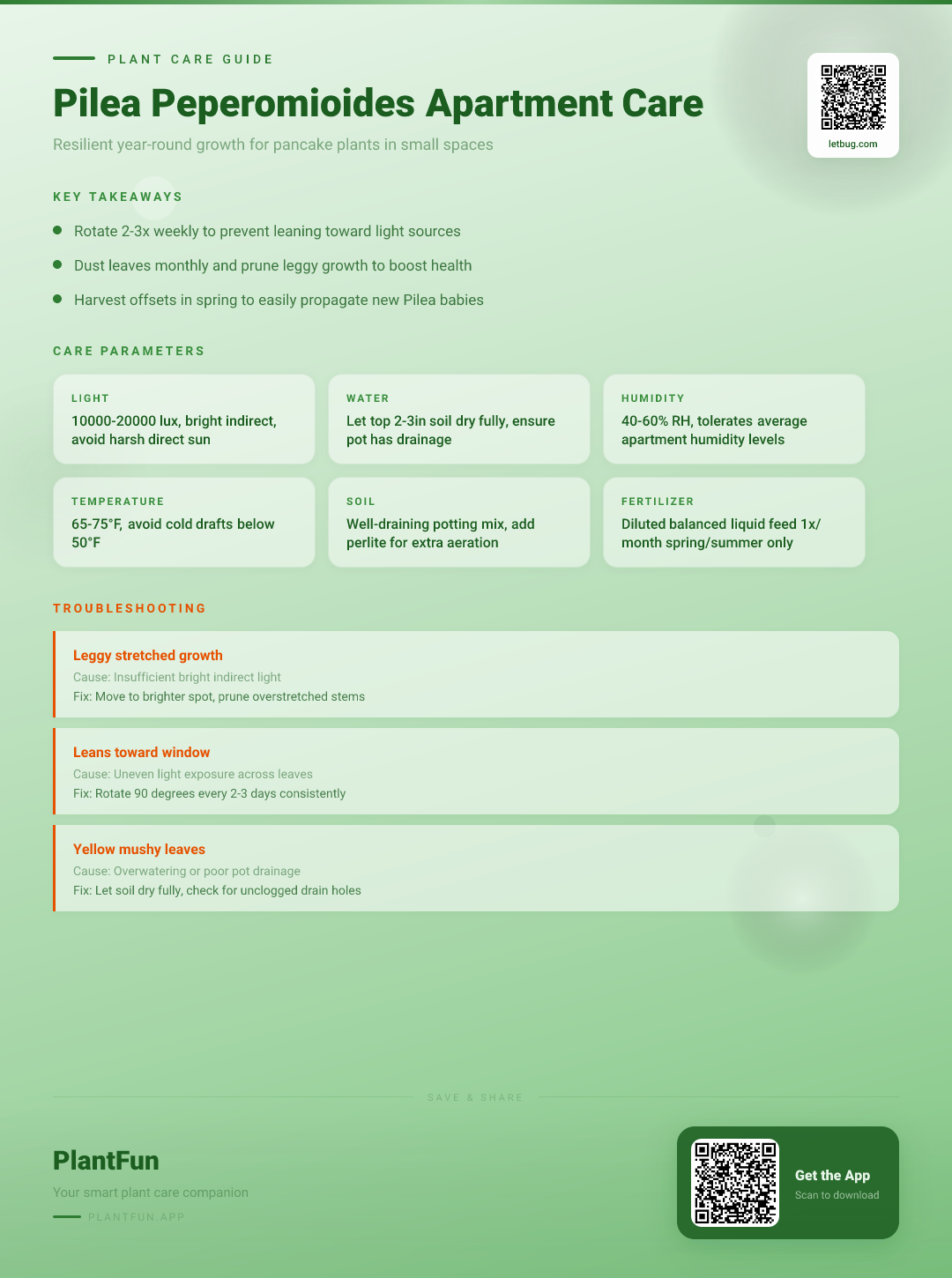
Key Takeaways
- Check soil moisture before watering — overwatering is the #1 killer of houseplants.
- Ensure your plant gets the right amount of light for its species.
- Be patient with recovery — most plants need 2–4 weeks to bounce back.
Quick Care Card: Essential Thresholds for Apartment Pilea
| Feature | Requirement |
|---|---|
| Light | 10,000–20,000 lux (bright, indirect) |
| Watering | Allow top 50% of soil to dry out |
| Temperature | 60°F–75°F (15°C–24°C) |
| Humidity | 40%–50% (average home) |
| Soil | Well-draining, peat-free mix with perlite |
| Fertilizer | Balanced liquid feed, monthly in summer |
| Toxicity | Non-toxic to cats and dogs (ASPCA, 2026) |
TL;DR: The 30-Second Pilea Survival Rule
To keep your Pilea peperomioides happy in an apartment, place it within 3 feet of a bright window, rotate it weekly to prevent leaning, and water only when the top half of the soil feels completely dry. Avoid overwatering—it is the fastest way to kill this plant.
My Experience: Learning the Hard Way
When I first brought my Pilea home to my compact city apartment, I placed it in a dark corner, thinking it would appreciate the “shade.” Within three weeks, the stems stretched, the lower leaves turned yellow, and it began tilting aggressively toward a sliver of light. I learned quickly that this plant is a light-seeker that demands consistent conditions (NC State Extension, 2026). My trial-and-error taught me that consistent rotation and strictly monitoring soil moisture are the secrets to the iconic “pancake” shape.
Why Pilea Peperomioides Struggle in Typical Apartments
Apartments often have inconsistent microclimates—think drafty windows, dry air from central heating, and limited natural light. Unlike in a greenhouse, your Pilea is fighting against stagnant air and light obstruction from neighboring buildings. Understanding that this plant is a member of the Urticaceae family helps explain why it requires specific airflow to prevent fungal issues often caused by overwatering (Winter et al., 2021).
Light Dynamics: Providing 10,000-20,000 Lux in Limited Spaces
Your Pilea thrives when it receives bright, indirect light. In a small apartment, this usually means placing the plant on a windowsill with sheer curtains or on a table just inside an east-facing window. If your plant is stretching, it isn’t getting enough energy to sustain its foliage.
The Watering Protocol: Measuring Moisture Levels (ML Guidelines)
I use the “finger test” every time. Push your finger 2 inches into the soil; if it feels damp, wait. A small pot (4-6 inches) usually needs 100-150ml of water every 10-14 days. Always ensure your pot has drainage holes—never let the roots sit in standing water, which leads to root rot (Radcliffe-Smith, 1997).
Seasonal Routine: Adjusting Care
- Summer (High Growth): Water once the top inch is dry. Feed monthly with a diluted houseplant fertilizer.
- Winter (Dormancy): Growth slows. Let the soil dry 75% of the way down before watering to prevent stagnant moisture.
Troubleshooting Guide
[Drooping Leaves]
Symptom: The leaves look sad and wilted even when the soil is damp.
Likely cause: Overwatering leading to root suffocation.
Fix:
- Check the roots for dark, mushy spots.
- Move to a pot with better drainage or repot into fresh, dry soil.
[Leggy Growth]
Symptom: Long, bare stems with sparse foliage.
Likely cause: Insufficient light.
Fix:
- Move the plant closer to a light source.
- Consider a grow light if your apartment windows are perpetually blocked.
How do I prevent my Pilea from tilting toward the window?
Rotation is key. Every time I water, I turn the pot 90 degrees. This ensures all sides receive equal light, keeping the growth pattern symmetrical rather than lopsided.
Can I keep my Pilea on a shelf away from direct sun?
While you can, it will likely lose its compact form. If a shelf is your only option, prioritize a high-traffic, bright area and consider using a supplemental LED grow light to maintain the recommended 10,000-20,000 lux (NC State Extension, 2026).
Step-by-Step: Rotating, Pruning, and Managing Offsets
- Rotate: Turn 90 degrees weekly during waterings.
- Prune: If leaves yellow, snip the petiole near the main stem with sterilized shears.
- Offsets: Once babies reach 2-3 inches, gently separate them from the mother plant’s root system for propagation.
Common Apartment Pitfalls
- Mistake: Using dense, garden soil.
- What happens: Root rot due to poor aeration.
- Instead: Use a well-draining indoor potting mix amended with 30% perlite.
Expert Tips for Propagating Pilea Babies
Propagating your Pilea is one of the most rewarding indoor plant tips I can share. Use a clean blade to cut the “pup” just below the soil line. Place the cutting in water until roots are 1 inch long, then transplant into a 3-inch pot.
References
- Winter, K.; Garcia, M.; Virgo, A. (2021). Low-level CAM photosynthesis in a succulent-leaved member of the Urticaceae, Pilea peperomioides. Functional Plant Biology. https://doi.org/10.1071/fp20151. Accessed 2026-03-13.
- Radcliffe‐Smith, A. (1997). A supplementary note on the cultivation of Pilea peperomioides. Curtis’s Botanical Magazine. https://doi.org/10.1111/1467-8748.00063. Accessed 2026-03-13.
- ASPCA. (2026). Toxic and Non-Toxic Plants List — ASPCA. https://www.aspca.org/pet-care/animal-poison-control/toxic-and-non-toxic-plants. Accessed 2026-03-13.
- NC State Extension. (2026). Pilea Peperomioides — NC State Extension Gardener Plant Toolbox. https://plants.ces.ncsu.edu/plants/pilea-peperomioides/. Accessed 2026-03-13.
Optional Helper: Plantfun.App
Plantfun.App identifies your plants by photo, diagnoses pests and diseases with clear fixes, and creates personalised watering and light schedules that adapt to your home conditions — a handy companion for putting this guide into daily practice.
Found an error or have suggestions? We'd love your feedback.
Need help identifying this problem?
Get instant identification, personalized care schedules, and effective pest treatment plans directly on your phone.
Sponsored • We may earn a commission from app downloads
Related Guides
The Complete Pilea Peperomioides Care Checklist for Resilient Growth in Small Urban Apartments
Grow a bushy, happy Pilea in your small urban apartment with our science-backed checklist. Get exact light levels, water amounts, and mistake fixes to avoid yellow leaves or leggy growth.
Care GuidePilea Peperomioides Care Checklist for East-Facing Apartment Shelves: Resilient Lush Growth
Stop dealing with leggy, droopy Pilea plants. Get our 12-step care checklist, exact light, water, and humidity thresholds for resilient, lush growth in your east-facing apartment.
Care GuideThe Complete Pilea Peperomioides Care Guide for Small Apartments: Resilient Growth All Year
Grow a lush, happy Pilea in your small apartment with exact care thresholds, a seasonal routine, and a printable checklist that prevents overwatering and yellow leaves all year.
Pest ControlAnts on Plants: What They Mean and What to Do
Ants usually aren't eating your plant. They are farming other pests.