
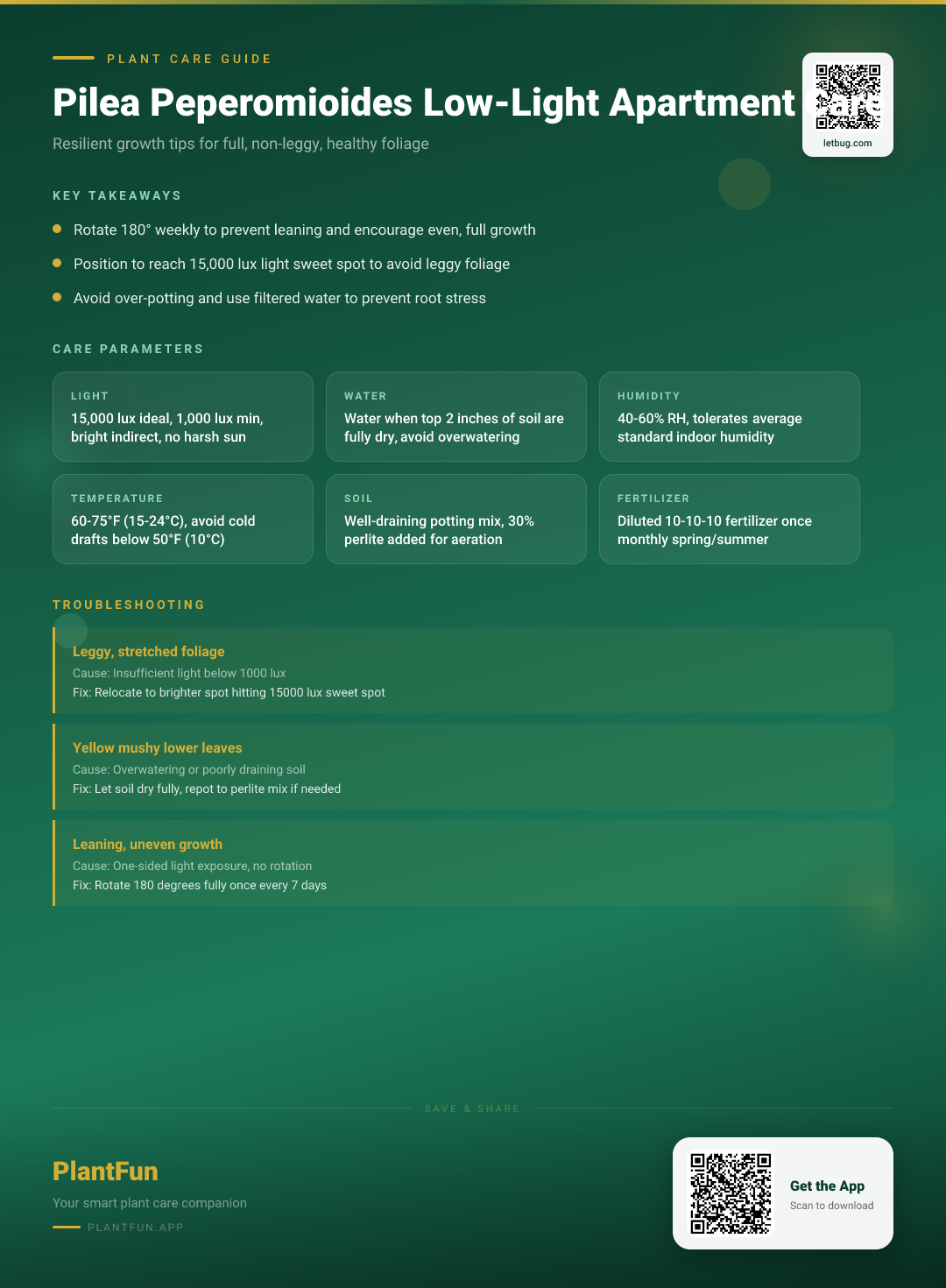
Key Takeaways
- Check soil moisture before watering — overwatering is the #1 killer of houseplants.
- Ensure your plant gets the right amount of light for its species.
- Be patient with recovery — most plants need 2–4 weeks to bounce back.
TL;DR: The Pilea Survival Key
If your Pilea is getting leggy, it is starving for light, not just water. Move it within 2 feet of a bright window, ensure your soil dries 75% of the way between waterings to prevent root rot, and rotate the pot 90 degrees weekly to encourage symmetrical, bushy growth. Consistent, indirect light is the single most important factor for success in apartment environments.
My Experience: Lessons from a Failed Window Sill
When I first brought home my Pilea, I placed it on a north-facing bookshelf, assuming its reputation as a “set it and forget it” plant held true. Within a month, the main stem had elongated by six inches, the leaves were yellowing at the base, and it was leaning aggressively toward the nearest light source. I learned the hard way that Pilea peperomioides isn’t a true low-light plant—it’s a sun-seeker that, when deprived, stretches its internodes (the stem space between leaves) to hunt for photons. My fix? A total relocation strategy and a consistent rotation schedule that completely transformed its architecture.
Quick Care Card: The Essentials
| Feature | Requirement |
|---|---|
| Light | Bright, indirect (15,000+ lux) |
| Water | When top 2 inches are dry |
| Humidity | 40-60% (average home) |
| Temperature | 65°F–75°F (18°C–24°C) |
| Soil | Well-draining succulent/cactus mix |
| Fertilizer | Balanced liquid 10-10-10 (monthly) |
| Toxicity | Non-toxic to cats and dogs (ASPCA, 2026) |
Why Your Pilea Struggles in Apartment Living
Apartments often present a “light-trapping” environment where intensity drops off exponentially even a few feet from the glass. Because Pilea peperomioides is native to high-altitude regions in Yunnan, China, it thrives in dappled, bright light (NC State Extension, 2026). When you place it in a dim apartment corner, the plant slows its metabolic functions. According to Winter et al. (2021), this plant utilizes specific photosynthetic pathways that require higher irradiance to maintain structural integrity. Without it, the plant prioritizes vertical growth over leaf density, leading to the dreaded “leggy” aesthetic.
Decoding the Habitat: Why Pilea Peperomioides Demands More Than Typical Low Light
Many beginners confuse “tolerating” low light with “thriving” in it. While the Pilea can survive in lower light, it won’t produce the iconic, overlapping circular leaves you see in professional plant care guides. It needs enough energy to maintain a tight rosette pattern. When light is insufficient, the plant undergoes etiolation, a biological response where the plant stretches its stems to escape perceived shade (Radcliffe-Smith, 1997).
The Rescue Plan for Leggy or Drooping Pileas
If your plant has already lost its shape, you need a reset:
- The Pruning Step: If the stem is exceptionally long and bare, consider a professional-grade propagation cut to restart the plant.
- The Light Pivot: Move the plant to the brightest area of your apartment, ideally an east-facing window.
- Root Health Check: Ensure your pot has drainage holes. If water sits at the bottom, the roots will suffocate, causing leaves to drop.
- Rotation Schedule: Rotate the plant a quarter turn every time you water to ensure even growth (NC State Extension, 2026).
Root Cause Analysis: Diagnosing Watering vs. Lighting Deficiencies
Leaf Droop
Symptom: Leaves look wilted even when soil feels damp.
Likely cause: Overwatering leading to root suffocation.
Fix:
- Check for soggy soil at the bottom of the pot.
- Repot into a chunkier, better-draining indoor potting mix.
Yellowing Lower Leaves
Symptom: Bottom leaves turn yellow and drop while the top remains green.
Likely cause: Natural aging or prolonged moisture in the root zone.
Fix:
- Verify drainage is functional.
- Reduce water frequency; wait until the top 2-3 inches are bone dry.
Immediate Rescue: The 4-Week Pivot Plan
- Week 1: Evaluate light intensity. If you don’t have a light meter, use a free phone app to check for 15,000 lux. Relocate if below 10,000 lux.
- Week 2: Inspect soil moisture. Only water when the soil feels dry to the second knuckle.
- Week 3: Introduce a 1/4 strength liquid fertilizer to support new, healthy tissue growth.
- Week 4: Assess growth. If you see signs of new leaf development, you have successfully stabilized the environment.
Measurable Thresholds: Defining the 15,000 Lux Sweet Spot
While many sources suggest “bright indirect light,” that is subjective. In my experience, a Pilea needs at least 15,000 lux to maintain a dense, compact form (Winter et al., 2021). You can achieve this in most apartments by placing the plant on a windowsill shielded by a thin sheer curtain. This provides the necessary intensity without the leaf-scorching direct UV rays of high noon.
Voice Search FAQ
- Why is my Pilea getting leggy and reaching for the window? It is seeking a higher light intensity. Move it closer to the window and rotate it weekly so all sides receive equal access to light.
- How often should I rotate my Pilea to stop it from leaning? Rotate it 90 degrees every time you water (typically every 7-10 days). This forces the plant to distribute energy evenly rather than pushing all growth toward the window (Radcliffe-Smith, 1997).
- Is my Pilea toxic to my cat? No, according to the ASPCA (2026), Pilea peperomioides is considered non-toxic to both cats and dogs, making it a safe choice for pet owners.
Seasonal Maintenance: Adjusting Care from High-Sun Summers to Dim Winters
During winter, your apartment’s light levels drop significantly. I decrease my watering frequency by about 30% during these months because the plant’s growth slows down. Always monitor your indoor temperature to ensure it doesn’t dip below 60°F near cold glass panes.
Common Mistakes: The Perils of Over-Potting and Mineral-Heavy Water
- Mistake: Using a pot that is too large. What happens: Excess soil holds too much water, leading to root rot. Instead: Only move up one pot size (e.g., 4-inch to 6-inch) when the plant is root-bound.
- Mistake: Using tap water with heavy chlorine or minerals. What happens: Salt buildup appears as white crusts on leaves or soil. Instead: Use filtered or room-temperature distilled water for consistent health.
References
- Winter, K.; Garcia, M.; Virgo, A. (2021). Low-level CAM photosynthesis in a succulent-leaved member of the Urticaceae, Pilea peperomioides. Functional Plant Biology. https://doi.org/10.1071/fp20151. Accessed 2026-03-18.
- Radcliffe‐Smith, A. (1997). A supplementary note on the cultivation of Pilea peperomioides. Curtis’s Botanical Magazine. https://doi.org/10.1111/1467-8748.00063. Accessed 2026-03-18.
- ASPCA. (2026). Toxic and Non-Toxic Plants List — ASPCA. https://www.aspca.org/pet-care/animal-poison-control/toxic-and-non-toxic-plants. Accessed 2026-03-18.
- NC State Extension. (2026). Pilea Peperomioides — NC State Extension Gardener Plant Toolbox. https://plants.ces.ncsu.edu/plants/pilea-peperomioides/. Accessed 2026-03-18.
Optional Helper: Plantfun.App
Plantfun.App identifies your plants by photo, diagnoses pests and diseases with clear fixes, and creates personalised watering and light schedules that adapt to your home conditions — a handy companion for putting this guide into daily practice.
Found an error or have suggestions? We'd love your feedback.
Need help identifying this problem?
Get instant identification, personalized care schedules, and effective pest treatment plans directly on your phone.
Sponsored • We may earn a commission from app downloads
Related Guides
Pilea in Your Apartment: The Only Care Guide You’ll Ever Need for Resilient Growth
Transform your Pilea's growth with our expert care guide. Get exact light levels, precise watering thresholds, and 5 proven steps to stop leaf drop forever.
Care GuidePilea peperomioides in a Drafty Apartment: The Complete Resilient Growth Care Guide
Stop losing leaves to drafts. Learn the exact light thresholds, watering schedules, and nutrient hacks to keep your Pilea thriving in any apartment setting.
Care GuidePilea Peperomioides in Low-Light Apartments: The Complete Care Guide for Resilient Growth
Revive your struggling Pilea with precise light metrics and watering schedules designed for city apartments. Learn the 4 key steps to stop drooping leaves now.
Pest ControlAnts on Plants: What They Mean and What to Do
Ants usually aren't eating your plant. They are farming other pests.