
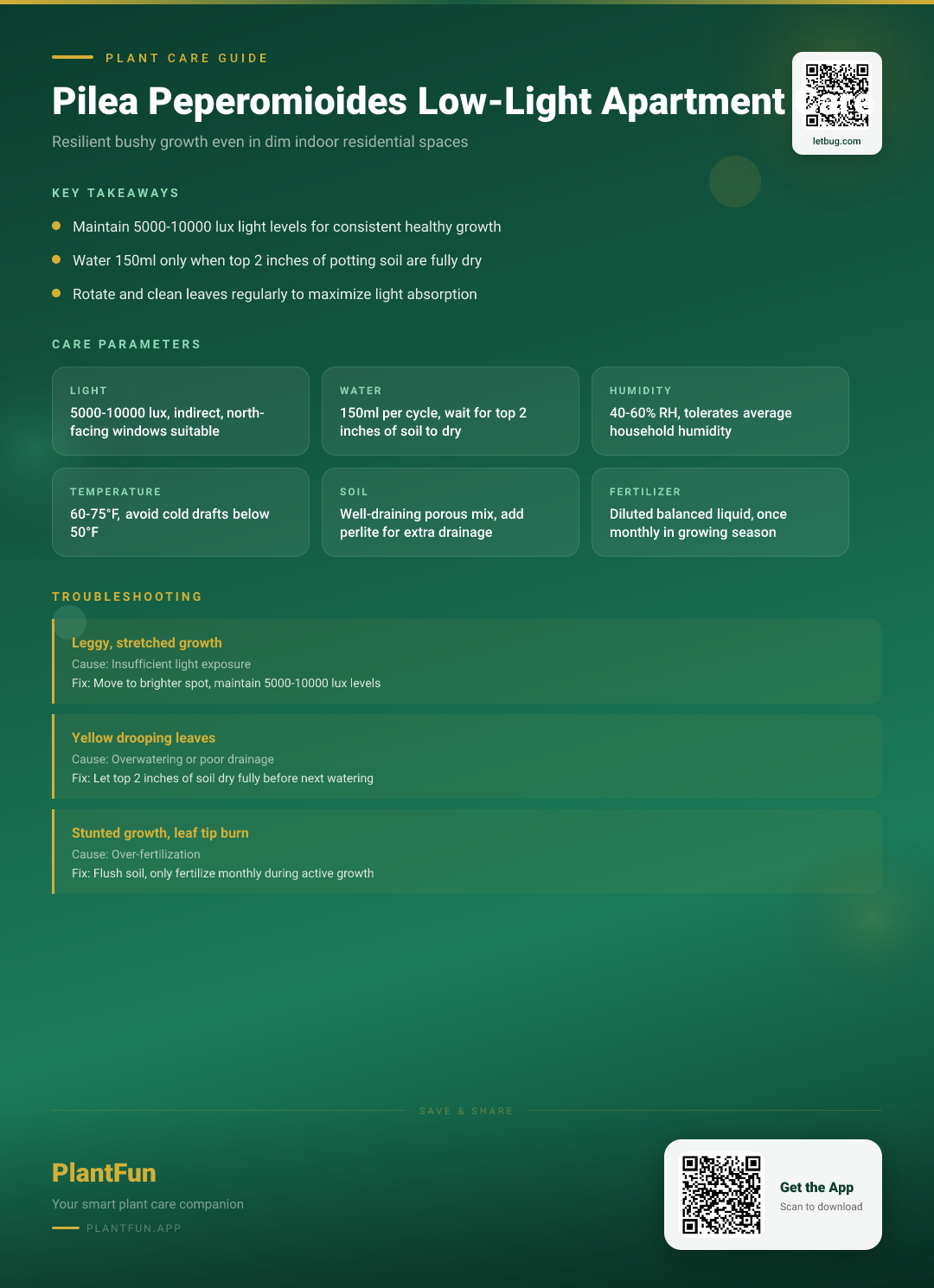
Key Takeaways
- Check soil moisture before watering — overwatering is the #1 killer of houseplants.
- Ensure your plant gets the right amount of light for its species.
- Be patient with recovery — most plants need 2–4 weeks to bounce back.
Quick Care Card: Essential Thresholds for Apartment Pilea
| Feature | Requirement |
|---|---|
| Light | 5,000–10,000 lux (bright indirect) |
| Watering | 150ml when top 2 inches of soil are dry |
| Humidity | 40%–60% (ambient is sufficient) |
| Temperature | 15°C–24°C (avoid drafts) |
| Soil | Fast-draining, peat-perlite blend |
| Fertilizer | Balanced liquid feed, half-strength monthly |
| Toxicity | Non-toxic to cats and dogs (ASPCA, 2026) |
TL;DR: The Reality of Pilea in Dim Apartments
Keeping a Pilea peperomioides in a low-light apartment is possible, but it requires precision. To prevent legginess and leaf drop, focus on maximizing the limited light you have through leaf cleaning and strategic placement. Water only when the soil is dry to the touch 2 inches down, and ensure your pot has excellent drainage to avoid root rot—a common killer in low-light conditions where evaporation is slow.
My Experience: The “Leggy” Lesson
When I first brought my Pilea home, I tucked it into a decorative ceramic pot without a drainage hole, placing it in a dimly lit corner. Within a month, the beautiful coin-shaped leaves started curling and dropping. I was overwatering, and because the light was so sparse, the plant couldn’t photosynthesize fast enough to utilize the water. I had to repot it into a terracotta container and move it onto a small plant stand right next to my north-facing window. The transformation from a sparse, drooping stalk to a bushy, vibrant plant didn’t happen overnight, but once I adjusted my watering cycle to the “2-inch rule,” the growth became steady and lush.
Why This Matters: How Photosynthesis Adapts to Indoor Lux Levels
Light is the primary energy driver for Pilea. In low-light environments, the plant struggles to produce sufficient carbohydrates, leading to etiolation—the stretching of stems as the plant “reaches” for light (NC State Extension, 2026). While some plants in the Urticaceae family show specialized adaptive photosynthesis (Winter, Garcia, & Virgo, 2021), Pilea requires consistent, high-quality light to maintain its compact, aesthetic architecture (Radcliffe-Smith, 1997).
Light Requirements: Achieving 5,000–10,000 lux in North-Facing Rooms
In most apartments, a north-facing window rarely exceeds 5,000 lux. To help your plant thrive, use a light meter app or observe the “shadow test.” If your plant casts a very soft, blurry shadow, it needs to be closer to the glass. Do not move it into direct midday sun, as this will scorch the leaves. Instead, place it within 12 inches of the window pane to ensure it receives the maximum available photons.
Watering Protocols: The 2-Inch Rule for 150ml Hydration Cycles
Never water on a calendar schedule. Instead, perform the finger test: push your index finger 2 inches into the soil. If it feels moist, wait. If it is dry, irrigate. In a typical 6-inch pot, I generally find that 150ml of water is sufficient to moisten the root ball without leaving the roots sitting in a stagnant pool. For better soil health and moisture management, ensure your pot has multiple drainage holes.
Soil Science: Creating Drainage-Focused Mediums for Indoor Pots
Standard potting soil is often too dense for Pilea. I recommend mixing 60% high-quality potting soil with 40% perlite or pumice. This high-aeration mix mimics the well-draining conditions described in historical cultivation notes (Radcliffe-Smith, 1997). Good drainage is the most effective way to prevent common indoor plant diseases that plague apartment-dwelling plants.
Step-by-Step: Rotating and Cleaning Leaves for Maximum Light Absorption
- Weekly Rotation: Rotate your pot 90 degrees every time you water. This prevents the plant from leaning permanently in one direction.
- Leaf Cleaning: Dust acts as a filter, blocking light. Use a damp microfiber cloth to gently wipe the top and underside of leaves every two weeks.
- Pruning: Remove dead or yellowing lower leaves to encourage the plant to direct energy toward new, healthy growth.
Seasonal Calendar: Adjusting Care from Winter Dormancy to Summer Growth
- Spring/Summer: The plant will actively push out “pups” (offsets). Increase water slightly and apply a balanced, diluted fertilizer once a month.
- Autumn/Winter: Growth slows as day length decreases. Reduce watering frequency by 30-50%. Avoid placing the plant near radiators or drafty, poorly insulated windows.
Troubleshooting Guide
Why is my Pilea getting leggy even near a window?
Symptom: Stems are long, thin, and leaves are spaced far apart.
Likely cause: Insufficient light intensity despite proximity to the window.
Fix:
- Move the plant closer to the light source.
- Use a grow light supplement for 4-6 hours during the day.
How do I know if my Pilea is getting too much or too little water?
Symptom: Yellowing, mushy leaves indicate overwatering; crispy, curling leaf edges indicate underwatering.
Likely cause: Inconsistent moisture management.
Fix:
- Check drainage holes to ensure they are not blocked.
- Adjust to the 2-inch dry-soil protocol.
Common Mistakes to Avoid
- Mistake: Using a pot without drainage.
- What happens: Water pools at the bottom, leading to root rot.
- Instead: Always use a nursery pot with drainage holes inside your decorative container.
- Mistake: Excessive fertilizing in winter.
- What happens: Fertilizer salt buildup in the soil, which the plant cannot process due to lack of light.
- Instead: Pause fertilizing from November through February.
FAQ
- Can I put my Pilea in a bathroom? Yes, if there is a window. The humidity is often beneficial, but ensure the plant is not sitting in a dark, stagnant corner.
- How do I propagate my Pilea? You can harvest the small “pups” that grow from the soil or along the stem, place them in water until roots reach 1 inch, then pot them in your custom soil mix.
- Is my Pilea safe for my cat? Yes, according to the ASPCA (2026), Pilea peperomioides is non-toxic to cats and dogs.
References
- ASPCA. (2026). Toxic and Non-Toxic Plants List — ASPCA. https://www.aspca.org/pet-care/animal-poison-control/toxic-and-non-toxic-plants. Accessed 2026-03-12.
- Winter, K., Garcia, M., & Virgo, A. (2021). Low-level CAM photosynthesis in a succulent-leaved member of the Urticaceae, Pilea peperomioides. Functional Plant Biology. https://doi.org/10.1071/fp20151. Accessed 2026-03-12.
- Radcliffe-Smith, A. (1997). A supplementary note on the cultivation of Pilea peperomioides. Curtis’s Botanical Magazine. https://doi.org/10.1111/1467-8748.00063. Accessed 2026-03-12.
- NC State Extension. (2026). Pilea Peperomioides — NC State Extension Gardener Plant Toolbox. https://plants.ces.ncsu.edu/plants/pilea-peperomioides/. Accessed 2026-03-12.
Optional Helper: Plantfun.App
Plantfun.App identifies your plants by photo, diagnoses pests and diseases with clear fixes, and creates personalised watering and light schedules that adapt to your home conditions — a handy companion for putting this guide into daily practice.
Found an error or have suggestions? We'd love your feedback.
Need help identifying this problem?
Get instant identification, personalized care schedules, and effective pest treatment plans directly on your phone.
Sponsored • We may earn a commission from app downloads
Related Guides
Pilea peperomioides in a Dim Apartment: The 5-Step Guide to Resilient Indoor Growth
Stop letting your Pilea suffer in low light. Master precise watering, specific lux thresholds, and rotation habits to grow a vibrant, symmetrical UFO plant.
Care GuideThe Complete Pilea Peperomioides Care Guide for Small Urban Apartments: Lush Resilient Growth
Grow full, happy Pilea peperomioides even in tiny urban apartments. Get exact light levels, watering amounts, and space-saving tips for resilient growth and plenty of new pups.
Care GuideThe Complete Pilea Peperomioides Care Checklist for Resilient Growth in Small Urban Apartments
Grow a bushy, happy Pilea in your small urban apartment with our science-backed checklist. Get exact light levels, water amounts, and mistake fixes to avoid yellow leaves or leggy growth.
Pest ControlAnts on Plants: What They Mean and What to Do
Ants usually aren't eating your plant. They are farming other pests.