
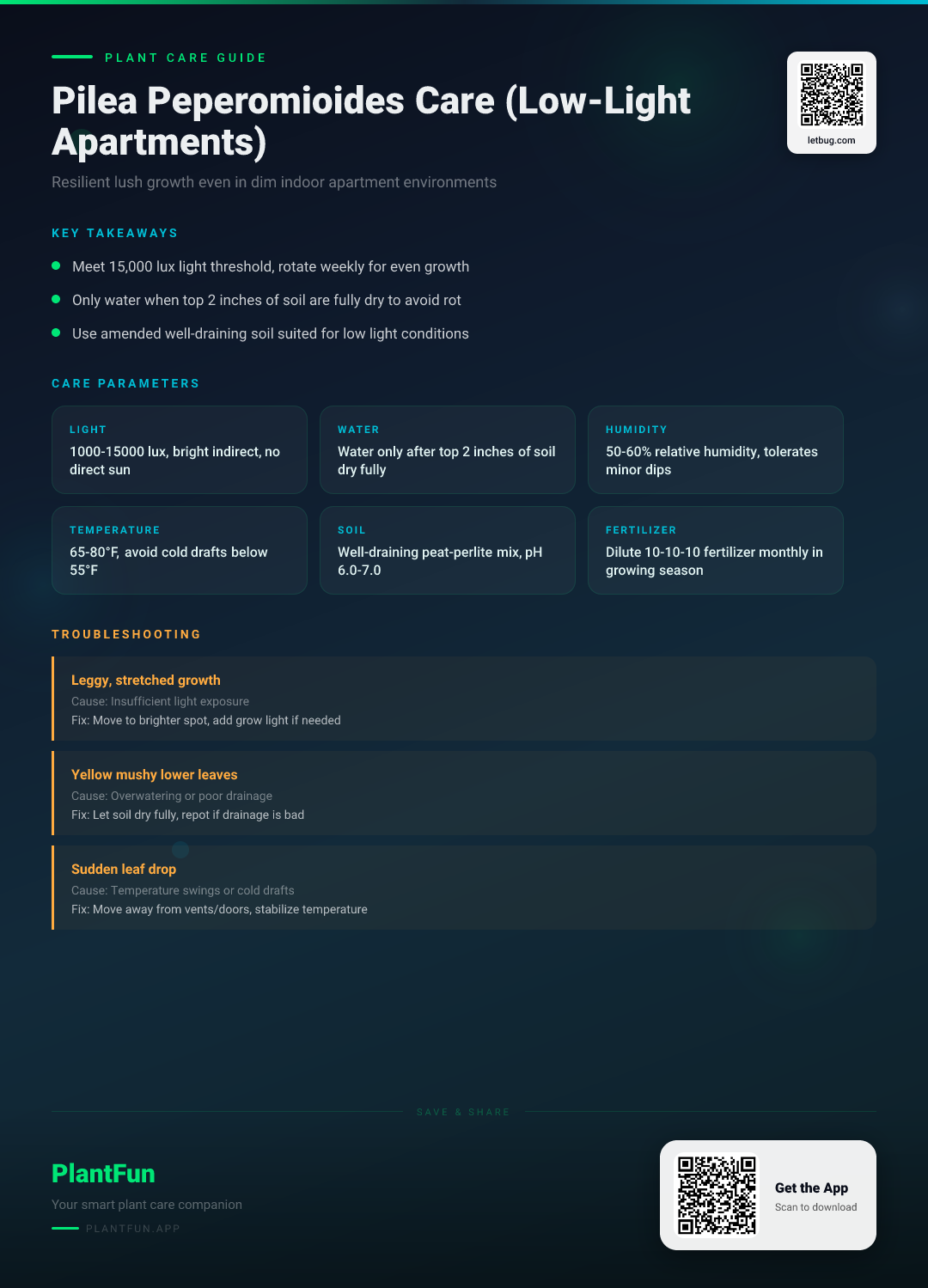
Key Takeaways
- Check soil moisture before watering — overwatering is the #1 killer of houseplants.
- Ensure your plant gets the right amount of light for its species.
- Be patient with recovery — most plants need 2–4 weeks to bounce back.
Quick Care Card: Essential Thresholds
| Feature | Optimal Range |
|---|---|
| Light | 10,000–15,000 lux (bright, indirect) |
| Water | 2-inch soil dry-down rule |
| Humidity | 50–60% |
| Temperature | 65–80°F (18–27°C) |
| Soil | Well-draining, peat-based mix |
| Fertilizer | Balanced liquid feed, monthly (Spring-Summer) |
| Toxicity | Non-toxic (ASPCA, 2026) |
TL;DR: The Reality of Pilea Growth in Dim Apartments
In my experience, the Pilea peperomioides—often called the Chinese Money Plant—is a resilient survivor, but it is not a “true” low-light plant. While it can tolerate dim corners, it will inevitably become “leggy” (stretching its stems toward light) if it receives less than 10,000 lux (NC State Extension, 2026). To keep it compact, place it in your brightest window and embrace a rotating schedule to ensure even growth. My personal rule: if you can’t read a book comfortably in your Pilea’s spot, it isn’t getting enough light.
Why Your Pilea is Stretching: Decoding Phototropism vs. Health
When I first brought home my Pilea, I placed it on a bookshelf six feet away from a window. Within weeks, the stems reached horizontally toward the glass. This is phototropism—the biological drive to reorient growth toward a light source (Radcliffe-Smith, 1997). Stretching is not just an aesthetic issue; it weakens the stem structure. When a plant is in a low-light apartment, its energy is diverted entirely to stem elongation rather than producing those iconic, rounded leaves.
Step 1: Maximizing Light Exposure without Direct Burn
- Window Selection: Place your Pilea in an East or North-facing window. Avoid harsh, midday direct sun, which can scorch the delicate foliage.
- The Lux Test: Use a free light meter app on your phone to measure the light at the leaf surface. You are aiming for a minimum of 10,000 lux (NC State Extension, 2026).
- Quarter-Turn Rotation: Every time I water, I rotate my pot 90 degrees. This prevents the plant from leaning permanently in one direction.
Step 2: The Science of Watering for Resilient Root Systems
In lower light, your Pilea’s metabolism slows down (Winter et al., 2021). You must adjust your watering volume accordingly. I use the “2-inch finger test”: stick your finger 2 inches deep into the soil. If it feels damp, wait. If it is dry, water thoroughly until liquid drains from the bottom of the pot. Never leave the plant sitting in a saucer of water, as this invites root rot.
Step 3: Soil Amendments for Drainage in Lower Light Environments
Standard potting soil is often too dense for a Pilea in a low-light room, where evaporation happens slowly. I create my own mix: 60% high-quality potting soil, 20% perlite for aeration, and 20% orchid bark. This ensures that even when the light is low, the roots are never suffocated by compacted, soggy soil.
Seasonal Care Calendar: Adjusting for Winter Low-Light Dips
- Spring/Summer: Growth is active. Water when the top 1 inch is dry. Use a balanced, water-soluble fertilizer at half-strength once a month.
- Autumn/Winter: The plant enters a semi-dormant phase. Because light levels drop in most apartments, the plant will drink significantly less. I shift to watering only when the top 3 inches are bone-dry (NC State Extension, 2026).
Common Mistakes: The Top 3 Causes of Pilea Leaf Drop
Overwatering
Symptom: Yellowing, mushy leaves near the base.
Likely cause: Excess moisture in low-light conditions.
Fix:
- Check roots for brown/mushy rot.
- Repot in fresh, well-draining, chunky soil.
Light Shock
Symptom: Brown, crispy spots on leaves.
Likely cause: Abrupt move to high-intensity sunlight.
Fix:
- Move the plant to a spot with filtered light.
- Acclimate slowly by adding 30 minutes of light per day.
Under-watering
Symptom: Drooping, curled, or shriveled leaves.
Likely cause: Soil has pulled away from the pot sides, causing water to bypass the roots.
Fix:
- Submerge the entire nursery pot in a bowl of water for 20 minutes.
- Allow to drain completely before returning to its spot.
FAQ: Why is my Pilea getting leggy in my living room?
It is likely suffering from insufficient light. Your plant is attempting to reach for a light source that is too far away. Moving it closer to the window or adding a small, focused LED grow light will stop the stretching (Radcliffe-Smith, 1997).
FAQ: How often should I water my Pilea in a standard apartment?
There is no one-size-fits-all schedule. Rely on the 2-inch dry-down rule. In my apartment, this means watering every 7-10 days in summer and every 14-20 days in winter.
FAQ: Can I use grow lights to supplement my Pilea’s light needs?
Absolutely. If you lack natural light, a full-spectrum LED placed 6-12 inches above the plant can provide the necessary 10,000+ lux (NC State Extension, 2026).
Expert Diagnostic Checklist: Is my plant dying or just adjusting?
- Lower leaf drop: Normal as the plant matures and sheds old energy-draining foliage.
- Stem browning: A sign of physical damage or excessive moisture.
- Leaf curling: Usually a sign of thirst or excessive heat (above 80°F).
- Is the plant safe for my home? Yes, the ASPCA classifies Pilea peperomioides as non-toxic to both cats and dogs (ASPCA, 2026).
References
- Winter, K.; Garcia, M.; Virgo, A. (2021). Low-level CAM photosynthesis in a succulent-leaved member of the Urticaceae, Pilea peperomioides. Functional Plant Biology. https://doi.org/10.1071/fp20151. Accessed 2026-03-18.
- Radcliffe‐Smith, A. (1997). A supplementary note on the cultivation of Pilea peperomioides. Curtis’s Botanical Magazine. https://doi.org/10.1111/1467-8748.00063. Accessed 2026-03-18.
- ASPCA. (2026). Toxic and Non-Toxic Plants List — ASPCA. https://www.aspca.org/pet-care/animal-poison-control/toxic-and-non-toxic-plants. Accessed 2026-03-18.
- NC State Extension. (2026). Pilea Peperomioides — NC State Extension Gardener Plant Toolbox. https://plants.ces.ncsu.edu/plants/pilea-peperomioides/. Accessed 2026-03-18.
Optional Helper: Plantfun.App
Plantfun.App identifies your plants by photo, diagnoses pests and diseases with clear fixes, and creates personalised watering and light schedules that adapt to your home conditions — a handy companion for putting this guide into daily practice.
Found an error or have suggestions? We'd love your feedback.
Need help identifying this problem?
Get instant identification, personalized care schedules, and effective pest treatment plans directly on your phone.
Sponsored • We may earn a commission from app downloads
Related Guides
Pilea peperomioides in a Dim Apartment: The 5-Step Guide to Resilient Indoor Growth
Stop letting your Pilea suffer in low light. Master precise watering, specific lux thresholds, and rotation habits to grow a vibrant, symmetrical UFO plant.
Care GuidePilea Peperomioides in Low-Light Apartments: The Complete Care Guide for Resilient Growth
Revive your struggling Pilea with precise light metrics and watering schedules designed for city apartments. Learn the 4 key steps to stop drooping leaves now.
Care GuidePilea Peperomioides in a Small Apartment: The Ultimate Care Guide for Resilient Year-Round Growth
Transform your Pilea's health with this apartment-tested care guide. Master precise light, watering schedules, and seasonal routines for lush, pancake-leaf growth.
Pest ControlAnts on Plants: What They Mean and What to Do
Ants usually aren't eating your plant. They are farming other pests.