
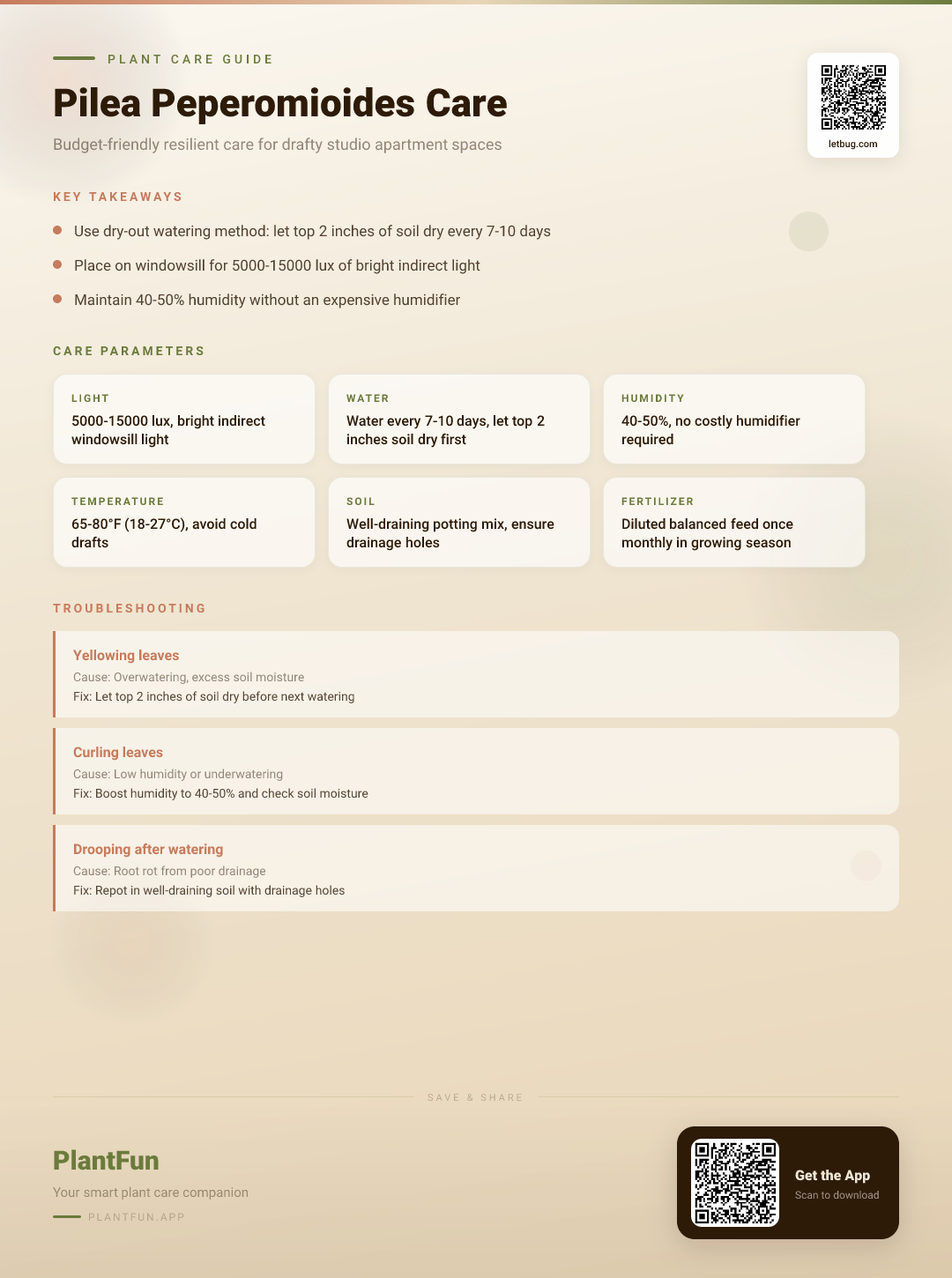
Key Takeaways
- Check soil moisture before watering — overwatering is the #1 killer of houseplants.
- Ensure your plant gets the right amount of light for its species.
- Be patient with recovery — most plants need 2–4 weeks to bounce back.
Quick Care Card: Essential thresholds for the Pilea peperomioides
| Feature | Requirement |
|---|---|
| Light | 5,000–15,000 lux (Bright, indirect) |
| Water | Every 7–10 days (Dry out top 2 inches) |
| Humidity | 40–50% |
| Temperature | 65–80°F (18–27°C) |
| Soil | Well-draining, peat-based mix |
| Fertilizer | Balanced liquid 20-20-20 (monthly in spring/summer) |
| Toxicity | Non-toxic to cats and dogs (ASPCA, 2026) |
TL;DR: The 60-second summary for busy apartment dwellers
To keep your Pilea thriving in a studio, prioritize light over everything else. Place it in your brightest window, but avoid direct scorching sun. Water only when the top two inches of soil are dry to the touch (NC State Extension, 2026). In small apartments, avoid cold window drafts; keep the plant away from AC vents and heaters to maintain a consistent 65–80°F environment. Because it is non-toxic (ASPCA, 2026), it is a safe choice for small-space pet owners.
Why your studio apartment is a unique Pilea environment
When I first got my Pilea peperomioides, I stuck it in a dark corner of my studio, and within weeks, it was leggy and sad. My mistake was underestimating how a single room’s microclimate—fluctuating between kitchen heat and window drafts—affects a plant’s metabolism. Pilea are succulent-leaved members of the Urticaceae family (Winter et al., 2021). Their unique physiology means they handle indoor conditions well, but they require stability. In a tight space, you are often working with limited airflow and extreme temperature swings, both of which stress this plant.
Understanding your lighting: Measuring 5,000–15,000 lux on a windowsill
The Pilea needs “bright, indirect light” (NC State Extension, 2026). In a studio, this usually means placing it within 1–2 feet of a window. If you aren’t sure if your spot is bright enough, you can use a free light meter app on your phone to aim for 5,000–15,000 lux. Avoid south-facing windows during peak summer hours, as the direct sun can scorch the foliage.
Budget-friendly watering: The ‘dry-out’ method (top 2 inches, every 7–10 days)
Forget watering on a strict schedule. Instead, use the “finger test”: push your index finger two inches into the soil. If it feels damp, wait. If it feels dry, it is time to water. This prevents the root rot that often plagues Pilea kept in non-porous pots. Always ensure your pot has drainage holes; if it doesn’t, drilling one or using a plastic nursery liner inside a decorative pot is a cost-effective fix.
Managing apartment drafts: Keeping temperatures between 65–80°F (18–27°C)
Studio apartments often have one window that doubles as a source of winter drafts. Pilea are sensitive to thermal shock (Radcliffe‐Smith, 1984). If your window is icy, move the plant back a few inches. If you must keep it on the sill, a simple cardboard buffer placed between the glass and the pot can insulate the roots against the cold.
Humidity hacks: Maintaining 40–50% without a costly humidifier
While a humidifier is nice, it’s unnecessary for this plant. You can mimic a humid microclimate by grouping your Pilea with other plants, which creates a small, moisture-retaining zone. Alternatively, place the pot on a tray filled with pebbles and a small amount of water, ensuring the bottom of the pot never touches the water directly.
Seasonal growth calendar: Adjusting for low-light winter months
- Spring/Summer: Rotate the pot 90 degrees every week to ensure even growth (preventing the “leaning” look) and fertilize monthly.
- Fall/Winter: Growth naturally slows. Reduce watering frequency and stop fertilizing entirely. If your light levels drop, move the plant closer to the window (NC State Extension, 2026).
FAQ: Why is my Pilea drooping after I watered it?
Drooping is usually a sign that the soil remained too wet for too long, causing the roots to suffocate. Check the drainage holes to ensure they aren’t clogged. If the soil is soggy, it’s time to repot into fresh, fast-draining mix.
FAQ: How do I know if my studio apartment light is bright enough?
Watch the stems. If they become long and sparse, or if the leaves start to turn downward, your plant is reaching for more light. Move it closer to the window or add a simple desk lamp with a daylight-balanced LED bulb.
Common apartment mistakes: Drainage, pot size, and air circulation
- Mistake: Using a pot with no drainage. What happens: Water pools at the bottom, leading to root rot. Instead: Always use a pot with a drainage hole or use a plastic insert.
- Mistake: Over-potting. What happens: Too much extra soil holds excess moisture. Instead: Only size up by 1–2 inches when the roots fill the current pot.
Troubleshooting: Yellowing leaves vs. curling leaves
Yellowing lower leaves
Symptom: The bottom leaves turn yellow and eventually drop off.
Likely cause: Normal aging or minor overwatering.
Fix:
- Check soil moisture; if wet, pause watering.
- Ensure the plant is not sitting in a saucer of stagnant water.
Curling leaves
Symptom: Leaves cup inward or look distorted.
Likely cause: Incorrect light or temperature stress.
Fix:
- Move the plant to a spot with slightly softer light.
- Ensure it isn’t sitting directly in a blast of hot air from a radiator.
References
- ASPCA. (2026). Toxic and Non-Toxic Plants List — ASPCA. https://www.aspca.org/pet-care/animal-poison-control/toxic-and-non-toxic-plants. Accessed 2026-03-10.
- NC State Extension. (2026). Pilea peperomioides — NC State Extension Gardener Plant Toolbox. https://plants.ces.ncsu.edu/plants/pilea-peperomioides/. Accessed 2026-03-10.
- Radcliffe‐Smith, A. (1984). PILEA PEPEROMIOIDES Urticaceae. Curtis’s Botanical Magazine. https://doi.org/10.1111/j.1467-8748.1984.tb00168.x. Accessed 2026-03-10.
- Winter, K.; Garcia, M.; Virgo, A. (2021). Low-level CAM photosynthesis in a succulent-leaved member of the Urticaceae, Pilea peperomioides. Functional Plant Biology. https://doi.org/10.1071/fp20151. Accessed 2026-03-10.
Optional Helper: Plantfun.App
Plantfun.App identifies your plants by photo, diagnoses pests and diseases with clear fixes, and creates personalised watering and light schedules that adapt to your home conditions — a handy companion for putting this guide into daily practice.
Found an error or have suggestions? We'd love your feedback.
Need help identifying this problem?
Get instant identification, personalized care schedules, and effective pest treatment plans directly on your phone.
Sponsored • We may earn a commission from app downloads
Related Guides
The Complete Pilea Peperomioides Care Guide for Small Apartments: Resilient Growth All Year
Grow a lush, happy Pilea in your small apartment with exact care thresholds, a seasonal routine, and a printable checklist that prevents overwatering and yellow leaves all year.
Care GuidePilea peperomioides in a Drafty Apartment: The Complete Care Guide for Resilient Growth
Transform your Pilea's health with our apartment-focused care guide. Learn exact lux, hydration, and temperature thresholds to ensure vibrant, pancake-shaped leaves.
Care GuidePilea Peperomioides in a Small Apartment: The Ultimate Care Guide for Resilient Year-Round Growth
Transform your Pilea's health with this apartment-tested care guide. Master precise light, watering schedules, and seasonal routines for lush, pancake-leaf growth.
Pest ControlAnts on Plants: What They Mean and What to Do
Ants usually aren't eating your plant. They are farming other pests.