
Key Takeaways
- Check soil moisture before watering — overwatering is the #1 killer of houseplants.
- Ensure your plant gets the right amount of light for its species.
- Be patient with recovery — most plants need 2–4 weeks to bounce back.
TL;DR: The Pilea Quick-Fix
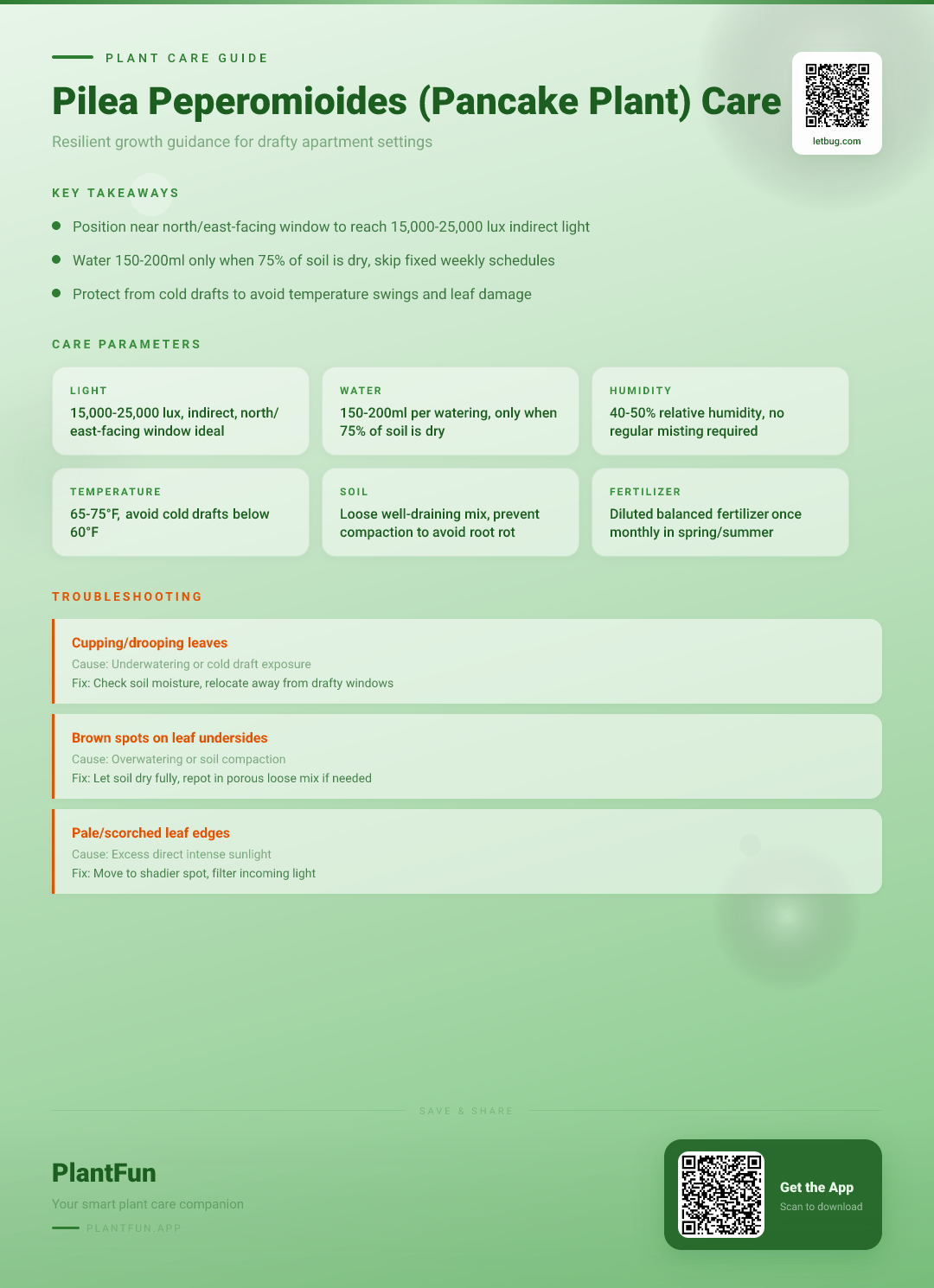
If your Pilea is struggling in an apartment, stop the ‘every Sunday’ watering cycle immediately. Only water when the soil is 75% dry (measured by a 2-inch deep finger test). Provide 15,000–25,000 lux of bright, indirect light, and keep the plant away from drafty windows. If leaves are curling, increase light intensity, not water.
My Experience: The “Apartment Lesson”
When I first brought home my Pilea peperomioides, I placed it on a windowsill in my drafty city apartment, thinking the natural light would be enough. Within weeks, the leaves were cupping inward, and the lower foliage was yellowing. I assumed it was thirsty and kept watering it, which only accelerated the root decline. It wasn’t until I adjusted for micro-climate shifts and tracked the light intensity that my Pilea finally began producing those iconic, vibrant coin-shaped leaves.
Quick Care Card: The Pilea Baseline
| Requirement | Parameter |
|---|---|
| Light | 15,000–25,000 lux |
| Water | 150ml–200ml when 75% dry |
| Humidity | 40–50% |
| Temperature | 65–75°F (18–24°C) |
| Soil | Well-draining aroid mix |
| Fertilizer | Balanced liquid, monthly in spring/summer |
| Toxicity | Non-toxic to cats and dogs (ASPCA, 2026) |
Why Pilea Peperomioides Struggles in Typical Apartments
Apartments are notorious for inconsistent airflow and temperature pockets. While Pilea peperomioides thrives in stable environments, the typical urban home often creates a “stagnant-but-cold” dynamic near windows. Research into the Urticaceae family suggests these plants prefer steady, moderate conditions (Radcliffe-Smith, 1984). When confined in an apartment, they often face sudden drops in thermal energy near glass, which inhibits proper nutrient uptake even if the soil moisture seems correct.
Understanding the Science of Leaf Cupping and Drooping
Leaf cupping is the most common grievance for Pilea owners. While often mistaken for a watering issue, it is usually a photo-morphological response. A study on the Urticaceae family confirms that these plants exhibit specific physiological responses to their environment, including light-harvesting behaviors that dictate leaf shape (Winter et al., 2021). When the plant senses insufficient light, it cups its leaves to increase surface area exposure, attempting to capture more photons. If your Pilea is drooping, it is likely experiencing vascular stress due to root-zone saturation combined with poor light (NC State Extension, 2026).
Optimizing Light: Achieving 15,000-25,000 Lux in North or East-Facing Windows
For a thriving Pilea, intensity matters more than duration. In a North-facing window, you may need to move the plant within 6 inches of the glass. In East-facing windows, ensure the morning sun is diffused by a sheer curtain to prevent leaf scorch. You can use a basic light meter app to check your lux levels during midday.
Hydration Strategy: Why ‘Every Sunday’ Watering Fails in Urban Settings
Most apartment dwellers overwater their Pilea because they follow a calendar rather than plant cues. Because apartments often have lower air circulation, soil moisture evaporates slowly. Always check the top 2 inches of soil; if it feels cool and damp, your plant is not ready. Use approximately 150ml–200ml of room-temperature, filtered water to ensure even saturation without pooling at the base.
Managing Temperature Fluctuations: The Drafty Window Dilemma
Cold drafts are the silent killer of the Pilea peperomioides. A temperature drop below 60°F (15°C) can cause sudden leaf drop. If your apartment window feels cold to the touch, move the plant back 12–18 inches. If space is tight, consider a small, portable grow light to compensate for the distance from the window.
Step-by-Step: The Seasonal Watering & Feeding Calendar
- Spring (Mar–May): Increase light exposure. Apply balanced liquid fertilizer at half-strength once per month.
- Summer (Jun–Aug): Monitor for high temperatures. Water every 7–10 days, ensuring the soil is 75% dry.
- Autumn (Sep–Nov): Reduce watering frequency as light levels drop.
- Winter (Dec–Feb): Cease fertilization. Allow the soil to dry out more significantly between waterings to prevent root rot.
Troubleshooting Guide
Leaf Cupping
Symptom: Leaves curl inward like a cup.
Likely cause: Insufficient light intensity.
Fix:
- Move the plant to a brighter location (closer to a window).
- Supplement with a full-spectrum LED grow light if necessary.
Yellow Leaves
Symptom: Older, lower leaves turn yellow and drop.
Likely cause: Overwatering or poor drainage.
Fix:
- Check the roots for rot; they should be firm and white.
- Repot into a specialized, well-draining soil mix if the current medium is compacted.
Brown Spots on Undersides
Symptom: Small, corky brown bumps on leaf undersides.
Likely cause: Oedema (excess water retention/burst cells).
Fix:
- Increase airflow around the plant with a small fan.
- Wait longer between waterings.
Stunted Growth
Symptom: The plant stops producing new “pancakes.”
Likely cause: Over-potting or nutrient deficiency.
Fix:
- Ensure the pot is only 1–2 inches wider than the root ball.
- Check for root-bound conditions; repot if necessary.
FAQ
- Can I keep my Pilea in a bedroom with low air circulation? Yes, but you must be more disciplined with your watering. Since air is stagnant, soil will stay wet longer. Consider using a small circulation fan to prevent fungal issues.
- How do I know if my Pilea is getting too much or too little light? Too little light results in cupped, small leaves. Too much direct, harsh light causes bleached, pale spots (scorch) on the foliage.
- Are Pilea plants safe for my cats? Yes, the ASPCA classifies Pilea peperomioides as non-toxic to pets (ASPCA, 2026).
Common Mistakes to Avoid
- Mistake: Using dense, garden-variety potting soil.
- What happens: Root suffocation and constant moisture retention.
- Instead: Use an aroid mix containing perlite, orchid bark, and high-quality potting soil for aeration.
- Mistake: Repotting into a container that is too large.
- What happens: Excess soil holds too much water, leading to root rot.
- Instead: Choose a pot that is only slightly larger than the current root system.
References and Botanical Resources
- ASPCA. (2026). Toxic and Non-Toxic Plants List — ASPCA. https://www.aspca.org/pet-care/animal-poison-control/toxic-and-non-toxic-plants. Accessed 2026-03-10.
- Winter, K.; Garcia, M.; Virgo, A. (2021). Low-level CAM photosynthesis in a succulent-leaved member of the Urticaceae, Pilea peperomioides. Functional Plant Biology. https://doi.org/10.1071/fp20151. Accessed 2026-03-10.
- Radcliffe‐Smith, A. (1984). PILEA PEPEROMIOIDES Urticaceae. Curtis’s Botanical Magazine. https://doi.org/10.1111/j.1467-8748.1984.tb00168.x. Accessed 2026-03-10.
- NC State Extension. (2026). Pilea peperomioides — NC State Extension Gardener Plant Toolbox. https://plants.ces.ncsu.edu/plants/pilea-peperomioides/. Accessed 2026-03-10.
Optional Helper: Plantfun.App
Plantfun.App identifies your plants by photo, diagnoses pests and diseases with clear fixes, and creates personalised watering and light schedules that adapt to your home conditions — a handy companion for putting this guide into daily practice.
Found an error or have suggestions? We'd love your feedback.
Need help identifying this problem?
Get instant identification, personalized care schedules, and effective pest treatment plans directly on your phone.
Sponsored • We may earn a commission from app downloads
Related Guides
Pilea peperomioides in a Drafty Apartment: The Complete Resilient Growth Care Guide
Stop losing leaves to drafts. Learn the exact light thresholds, watering schedules, and nutrient hacks to keep your Pilea thriving in any apartment setting.
Care GuideThe Complete Pilea Peperomioides Care Guide for Small Apartments: Resilient Growth All Year
Grow a lush, happy Pilea in your small apartment with exact care thresholds, a seasonal routine, and a printable checklist that prevents overwatering and yellow leaves all year.
Care GuidePilea peperomioides in a Drafty Studio Apartment: A Budget-Friendly Resilience Care Plan
Master Pilea peperomioides care in small spaces. Learn precise light, humidity, and budget-friendly drainage hacks to keep your UFO plant healthy all year.
Pest ControlAnts on Plants: What They Mean and What to Do
Ants usually aren't eating your plant. They are farming other pests.