
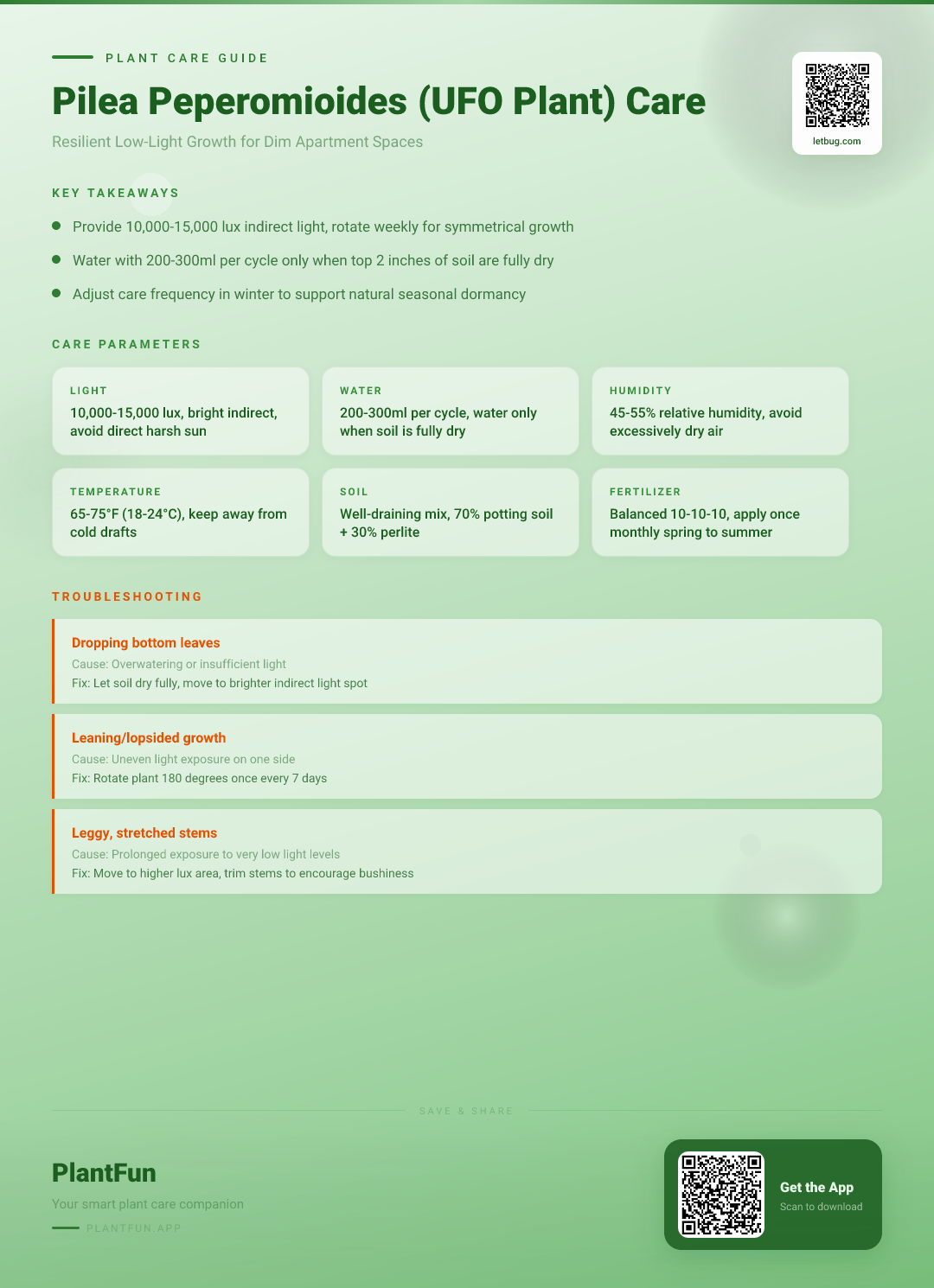
Key Takeaways
- Check soil moisture before watering — overwatering is the #1 killer of houseplants.
- Ensure your plant gets the right amount of light for its species.
- Be patient with recovery — most plants need 2–4 weeks to bounce back.
TL;DR: The Pilea Quick Fix
If your Pilea is drooping or losing leaves, it is likely crying out for more light, not more water. Move your plant within 3 feet of a window, aim for 10,000–15,000 lux, and only water when the top 2 inches of soil are completely dry. Use a well-draining, peat-based mix to prevent root rot. Consistency is the secret to a thriving UFO plant.
Quick Care Card: The Vital Thresholds
| Feature | Requirement |
|---|---|
| Light | 10,000–15,000 lux (Bright, indirect) |
| Water | When top 2 inches are dry (200-300ml) |
| Humidity | 45-55% (Moderate) |
| Temperature | 65–75°F (18–24°C) |
| Soil | Fast-draining, perlite-heavy mix |
| Fertilizer | Balanced liquid feed, monthly (Spring/Summer) |
| Toxicity | Non-toxic to cats/dogs (ASPCA, 2026) |
Why Your Pilea Struggles in Apartment Corners
When I first brought home my first Pilea peperomioides, I placed it in a trendy, dark corner of my apartment, convinced by photos on social media that it could handle “low light.” Within three weeks, the leaves yellowed and dropped. I learned the hard way that Pilea is not a shade-loving plant; it is a sun-seeker that simply tolerates indoor living if we provide the right indoor plant light levels. In dimly lit apartments, the plant stretches its petioles (leaf stalks) toward the light, resulting in a “leggy” and unstable structure.
Decoding Pilea Light Requirements (10,000-15,000 lux)
Pilea peperomioides requires bright, indirect light to maintain its signature flat, circular leaves. While some claim it can survive in shadows, research into the physiology of the Urticaceae family suggests that these plants need consistent irradiance to support healthy metabolic processes (Winter et al., 2021). If you don’t have a light meter, use this rule: if you can comfortably read a book in the spot without a lamp, it’s a good starting point. If the plant leans heavily toward the window, it is signaling that it needs more intensity.
Watering Mastery: Soil Dryness and 200-300ml Cycles
Overwatering is the fastest way to kill a Pilea. In my experience, the ideal watering schedule depends entirely on your home’s microclimate.
- The Finger Test: Insert your index finger 2 inches into the soil. If it feels cool or moist, wait.
- The Dosage: When dry, apply 200-300ml of water slowly, ensuring it drains fully through the pot holes. Never let the plant sit in a saucer of standing water, which causes the roots to suffocate (NC State Extension, 2026).
Maintaining 45-55% Relative Humidity for Healthy Foliage
While these plants are resilient, they prefer moderate humidity. In dry, heated apartments, leaf edges may turn brown or crispy. I maintain this by grouping my Pilea with other tropicals, which creates a small, humid microclimate.
Temperature Control: Keeping Between 65-75°F (18-24°C)
Avoid placing your Pilea near AC vents or radiators. Sudden temperature swings cause significant stress, leading to leaf drop. Keeping the plant in a stable environment is crucial for longevity (Radcliffe‐Smith, 1997).
Troubleshooting Guide
Pilea Leaf Yellowing
Symptom: Lower leaves turn pale yellow and drop off.
Likely cause: Usually a sign of overwatering or poor drainage.
Fix:
- Check for soggy soil; stop watering until the top 2 inches dry out.
- Ensure the potting mix is amended with perlite or pumice to improve aeration.
Why is my Pilea losing its bottom leaves?
Symptom: The bottom leaves die off while the top growth stays green.
Likely cause: This is often natural aging or a lack of sufficient light reaching the lower canopy.
Fix:
- Rotate the pot 90 degrees every week to ensure even light distribution.
- If the plant is very tall, consider pruning or propagating to start a bushier new plant.
How do I fix a leaning Pilea peperomioides?
Symptom: The plant is bent at a 45-degree angle.
Likely cause: Phototropism—the plant is growing toward the primary light source.
Fix:
- Move the plant closer to the light source so it doesn’t need to ‘reach’.
- Rotate it consistently so the growth balances out.
FAQ: Frequently Asked Questions
- Can I keep my Pilea on a bookshelf away from a window? Only if you use a full-spectrum grow light. Without direct or strong indirect light, a Pilea will eventually weaken and lose its structural integrity.
- Is my Pilea getting enough light? If the leaves are flat and dark green, you are succeeding. If the leaves are curling downward or the stem is elongated and thin, it is starving for light.
- Is the Pilea toxic to my pets? No, according to the ASPCA, Pilea peperomioides is non-toxic to cats and dogs (ASPCA, 2026).
Step-by-Step Recovery: Moving from Leggy to Lush
- Assess: Check roots for rot. Trim any mushy, black roots.
- Repot: Use fresh, high-quality potting soil designed for indoor foliage.
- Relocate: Move the plant to a spot within 3 feet of an unobstructed window.
- Rotate: Turn the pot 90 degrees every time you water to ensure uniform growth.
Seasonal Adjustments: Managing Winter Dormancy
During winter, the plant’s growth slows. You must reduce watering frequency. If you were watering every 7 days in summer, you might only need to water every 14 days in winter. Never fertilize during this period, as the plant cannot process the nutrients while dormant.
References
- Winter, K.; Garcia, M.; Virgo, A. (2021). Low-level CAM photosynthesis in a succulent-leaved member of the Urticaceae, Pilea peperomioides. Functional Plant Biology. https://doi.org/10.1071/fp20151. Accessed 2026-03-12.
- Radcliffe‐Smith, A. (1997). A supplementary note on the cultivation of Pilea peperomioides. Curtis’s Botanical Magazine. https://doi.org/10.1111/1467-8748.00063. Accessed 2026-03-12.
- ASPCA. (2026). Toxic and Non-Toxic Plants List — ASPCA. https://www.aspca.org/pet-care/animal-poison-control/toxic-and-non-toxic-plants. Accessed 2026-03-12.
- NC State Extension. (2026). Pilea peperomioides — NC State Extension Gardener Plant Toolbox. https://plants.ces.ncsu.edu/plants/pilea-peperomioides/. Accessed 2026-03-12.
Optional Helper: Plantfun.App
Plantfun.App identifies your plants by photo, diagnoses pests and diseases with clear fixes, and creates personalised watering and light schedules that adapt to your home conditions — a handy companion for putting this guide into daily practice.
Found an error or have suggestions? We'd love your feedback.
Need help identifying this problem?
Get instant identification, personalized care schedules, and effective pest treatment plans directly on your phone.
Sponsored • We may earn a commission from app downloads
Related Guides
Pilea Peperomioides in a Small Apartment: The Ultimate Care Guide for Resilient Year-Round Growth
Transform your Pilea's health with this apartment-tested care guide. Master precise light, watering schedules, and seasonal routines for lush, pancake-leaf growth.
Care GuidePilea Peperomioides Care Checklist for Resilient Growth in Typical Urban Apartments
Stop guessing Pilea peperomioides care rules. Get our evidence-based 8-step checklist, exact light/water thresholds, and stress sign diagnosis guide to grow lush, resilient Pileas in your apartment.
Care GuideThe Complete Pilea Peperomioides Care Guide for Small Apartments: Resilient Growth All Year
Grow a lush, happy Pilea in your small apartment with exact care thresholds, a seasonal routine, and a printable checklist that prevents overwatering and yellow leaves all year.
Pest ControlAnts on Plants: What They Mean and What to Do
Ants usually aren't eating your plant. They are farming other pests.