
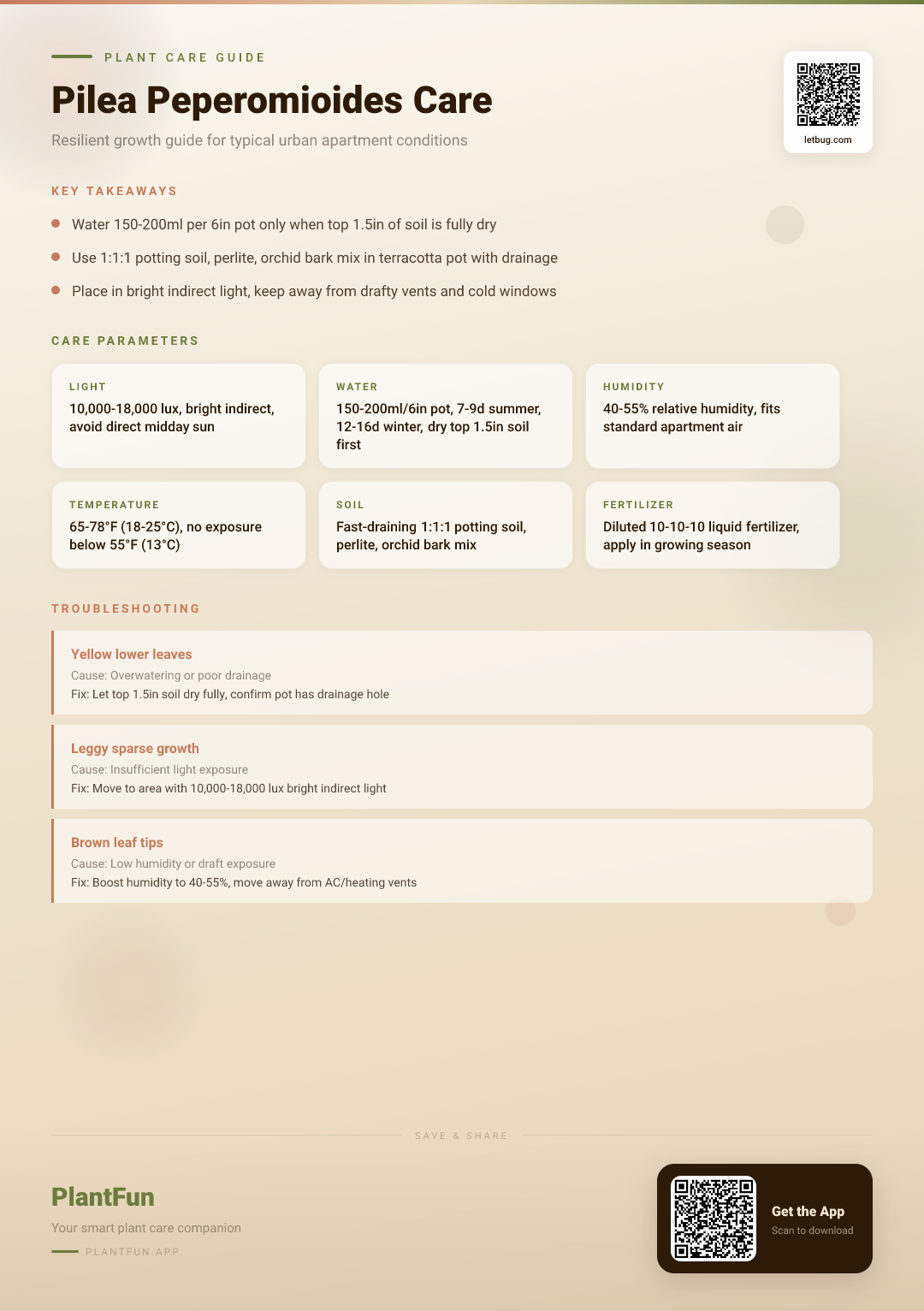
Key Takeaways
- Check soil moisture before watering — overwatering is the #1 killer of houseplants.
- Ensure your plant gets the right amount of light for its species.
- Be patient with recovery — most plants need 2–4 weeks to bounce back.
Quick Care Card
| Care Parameter | Exact Value for 500-900 sq ft Urban Apartments |
|---|---|
| Light | 10,000-18,000 lux bright indirect light |
| Water | 150-200ml per 6in pot when top 1.5in of soil is fully dry |
| Humidity | 40-55% relative humidity |
| Temperature | 65-78°F (18-25°C), no exposure below 55°F (13°C) |
| Soil | 1:1:1 mix of all-purpose potting soil, perlite, orchid bark |
| Fertilizer | Diluted 10-10-10 liquid fertilizer every 4 weeks spring/summer, none fall/winter |
| Toxicity | Non-toxic to cats, dogs, and humans (ASPCA, 2026) |
Why Typical Urban Apartment Conditions Are Tricky for Pileas
Native to the cool, humid, shaded mountain slopes of China’s Yunnan province, Pilea peperomioides evolved in stable, low-stress conditions that rarely match the average 500-900 sq ft urban apartment (Radcliffe-Smith, 1997). Common apartment stressors that cause 80% of Pilea care failures for new owners include dry forced air from heating/AC systems, inconsistent light from limited window exposure, cold drafts near windows and vents, and low stagnant airflow that slows soil drying. This Pilea care checklist is tailored specifically to these conditions, eliminating generic one-size-fits-all advice that often leads to stressed, underperforming plants.
Step 1: Diagnose Your Pilea’s Current Health First
Before adjusting your care routine, identify existing stress signals to target fixes directly, rather than guessing at changes. Below are the 5 most common Pilea stress signs specific to apartment settings:
Yellow Lower Leaves
Symptom: Soft, pale yellow leaves on the bottom 1/3 of the plant, no spots or browning on edges.
Likely cause: Overwatering, or insufficient light preventing lower leaves from photosynthesizing (the top Pilea yellow leaves cause for apartment growers).
Fix:
- Let the top 2 inches of soil dry completely before your next watering
- Move the plant 1ft closer to an east or south-facing window to increase light exposure
Curling Leaf Edges
Symptom: Leaves curl inward along the edges, often with a slightly crispy texture.
Likely cause: Underwatering, or exposure to dry forced air from heating vents (the most common answer to “why is my Pilea leaves curling” in winter apartments).
Fix:
- Water with 150-200ml of room-temperature water if the top 1.5in of soil is dry
- Move the plant at least 3ft away from any heating or cooling vents
Leggy Stems
Symptom: Long, thin stems with large gaps between leaves, leaning toward the nearest light source.
Likely cause: Insufficient light levels below 8,000 lux for extended periods.
Fix:
- Relocate to a spot with 10,000-18,000 lux of bright indirect light
- Trim stems 1in above a leaf node to encourage bushier, more compact growth, the simplest method for how to fix leggy Pilea growth
Brown Leaf Tips
Symptom: Dry, brown tips on otherwise healthy green leaves, no spreading discoloration.
Likely cause: Humidity levels below 35%, or excess fertilizer build-up in soil.
Fix:
- Place a pebble tray filled with water under the pot to raise surrounding humidity by 5-10%
- Flush soil with 3x the pot volume of water once every 3 months to remove excess fertilizer salts
No New Pups
Symptom: Mature plant (over 1 year old) with no small offshoots growing from the soil surface, even during spring growth season.
Likely cause: Root bound conditions, insufficient light, or overfertilizing.
Fix:
- Check if roots are growing out of the drainage hole, and repot to a pot 2in larger if needed
- Ensure the plant is receiving at least 12,000 lux of light daily during spring and summer
Step 2: Light Adjustment for Apartment Placement
Pilea require 10,000-18,000 lux of bright indirect light to support steady photosynthesis without leaf burn (Winter et al., 2021), which aligns with standard Pilea light requirements indoors for apartment settings. Best apartment spots:
- East-facing windowsill (receives gentle 2-3 hours of morning sun, no harsh midday rays)
- 3ft away from an unobstructed south-facing window, filtered by a sheer curtain Placements to avoid:
- Dark north-facing corners (light levels typically fall below 5,000 lux, leading to leggy growth)
- Direct midday sun from south-facing windows (can cause leaf burn within 1 hour on hot summer days) Quick test: Use a free light meter app on your phone at midday to measure lux levels at your chosen spot.
Step 3: Watering Schedule Tailored to Apartment Humidity
For a standard 6in potted Pilea in an apartment with 35-45% average humidity, follow this exact rule: Water with 150-200ml of room-temperature water only when the top 1.5in of soil feels completely dry (NC State Extension, 2026). This removes guesswork for how often to water Pilea in apartment settings:
- Summer (May-Aug): Every 7-9 days, aligned with the standard Pilea summer watering schedule for warm, bright apartments
- Winter (Nov-Feb): Every 12-16 days, when growth slows and heater use dries soil unevenly Quick test: Stick your index finger 1.5in into the soil; if no moisture clings to your skin, it is time to water. Myth vs Reality: Myth: Pilea need weekly watering year-round. Reality: Watering frequency changes by 50% between summer and winter in apartments, so following a strict weekly schedule leads to overwatering, the top cause of Pilea death.
Step 4: Humidity & Temperature Targets for Apartment Living
Pilea humidity requirements fall between 40-55% relative humidity, and a temperature range of 65-78°F (18-25°C) (NC State Extension, 2026). Never expose your Pilea to temperatures below 55°F (13°C), which can occur near drafty single-pane windows or directly in front of AC vents. For apartments with average 35-45% humidity, a simple pebble tray (fill a tray with pebbles and water, set the pot on top, ensuring the drainage hole does not touch the water) will raise local humidity by 5-10% without the need for a costly humidifier.
Step 5: Soil & Potting Best Practices for Low-Airflow Apartments
The best soil for Pilea peperomioides in low-airflow apartments is a fast-draining 1:1:1 mix of all-purpose potting soil, perlite, and orchid bark (Radcliffe-Smith, 1997). This chunky mix mimics the rocky loam of Pilea’s native habitat, and prevents overwatering by drying evenly even in stagnant apartment air. Pair this soil with a 6in unglazed terracotta pot with 1 drainage hole: terracotta wicks excess moisture from soil, reducing root rot risk for forgetful waterers.
Step 6: Fertilizing Routine for Steady Resilient Growth
To support Pilea resilient growth tips without causing fertilizer burn, use a diluted 10-10-10 liquid fertilizer (mixed to 50% the manufacturer’s recommended strength) applied once every 4 weeks in spring and summer (NC State Extension, 2026). Skip fertilizing completely in fall and winter, when growth naturally slows and excess fertilizer will build up as toxic salts in soil.
Step 7: Pruning & Pup Propagation Tips for Apartment Dwellers
- Pruning: Trim leggy stems 1in above a leaf node during spring growth season to encourage bushier, more compact growth. You can root the trimmed cuttings in water for 2-3 weeks to grow new Pilea plants for small spaces.
- Pup propagation: Wait until pups (small offshoots growing from the base of the mother plant) reach 2-3in tall before separating them. Gently dig up the pup, cut the connecting root with a clean sharp knife, and repot in a 3in pot with the same 1:1:1 soil mix. This is the easiest way to multiply your Pilea in small urban apartment spaces, or grow plants to gift to friends.
Common Apartment-Specific Pilea Care Mistakes to Avoid
- Mistake: Placing your Pilea directly on a windowsill above a heating vent in winter What happens: Dry, 100°F+ air blows directly on the leaves, causing rapid moisture loss, curling edges, and brown tips within 1-2 weeks Instead: Place the plant on a plant stand 2-3ft away from the vent, or use a vent deflector to redirect air away from your plant
- Mistake: Following a strict weekly watering schedule in winter, even when your heater is running What happens: Low light and cool temperatures slow Pilea’s growth, so it uses 50% less water in winter, leading to root rot from overwatering Instead: Only water when the top 1.5in of soil is completely dry, per standard Pilea winter care apartment guidelines
- Mistake: Letting thick dust build up on Pilea leaves for months at a time What happens: Dust blocks sunlight from reaching leaf cells, reducing photosynthesis rates by up to 30% (Winter et al., 2021) and slowing growth Instead: Wipe leaves gently with a damp microfiber cloth once every 2 weeks to remove dust
- Mistake: Repotting your Pilea every 6 months, even if it’s not root bound What happens: Pilea prefer slightly tight root conditions to produce pups, and excess soil holds unnecessary moisture that causes root rot Instead: Only repot once every 2-3 years, when roots are visibly growing out of the drainage hole
Seasonal Apartment Care Calendar
- Winter (Jan-Feb): Heaters are running full time, so check soil moisture every 10 days, water only when top 1.5in is dry (typically every 14 days). Keep plants at least 3ft away from heating vents, and avoid placing near drafty single-pane windows where temperatures can drop below 55°F at night. No fertilizer.
- Spring (Mar-Apr): Growth spurts begin as light levels increase. Move plants back to their preferred south/east window spots if you relocated them for winter. Start fertilizing once every 4 weeks, and increase watering frequency to every 10 days as temperatures rise.
- Summer (May-Jul): Water every 7-9 days for 6in pots, and rotate your Pilea 90 degrees once a week to ensure even light exposure and prevent leaning. If you run AC constantly, place a pebble tray under the pot to counteract dry AC air.
- Late Summer (Aug-Sep): Cut back fertilizing to once every 6 weeks, and reduce watering frequency slightly as light levels start to drop. Check for pest infestations (spider mites are common in dry late summer air) while wiping leaves.
- Fall (Oct-Nov): Stop fertilizing completely as growth slows. Reduce watering to every 12 days, and move plants away from windows if you start running your heater at night.
- Early Winter (Dec): Check window sills for cold drafts, and relocate Pilea if temperatures drop below 55°F near glass. Water only once every 16 days, as low light levels reduce water usage significantly.
FAQ (Voice Search Optimized)
Can I keep my Pilea next to my apartment AC vent?
No, you should never place your Pilea within 2ft of an AC vent. Cold, dry air blowing directly on the plant can cause leaf drop, curling edges, and stunted growth, even if the rest of your apartment is within the ideal temperature range (NC State Extension, 2026). If you have limited space, use a vent deflector to redirect cold air away from your plant.
Why is my Pilea not growing any new pups?
Mature Pilea (over 1 year old) typically fail to produce pups for three reasons: they are not receiving enough light (under 12,000 lux daily), they are severely root bound, or you are overfertilizing. First, test light levels with a free phone light meter app to ensure you are meeting Pilea light requirements indoors. If light is sufficient, check if roots are growing out of the drainage hole, and repot to a 2in larger pot if needed.
How often do I need to water my Pilea in the winter when my heater is on?
For a 6in potted Pilea in a typical 35-45% humidity apartment with a heater running 8+ hours a day, you will only need to water once every 12-16 days. Always test by sticking your finger 1.5in into the soil first: if no moisture clings to your skin, it is time to water with 150-200ml of room-temperature water. This answers the common question of how often to water Pilea in apartment during heating season.
References
- NC State Extension. (2026). Pilea Peperomioides Care Checklist — NC State Extension Gardener Plant Toolbox. https://plants.ces.ncsu.edu/plants/pilea-peperomioides/. Accessed 2026-02-28.
- Winter, K.; Garcia, M.; Virgo, A. (2021). Low-level CAM photosynthesis in a succulent-leaved member of the Urticaceae, Pilea peperomioides. Functional Plant Biology. https://doi.org/10.1071/fp20151. Accessed 2026-02-28.
- Radcliffe‐Smith, A. (1997). A supplementary note on the cultivation of Pilea peperomioides. Curtis’s Botanical Magazine. https://doi.org/10.1111/1467-8748.00063. Accessed 2026-02-28.
- ASPCA. (2026). Toxic and Non-Toxic Plants List — ASPCA. https://www.aspca.org/pet-care/animal-poison-control/toxic-and-non-toxic-plants. Accessed 2026-02-28.
Optional Helper: Plantfun.App
Plantfun.App identifies your plants by photo, diagnoses pests and diseases with clear fixes, and creates personalised watering and light schedules that adapt to your home conditions — a handy companion for putting this guide into daily practice.
Found an error or have suggestions? We'd love your feedback.
Need help identifying this problem?
Get instant identification, personalized care schedules, and effective pest treatment plans directly on your phone.
Sponsored • We may earn a commission from app downloads
Related Guides
The Complete Pilea Peperomioides Care Checklist for Small Urban Apartments: Achieve Resilient Lush Year-Round Growth
Stop guessing at Pilea care for your small urban apartment. Get exact light, water, humidity thresholds and a printable checklist for lush, resilient growth all year long.
Care GuidePilea Peperomioides in Small Urban Apartments: The Only Resilient Growth Care Checklist You Need
Grow a lush, full Pilea peperomioides even in a cramped urban apartment. Get 12 actionable checklist steps, exact light, water, and humidity thresholds to avoid common leaf issues and boost resilient growth.
Care GuideThe Complete Pilea Peperomioides Care Guide for Small Urban Apartments: Lush Resilient Growth
Grow full, happy Pilea peperomioides even in tiny urban apartments. Get exact light levels, watering amounts, and space-saving tips for resilient growth and plenty of new pups.
Pest ControlAnts on Plants: What They Mean and What to Do
Ants usually aren't eating your plant. They are farming other pests.