
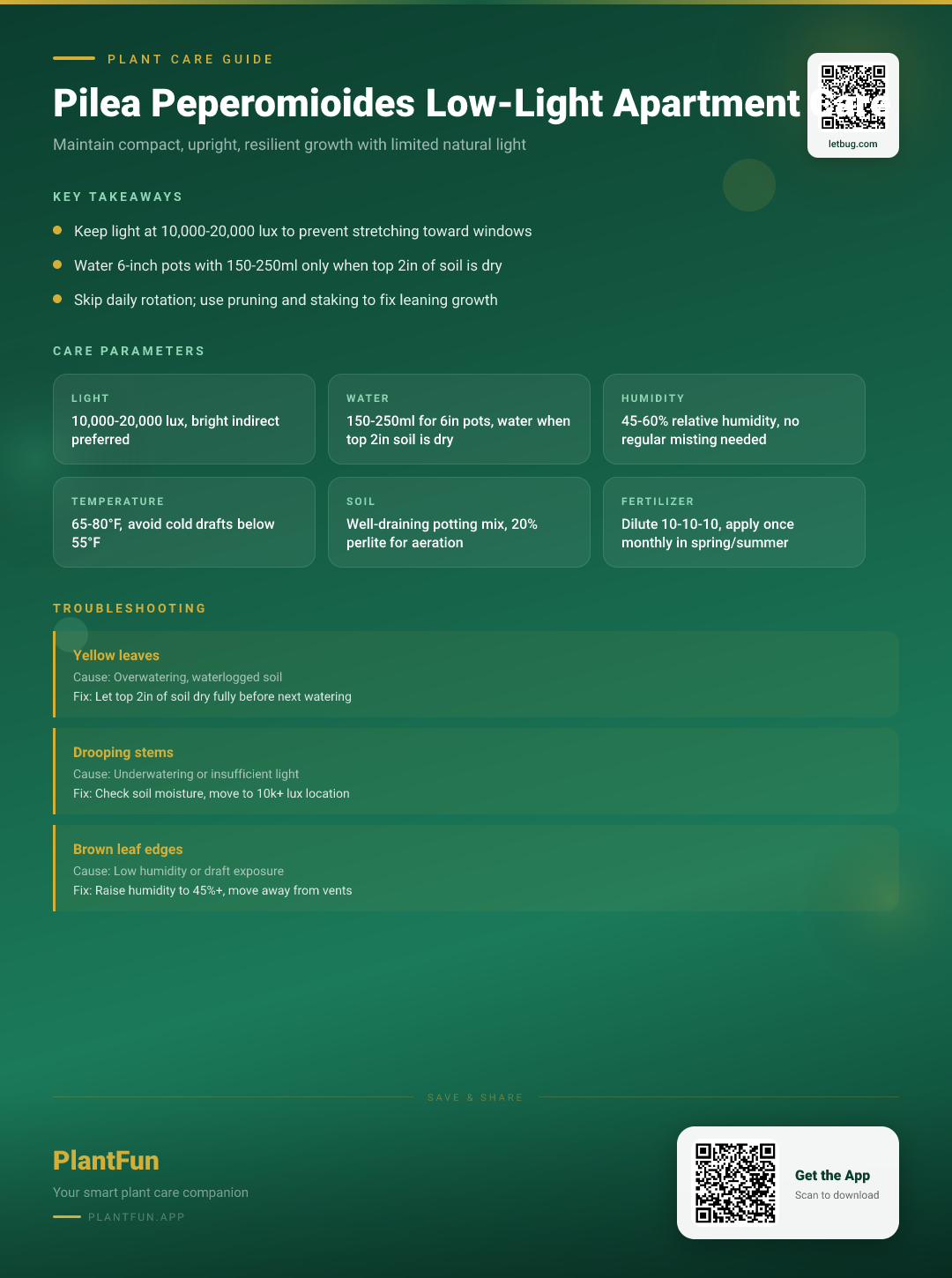
Key Takeaways
- Check soil moisture before watering — overwatering is the #1 killer of houseplants.
- Ensure your plant gets the right amount of light for its species.
- Be patient with recovery — most plants need 2–4 weeks to bounce back.
TL;DR: Quick Solutions for Compact Growth
If your Pilea is reaching for the light, it is suffering from etiolation. To keep it compact, move it to within 2 feet of a south or east-facing window to hit the 10,000–20,000 lux requirement (NC State Extension, 2026). Water with 150-250ml only when the top 2 inches of soil are dry. Avoid daily rotation, as this disrupts the plant’s natural orientation and energy-saving processes.
Quick Care Card: Essential Stats
| Requirement | Optimal Range |
|---|---|
| Light Intensity | 10,000 – 20,000 lux |
| Watering Volume | 150ml – 250ml (for 6-inch pot) |
| Humidity | 45% – 60% |
| Temperature | 65°F – 80°F |
| Soil | Well-draining, peat-based mix |
| Fertilizer | Balanced liquid 10-10-10 (monthly in summer) |
| Toxicity | Non-toxic to cats and dogs (ASPCA, 2026) |
Why Your Pilea Struggles in Apartments
When I first brought home my own Pilea peperomioides, I placed it in a trendy, dim corner of my living room. Within a month, the stems became long and spindly. The reality is that these plants originate from the shaded forest floors of China’s Yunnan province, but they are adapted to filtered, bright light. Most apartments suffer from “light-starved” pockets that provide less than 5,000 lux, causing the plant to prioritize stem elongation over leaf production in a desperate search for energy (NC State Extension, 2026).
The 10,000 Lux Threshold
To stop the stretching, you must measure your light. Using a light meter (or a reliable smartphone app), look for the ‘Sweet Spot.’ You want at least 10,000 lux. In a typical apartment, this is usually on a windowsill or on a plant stand placed directly adjacent to a window. If your plant is more than 3 feet from the glass, it is likely not receiving the minimum intensity required to maintain its signature “pancake” shape.
Watering by the Numbers
Overwatering is the fastest way to kill a Pilea. I use a standardized 150-250ml measurement for my 6-inch pots. Never water on a schedule. Instead, test the soil by sticking your finger 2 inches deep. If it feels moist, do not water. When dry, apply water slowly until you see moisture in the saucer, then discard the excess to prevent root rot.
The Structural Support Plan
If your Pilea is already leaning, follow these steps to reset its growth:
- Pruning: Remove the lowest, oldest leaves to encourage energy flow to the top canopy.
- Staking: Insert a thin, discreet bamboo stake near the stem. Use soft garden tape to gently secure the stem in an upright position.
- Consistency: Ensure the plant receives light from above rather than from the side to prevent future leaning.
Myth-Busting: Why Daily Rotation is Hurmful
Many owners rotate their pots daily to keep the plant straight. However, this creates “phototropic stress.” The plant constantly reorients its auxiliary leaves to track the sun, wasting the energy it could be using for new growth. Rotate your plant only once every two weeks by 90 degrees to ensure even development without exhaustion.
How do I know if my Pilea needs more light?
Symptom: Small leaves, leggy stems, and slow growth.
Fix: Move the plant 1-2 feet closer to a window or add a dedicated full-spectrum grow light during the winter months.
Can I use a normal lamp to supplement my Pilea’s light in winter?
Symptom: Using standard household bulbs.
Fix: A normal desk lamp lacks the intensity (measured in lux) required for photosynthesis. You must use a dedicated LED grow light placed 6-12 inches above the foliage to actually aid the plant.
Why is my Pilea losing its lower leaves even with regular water?
Symptom: Yellowing and drop-off of older foliage.
Fix: This is often a sign of uneven watering or, according to ASPCA (2026), a response to environmental changes. Ensure you are watering thoroughly and that the plant isn’t sitting in a cold draft.
Seasonal Maintenance Calendar
- Spring/Summer: Increase light exposure; water every 7-10 days; feed monthly with balanced fertilizer (NC State Extension, 2026).
- Autumn/Winter: Move closer to the glass as sunlight wanes; reduce watering by 30% as metabolic rates drop.
Troubleshooting Guide
Yellowing Leaves
Symptom: Leaves turn yellow from the bottom up.
Likely cause: Overwatering leading to waterlogged roots.
Fix:
- Withhold water until the top 2 inches of soil are completely dry.
- Check drainage holes to ensure they are not blocked.
Drooping Stems
Symptom: Entire plant looks limp and thirsty.
Likely cause: Inconsistent hydration or heat stress.
Fix:
- Check soil moisture; if bone dry, give it a deep, soaking water.
- Keep away from heating vents or radiators.
Brown Edges
Symptom: Crisp, brown leaf tips or margins.
Likely cause: Low humidity or mineral buildup.
Fix:
- Increase humidity by placing the pot on a pebble tray.
- Use distilled water to avoid tap water chlorine buildup.
References
- ASPCA. (2026). Toxic and Non-Toxic Plants List — ASPCA. https://www.aspca.org/pet-care/animal-poison-control/toxic-and-non-toxic-plants. Accessed 2026-03-18.
- Gilman, E. (2007). Pilea cadierei Aluminum Plant. EDIS. https://doi.org/10.32473/edis-fp478-1999. Accessed 2026-03-18.
- Gilman, E. (2007). Pilea microphylla Artillery Plant. EDIS. https://doi.org/10.32473/edis-fp479-1999. Accessed 2026-03-18.
- NC State Extension. (2026). Pilea — NC State Extension Gardener Plant Toolbox. https://plants.ces.ncsu.edu/plants/pilea-care/. Accessed 2026-03-18.
Optional Helper: Plantfun.App
Plantfun.App identifies your plants by photo, diagnoses pests and diseases with clear fixes, and creates personalised watering and light schedules that adapt to your home conditions — a handy companion for putting this guide into daily practice.
Found an error or have suggestions? We'd love your feedback.
Need help identifying this problem?
Get instant identification, personalized care schedules, and effective pest treatment plans directly on your phone.
Sponsored • We may earn a commission from app downloads
Related Guides
The Complete Pilea Peperomioides Care Checklist for Resilient Growth in Small Urban Apartments
Grow a bushy, happy Pilea in your small urban apartment with our science-backed checklist. Get exact light levels, water amounts, and mistake fixes to avoid yellow leaves or leggy growth.
Care GuidePilea Peperomioides Care Checklist for East-Facing Apartment Shelves: Resilient Lush Growth
Stop dealing with leggy, droopy Pilea plants. Get our 12-step care checklist, exact light, water, and humidity thresholds for resilient, lush growth in your east-facing apartment.
Care GuidePilea Peperomioides in a Small Apartment: The Ultimate Care Guide for Resilient Year-Round Growth
Transform your Pilea's health with this apartment-tested care guide. Master precise light, watering schedules, and seasonal routines for lush, pancake-leaf growth.
Pest ControlAnts on Plants: What They Mean and What to Do
Ants usually aren't eating your plant. They are farming other pests.