
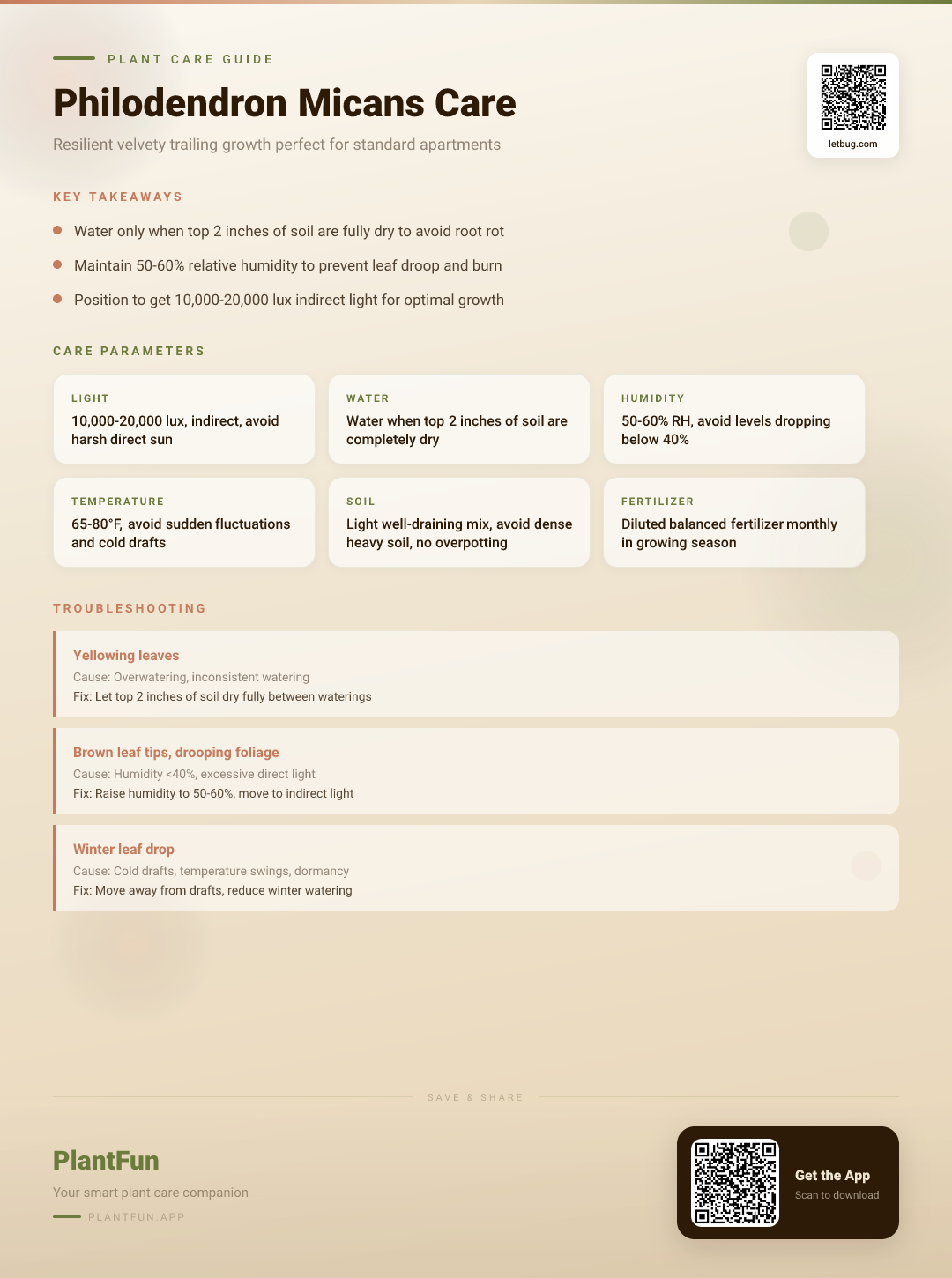
Key Takeaways
- Check soil moisture before watering — overwatering is the #1 killer of houseplants.
- Ensure your plant gets the right amount of light for its species.
- Be patient with recovery — most plants need 2–4 weeks to bounce back.
Quick Care Card: Essential Thresholds
| Feature | Requirement |
|---|---|
| Light | 10,000–20,000 lux (bright, indirect) |
| Water | When top 2 inches are dry |
| Humidity | 50–60% |
| Temperature | 65–80°F (18–27°C) |
| Soil | Chunky, well-draining aroid mix |
| Fertilizer | Balanced liquid feed, diluted, monthly in spring/summer |
| Toxicity | Toxic to cats and dogs (ASPCA, 2026) |
TL;DR: The Micans Manifesto
If you want a high-reward trailing plant for your apartment, Philodendron hederaceum var. micans is it. It thrives in the moderate light found in most apartments and adapts well to indoor containers. The secret to success lies in maintaining consistent moisture and resisting the urge to over-pot. By mimicking its native tropical understory, you can enjoy its signature velvet shimmer year-round (NC State Extension, 2026).
My Experience: Learning the Velvet Touch
When I first brought home my Philodendron Micans, I made the mistake of placing it in a dark bookshelf, thinking it was a low-light plant. Within weeks, the stems grew leggy, and the stunning, iridescent heart-shaped leaves lost their luster. I learned quickly that while it survives in lower light, it absolutely thrives when given just enough brightness to photosynthesize efficiently. I’ve since moved it to an east-facing window, and the growth rate has been impressive.
The Science of Texture
The velvety, shimmery appearance of Micans leaves is more than just an aesthetic quirk; it is a specialized adaptation. Humidity is crucial because these thinner, textured leaves lose water vapor rapidly. When ambient humidity drops below 40%, the plant struggles to maintain turgor pressure, leading to drooping or curling leaves. While micropropagation studies have focused on clonal stability (Han & Park, 2008), the physical health of your plant relies on maintaining the delicate balance between transpiration and root uptake.
Light Requirements
Positioning your vine is an art. You need 10,000–20,000 lux. If you don’t have a light meter, imagine the light level where you can easily read a book without straining your eyes. Avoid direct, harsh sun, which can cause leaf scorch. If the leaves look pale or exhibit stunted growth, move them closer to the window (NC State Extension, 2026).
The Watering Ritual
Overwatering is the fastest way to kill this plant. I use the “2-inch finger test”: stick your index finger into the soil up to the second knuckle. If it feels dry, it is time to water. Consistency prevents the yellowing leaves often caused by erratic dry-and-drown cycles.
Apartment-Specific Humidity Hacks
If your apartment stays dry due to HVAC systems, try these methods to reach 50-60% humidity:
- Group plants: Placing your Micans near other tropicals creates a localized humid micro-climate.
- Pebble trays: Fill a shallow tray with stones and water, then rest the pot on the stones (ensuring the roots don’t sit in water).
- Grouping in the bathroom: If you have a bathroom with a window, the intermittent steam will keep your Micans very happy.
Can I keep my Philodendron Micans in a low-light corner of my apartment?
While it will survive, it will not thrive. It will exhibit thin, sparse vines and smaller leaf production. If you must keep it in a low-light corner, I recommend a supplemental grow light to maintain its health and aesthetic density.
Why is my Philodendron Micans dropping leaves during the winter months?
Winter dormancy naturally slows the growth rate, but leaf drop is usually caused by cold drafts or radiator heat drying out the foliage. Ensure it stays away from vents and maintain a steady temperature (NC State Extension, 2026).
Common Mistakes to Avoid
- Mistake: Over-potting. What happens: Excess soil holds too much water, leading to root rot. Instead: Use a pot only 1–2 inches larger than the root ball.
- Mistake: Dense, heavy soil. What happens: The roots suffocate. Instead: Mix potting soil with perlite and orchid bark for maximum aeration.
Seasonal Care Calendar
- Spring/Summer: This is the peak trailing plant care window. Increase watering frequency and apply a balanced fertilizer once per month.
- Fall/Winter: Growth slows significantly. Allow the soil to dry out a bit more between waterings and withhold fertilizer until spring.
Troubleshooting
Root Rot
Symptom: Yellowing, mushy leaves and a foul smell from the soil.
Likely cause: Overwatering or poor drainage.
- Carefully remove the plant from the pot.
- Trim away brown, mushy roots.
- Repot in fresh, well-draining substrate.
Spider Mites
Symptom: Tiny webs between leaves and speckled, yellowing foliage.
Likely cause: Low humidity in the apartment.
- Wipe leaves with a damp cloth.
- Increase local humidity levels.
- Use an insecticidal soap if the infestation persists.
Edema
Symptom: Small, water-soaked bumps on the underside of leaves.
Likely cause: The plant absorbed more water than it could transpire.
- Allow soil to dry more between waterings.
- Improve air circulation around the foliage.
References
- Han, B., & Park, B. (2008). In vitro micropropagation of Philodendron cannifolium. Journal of Plant Biotechnology. https://doi.org/10.5010/jpb.2008.35.3.203. Accessed 2026-03-19.
- Journal of Plant Biotechnology. (2004). Micropropagation of Philodendron wend-imbe through Adventitious Multi-bud Cluster Formation. Journal of Plant Biotechnology. https://doi.org/10.5010/jpb.2004.31.2.115. Accessed 2026-03-19.
- ASPCA. (2026). Toxic and Non-Toxic Plants List — ASPCA. https://www.aspca.org/pet-care/animal-poison-control/toxic-and-non-toxic-plants. Accessed 2026-03-19.
- NC State Extension. (2026). Philodendron Micans — NC State Extension Gardener Plant Toolbox. https://plants.ces.ncsu.edu/plants/micans-care/. Accessed 2026-03-19.
Optional Helper: Plantfun.App
Plantfun.App identifies your plants by photo, diagnoses pests and diseases with clear fixes, and creates personalised watering and light schedules that adapt to your home conditions — a handy companion for putting this guide into daily practice.
Found an error or have suggestions? We'd love your feedback.
Need help identifying this problem?
Get instant identification, personalized care schedules, and effective pest treatment plans directly on your phone.
Sponsored • We may earn a commission from app downloads
Related Guides
The Complete Philodendron Micans Care Checklist for Lush Resilient Growth in Typical Urban Apartments
Fix leggy growth, yellow leaves, and dull velvet texture on your Philodendron Micans. Get exact light, water, and humidity thresholds for lush, resilient growth in your standard apartment.
Care GuidePhilodendron Micans in Small Urban Apartments: The Only Resilient Growth Checklist You Need
Grow lush, velvety Philodendron Micans even in tight urban apartments. Get exact light levels, watering amounts, and space-saving hacks for resilient, fast growth year-round.
Care GuidePhilodendron Micans in a Typical Apartment: The Complete Care Guide for Resilient Growth
Transform your Philodendron Micans into a lush, vining display with our precise care guide. Learn exact light, water, and humidity levels for apartment living.
Pest ControlAnts on Plants: What They Mean and What to Do
Ants usually aren't eating your plant. They are farming other pests.