
Key Takeaways
- Check soil moisture before watering — overwatering is the #1 killer of houseplants.
- Ensure your plant gets the right amount of light for its species.
- Be patient with recovery — most plants need 2–4 weeks to bounce back.
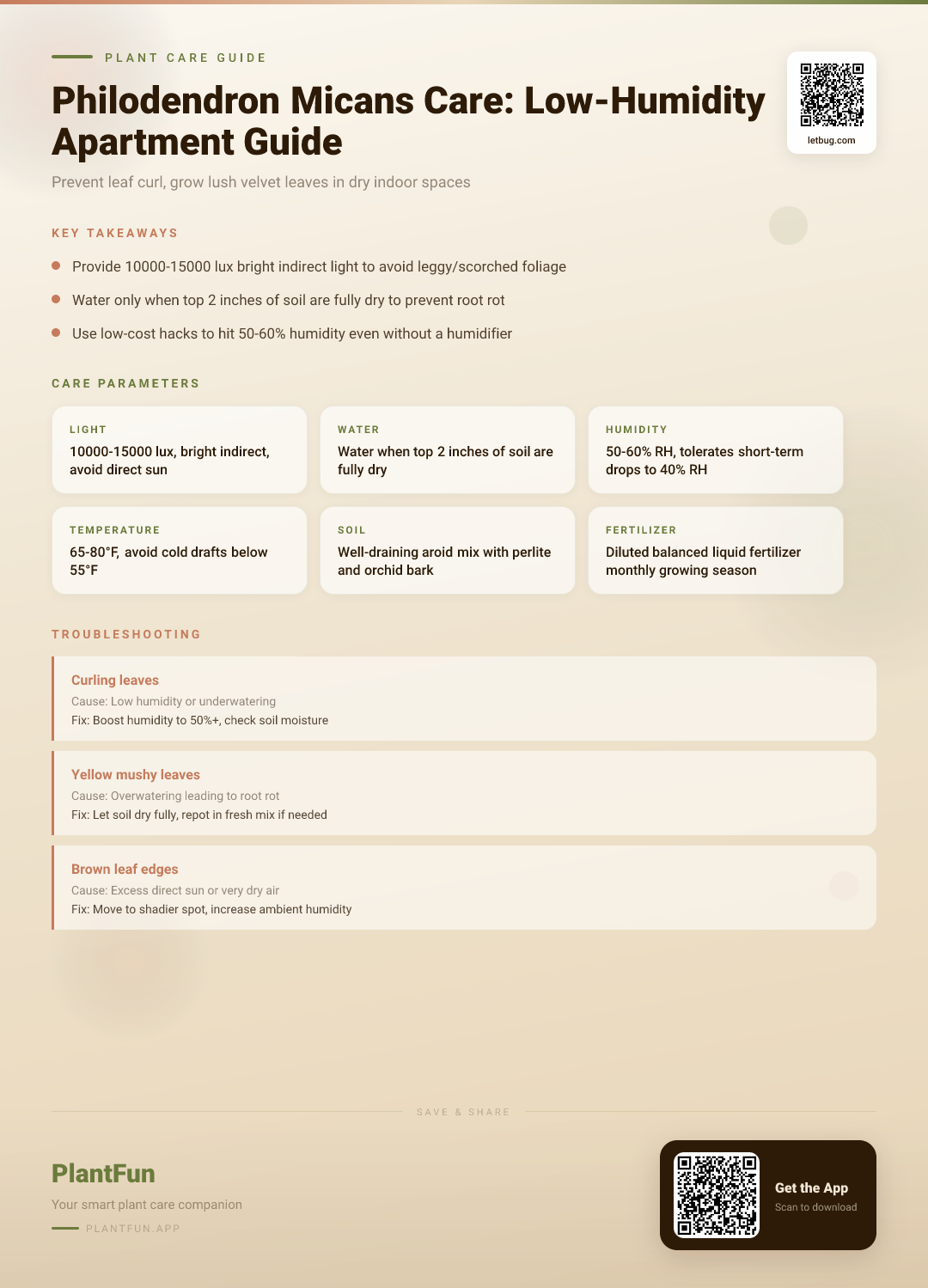
Quick Care Card: Essential Thresholds for Micans Success
| Feature | Requirement |
|---|---|
| Light | 10,000–15,000 lux (bright, indirect) |
| Humidity | 50–60% |
| Temperature | 65–80°F (18–27°C) |
| Water | When top 2 inches of soil are dry |
| Soil | Aroid mix (bark, perlite, coco coir) |
| Fertilizer | Balanced liquid feed, monthly in spring/summer |
| Toxicity | Toxic to cats and dogs (ASPCA, 2026) |
TL;DR: The Micans Reality Check for Apartment Living
If your Philodendron Micans is struggling, it is almost certainly a humidity or watering mismatch. These vining aroids require a stable, moderate environment. In most modern apartments, ambient air is too dry, causing the characteristic velvet leaves to curl and develop brown edges. By adjusting your light levels to the 10,000-15,000 lux range and ensuring the top 2 inches of soil are dry before re-watering, you can stabilize your plant’s health (NC State Extension, 2026).
Why Your Philodendron Micans Curles Leaves in Modern Apartments
When I first got my Philodendron Micans, I made the mistake of placing it directly on a sunny windowsill in a drafty corner. Within weeks, the beautiful heart-shaped leaves began to curl inwards—a defensive mechanism to prevent water loss through transpiration. In apartment settings, HVAC systems constantly strip moisture from the air, creating a desert-like microclimate that this tropical species is not evolved to handle.
Step 1: Mastering the Light - Finding the Sweet Spot Between Scorched and Leggy
Lighting is the engine of your plant’s growth. Too little light, and the stems become leggy with large gaps between leaves. Too much direct sun, and the velvety surface will bleach or scorch.
- The Lux Test: I recommend using a light meter app to ensure your plant sits in a space receiving 10,000 to 15,000 lux.
- Placement: An east-facing window is usually perfect. If you have a south-facing window, pull the plant back 3-5 feet to avoid harsh mid-day rays.
- Growth habits: Remember that even when the plant is happy, its growth rate will naturally fluctuate based on the light season (Han & Park, 2008).
Step 2: Hydration Science - How to Water Without Risking Root Rot
Watering isn’t a schedule; it’s a reaction to the soil moisture. I use the “finger test”: stick your finger 2 inches into the soil. If it feels dry to the touch, it is time to hydrate. Overwatering is the fastest way to kill a Micans because it suffocates the root system (NC State Extension, 2026).
- Use room-temperature, filtered water to avoid chlorine shock.
- Pour until water drains from the bottom holes.
- Empty the saucer immediately; never let your plant sit in stagnant water.
Step 3: Humidity Hacks - Strategies for Low-Humidity Living Spaces
- The Pebble Tray: Fill a tray with pebbles and water, then set your plant pot on top (ensure the pot bottom does not touch the water). As the water evaporates, it increases local humidity.
- Grouping: Place your Micans near other leafy plants. They create a small, shared humid microclimate through transpiration.
- The Bathroom Strategy: If your bathroom has a window, it is the best room for a Micans. The frequent shower steam mimics their native tropical habitat.
Seasonal Calendar: Adjusting Care from Dry Winters to Humid Summers
- Spring/Summer: This is peak growth time. You will need to water more frequently as the plant consumes moisture faster. I typically feed with a balanced fertilizer every 4-6 weeks.
- Autumn/Winter: Growth slows down. Reduce watering frequency, as the soil will remain damp for longer. Keep the plant away from cold drafts or direct heat vents, which are common in city apartments.
Common Mistakes: The Top 3 Reasons Why Micans Fail Indoors
Improper Watering Frequency
Mistake: Watering on a calendar day (e.g., “every Monday”). What happens: Root rot or severe dehydration. Instead: Check the soil moisture manually before adding water.
Inadequate Substrate
Mistake: Using standard, dense garden soil. What happens: The roots lack oxygen, leading to stunted growth. Instead: Use an airy aroid mix containing bark, perlite, and high-quality coco coir.
Neglecting Toxicity
Mistake: Placing the plant where pets can reach it. What happens: Ingestion causes oral irritation or vomiting (ASPCA, 2026). Instead: Keep your vining stems on high shelves or in hanging planters.
Voice FAQ: Why is my Philodendron Micans leaf edges turning brown?
This is typically a sign of low humidity. The plant is struggling to keep its edges hydrated as the surrounding air pulls moisture away. Increasing the humidity using a pebble tray or group-placement should stabilize the situation.
Voice FAQ: How do I know when my Philodendron Micans needs more light?
You will notice the stems stretching significantly between leaves, creating a “leggy” appearance. The plant may also start growing smaller leaves than usual as it searches for a stronger light source.
Voice FAQ: Can I grow a Philodendron Micans in an apartment without a humidifier?
Yes. While a humidifier is ideal, you can maintain success by grouping it with other plants and keeping it in a more humid room, such as a well-lit kitchen or bathroom, to regulate the micro-environment (Journal of Plant Biotechnology, 2004).
References
- Han, B.; Park, B. (2008). In vitro micropropagation of Philodendron cannifolium. Journal of Plant Biotechnology. https://doi.org/10.5010/jpb.2008.35.3.203. Accessed 2026-03-19.
- Journal of Plant Biotechnology. (2004). Micropropagation of Philodendron wend-imbe through Adventitious Multi-bud Cluster Formation. Journal of Plant Biotechnology. https://doi.org/10.5010/jpb.2004.31.2.115. Accessed 2026-03-19.
- ASPCA. (2026). Toxic and Non-Toxic Plants List — ASPCA. https://www.aspca.org/pet-care/animal-poison-control/toxic-and-non-toxic-plants. Accessed 2026-03-19.
- NC State Extension. (2026). Philodendron Micans — NC State Extension Gardener Plant Toolbox. https://plants.ces.ncsu.edu/plants/micans-care/. Accessed 2026-03-19.
Optional Helper: Plantfun.App
Plantfun.App identifies your plants by photo, diagnoses pests and diseases with clear fixes, and creates personalised watering and light schedules that adapt to your home conditions — a handy companion for putting this guide into daily practice.
Found an error or have suggestions? We'd love your feedback.
Need help identifying this problem?
Get instant identification, personalized care schedules, and effective pest treatment plans directly on your phone.
Sponsored • We may earn a commission from app downloads
Related Guides
Philodendron Micans in a Typical Apartment: The Complete Guide for Resilient Growth
Transform your Philodendron Micans into a lush, velvet masterpiece. Follow our exact light, humidity, and seasonal watering schedule for growth you can measure.
Care GuideThe Complete Philodendron Micans Care Checklist for Lush Resilient Growth in Typical Urban Apartments
Fix leggy growth, yellow leaves, and dull velvet texture on your Philodendron Micans. Get exact light, water, and humidity thresholds for lush, resilient growth in your standard apartment.
Care GuideThe Complete Philodendron Micans Care Checklist for Resilient Growth in Small Urban Apartments
Grow lush, velvety Philodendron Micans in your apartment without the guesswork. Get exact light, water, and humidity thresholds plus a 10-step checklist for stress-free, resilient growth year-round.
Pest ControlAnts on Plants: What They Mean and What to Do
Ants usually aren't eating your plant. They are farming other pests.