
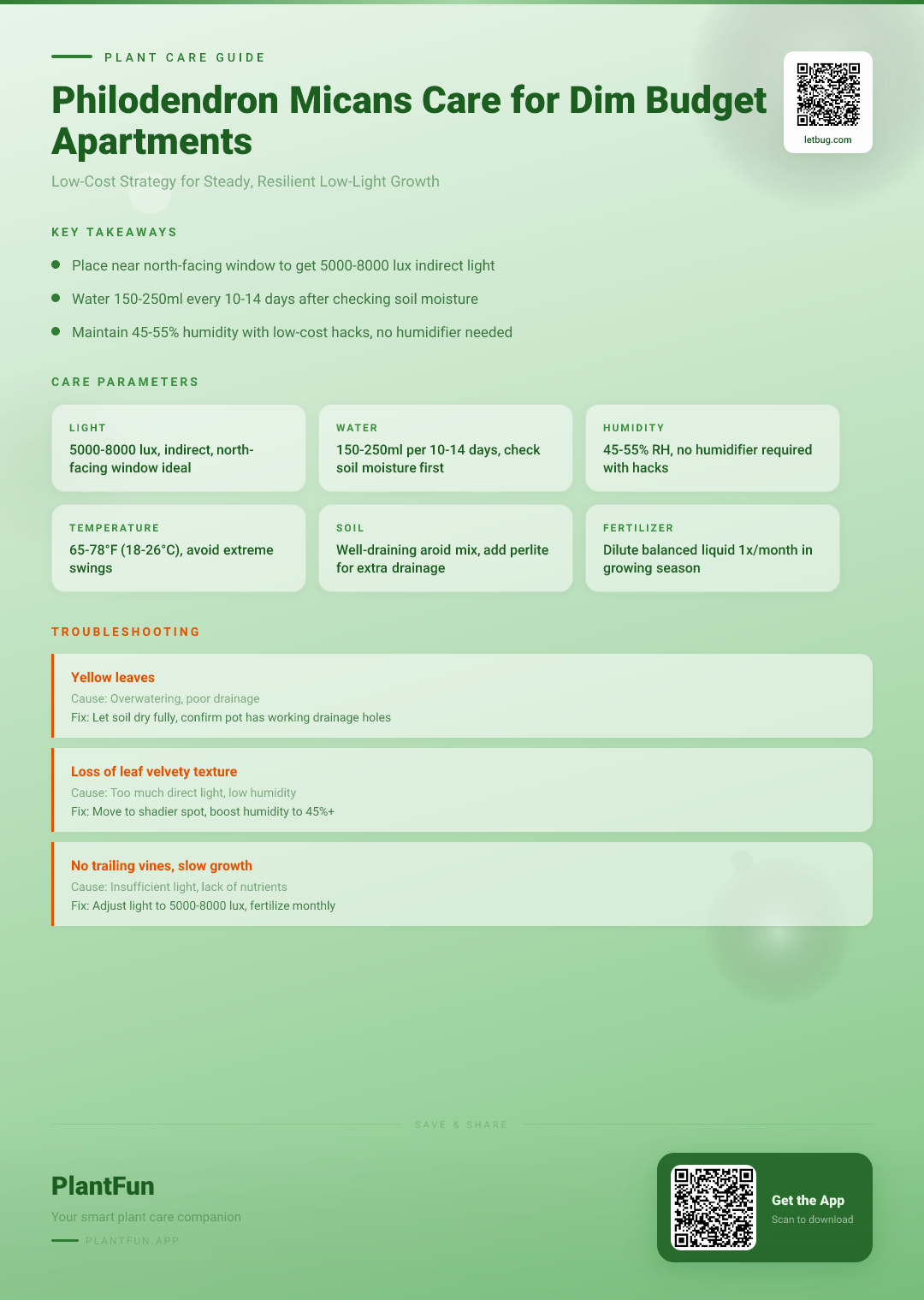
Key Takeaways
- Check soil moisture before watering — overwatering is the #1 killer of houseplants.
- Ensure your plant gets the right amount of light for its species.
- Be patient with recovery — most plants need 2–4 weeks to bounce back.
Quick Care Card: Essential Thresholds for Apartment Success
| Feature | Requirement |
|---|---|
| Light | 5,000–8,000 lux (Bright, indirect) |
| Watering Frequency | 150–250ml every 10–14 days |
| Humidity | 45–55% Relative Humidity |
| Temperature | 65–78°F (18–26°C) |
| Soil | Well-draining peat-perlite mix |
| Fertilizer | Balanced liquid feed (monthly in summer) |
| Toxicity | Toxic to cats and dogs (ASPCA, 2026) |
TL;DR: Why Your Micans Isn’t Thriving in Your Apartment
If your Philodendron micans is dropping leaves or looking leggy, you are likely overwatering or starving it of light. Despite its reputation, this plant is remarkably resilient in apartments if you mimic its native forest-floor conditions. Focus on a strict watering rhythm and placing it near a window rather than deep in a room corner. Success comes from consistency, not expensive gadgets.
Understanding the Philodendron Micans: Natural Habitat vs. The Living Room Corner
When I first brought home my Philodendron micans, I tucked it into a dark bookshelf, assuming its “low light” label meant “no light.” I watched it slowly shed its stunning velvet foliage until only bare vines remained. I learned the hard way that while these plants survive in low light, they do not thrive there.
Native to the Caribbean and Central America, P. micans grows as an understory vine (NC State Extension, 2026). In the wild, it receives filtered light through a dense canopy. In your apartment, that translates to “bright, indirect light”—meaning the plant should be able to “see” the sky, but never the sun directly.
Mastering the Light: Achieving 5,000-8,000 lux in North-Facing Windows
Light is the primary driver of metabolism for your Micans. If your apartment only has north-facing windows, you need to maximize every photon.
- Placement: Position your pot within 12–24 inches of the glass.
- Measurement: If you have a light meter app, aim for 5,000–8,000 lux. If you don’t, check for a soft shadow cast by your hand; if the shadow is non-existent, your plant is starving.
- Cleaning: Dust the velvet leaves with a soft, dry cloth monthly. Dust blocks light and reduces photosynthetic efficiency.
The Budget Watering Protocol: Using 150-250ml per 10-14 days based on soil moisture
Overwatering is the number one killer of indoor Philodendron. I never water on a schedule based on a calendar; I water based on a tactile test.
- The Finger Test: Stick your index finger into the soil up to the second knuckle (approx. 2 inches). If it feels damp, wait. If it is dry, proceed.
- The Volume: In a standard 6-inch pot, use exactly 150-250ml of water. This ensures enough moisture to saturate the roots without creating a boggy environment that leads to rot.
- Drainage: Ensure your pot has holes. If it doesn’t, repot immediately into one that does. A drainage-less pot is a death sentence for this species.
Humidity Hacks: Maintaining 45-55% relative humidity without a humidifier
You don’t need a $100 humidifier. The ambient humidity in most apartments sits around 30-40%, which is a bit dry. To boost it naturally:
- Grouping: Place your Micans near other plants. They create a microclimate as they transpire, raising local humidity.
- Tray Method: Place your pot on a tray filled with pebbles and water. Ensure the pot sits on the pebbles, not in the water, to avoid root rot.
Temperature Control: Keeping between 65-78°F (18-26°C) for optimal metabolism
These plants are sensitive to drafts. Avoid placing your Micans near air conditioning vents or drafty windows in the winter. Temperatures below 60°F can induce dormancy and slow growth significantly, while temperatures above 80°F can cause the edges of the leaves to crisp (NC State Extension, 2026).
Voice Search FAQ: Why is my Philodendron Micans losing its velvety texture?
Usually, this is a symptom of low humidity or chemical stress. If the air is too dry, the plant loses its luster. Ensure you aren’t using hard water with heavy mineral deposits, which can leave white residue on the leaves. Use filtered or tap water that has sat out for 24 hours to dissipate chlorine.
Voice Search FAQ: How do I get my Micans to grow trailing vines faster?
Growth rate is a function of light and nutrient availability. To increase speed, focus on the light requirements mentioned above. Once you hit the 5,000–8,000 lux threshold, apply a balanced, water-soluble fertilizer at half-strength during the growing season (spring through summer). Do not over-fertilize, as this leads to salt buildup in the soil.
Seasonal Care Calendar: Adjusting for the ‘Apartment Winter’ Dip
- Spring/Summer: Increase watering to once every 7-10 days; apply fertilizer once a month. This is when the plant is actively metabolizing (Han & Park, 2008).
- Fall/Winter: Reduce water to every 14 days. Hold off on fertilizer completely. The lower light levels of winter mean the plant cannot process extra nutrients.
Common Mistakes to Avoid: Over-potting and Drainage Neglect
-
Mistake: Using a pot that is too large (over-potting).
-
What happens: Excess soil holds too much water, leading to root rot.
-
Instead: Only repot when roots are circling the drainage holes.
-
Mistake: Ignoring drainage.
-
What happens: Water accumulates at the bottom, suffocating the roots.
-
Instead: Always use a container with drainage holes and a saucer.
References
- ASPCA. (2026). Toxic and Non-Toxic Plants List — ASPCA. https://www.aspca.org/pet-care/animal-poison-control/toxic-and-non-toxic-plants. Accessed 2026-03-12.
- Han, B.; Park, B. (2008). In vitro micropropagation of Philodendron cannifolium. Journal of Plant Biotechnology. https://doi.org/10.5010/jpb.2008.35.3.203. Accessed 2026-03-12.
- Journal of Plant Biotechnology. (2004). Micropropagation of Philodendron wend-imbe through Adventitious Multi-bud Cluster Formation. https://doi.org/10.5010/jpb.2004.31.2.115. Accessed 2026-03-12.
- NC State Extension. (2026). Philodendron Micans — NC State Extension Gardener Plant Toolbox. https://plants.ces.ncsu.edu/plants/micans-care/. Accessed 2026-03-12.
Optional Helper: Plantfun.App
Plantfun.App identifies your plants by photo, diagnoses pests and diseases with clear fixes, and creates personalised watering and light schedules that adapt to your home conditions — a handy companion for putting this guide into daily practice.
Found an error or have suggestions? We'd love your feedback.
Need help identifying this problem?
Get instant identification, personalized care schedules, and effective pest treatment plans directly on your phone.
Sponsored • We may earn a commission from app downloads
Related Guides
Philodendron Micans in a Low-Light Apartment: The Complete Care Guide for Resilient Growth
Master Philodendron Micans care in your apartment with this 5-step guide. Learn exact lux levels, watering volumes, and light-hacking tips for lush vines today.
Care GuideThe Complete Philodendron Micans Care Checklist for Lush Resilient Growth in Typical Urban Apartments
Fix leggy growth, yellow leaves, and dull velvet texture on your Philodendron Micans. Get exact light, water, and humidity thresholds for lush, resilient growth in your standard apartment.
Care GuidePhilodendron Micans in a Standard Apartment: The Complete Care Guide for Resilient Growth
Transform your apartment into a lush oasis with this Philodendron Micans guide. Learn exact light thresholds, seasonal watering hacks, and 3 steps to lush growth.
Pest ControlAnts on Plants: What They Mean and What to Do
Ants usually aren't eating your plant. They are farming other pests.