
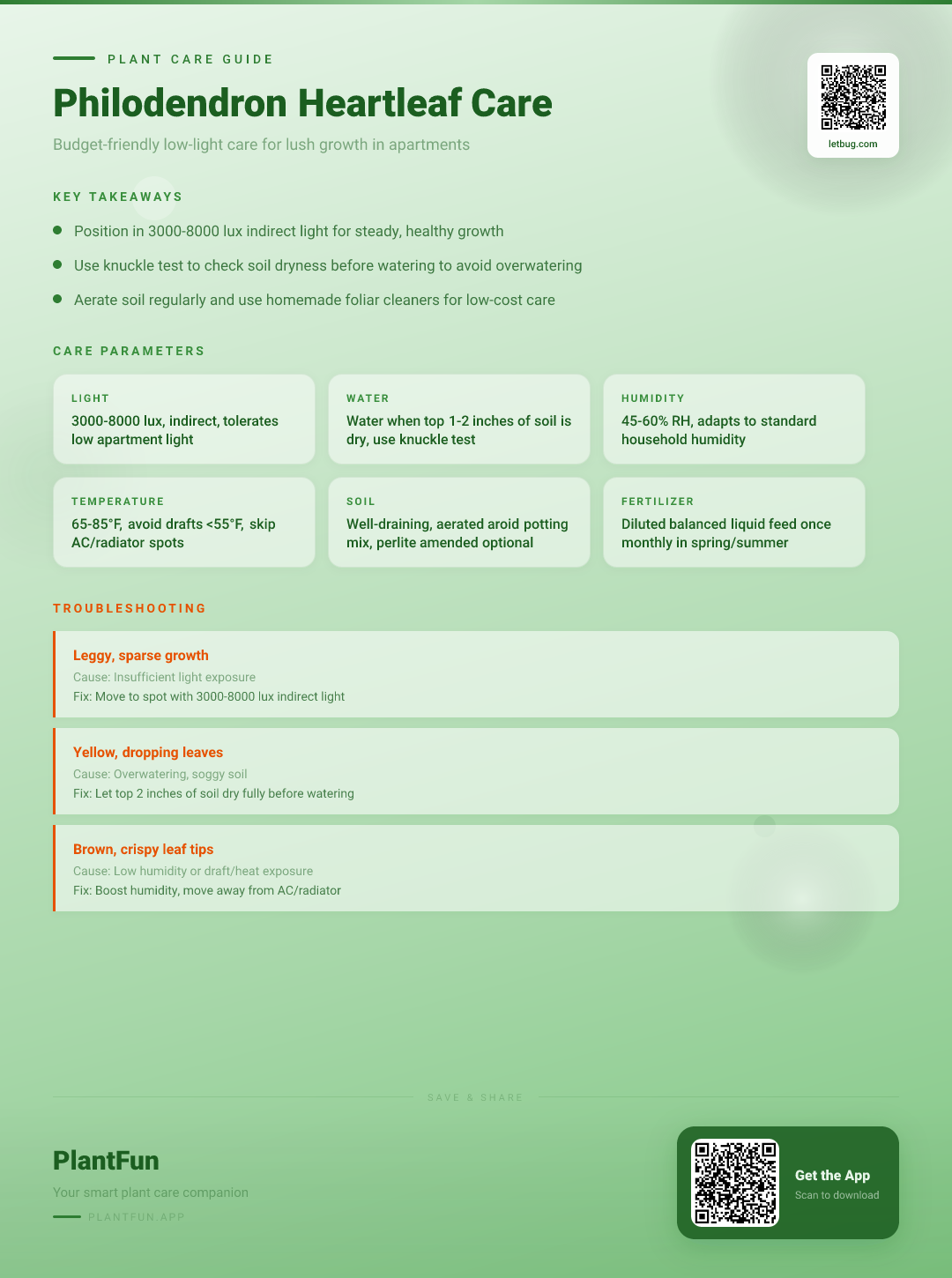
Key Takeaways
- Check soil moisture before watering — overwatering is the #1 killer of houseplants.
- Ensure your plant gets the right amount of light for its species.
- Be patient with recovery — most plants need 2–4 weeks to bounce back.
Quick Care Card: Essential Thresholds for Apartment Philodendrons
| Feature | Optimal Range | Notes |
|---|---|---|
| Light | 3,000–8,000 Lux | Avoid direct, harsh sun |
| Water | Allow top 2” to dry | Use the knuckle test |
| Humidity | 45–60% RH | Mist foliage during winter |
| Temperature | 65°F–80°F | Keep away from AC vents |
| Soil | Well-draining, airy | Use perlite for aeration |
| Fertilizer | Balanced liquid | Monthly during growing season |
| Toxicity | Toxic to pets | Keep away from cats/dogs |
TL;DR: The Low-Light Secret for Heartleaf Philodendrons
Growing a lush Philodendron hederaceum in a dim apartment comes down to maximizing the light you do have rather than buying expensive equipment. Keep your plant within 3 feet of a window, prioritize consistent soil moisture without waterlogging, and prune back leggy stems to encourage branching. As long as you maintain moderate humidity and avoid extreme temperatures, these resilient araceae species will thrive (NC State Extension, 2026).
Why Your Philodendron Isn’t Thriving in Your Studio Apartment
When I first got my Philodendron heartleaf, I made the mistake of tucking it into a dark corner, thinking its reputation as a “low-light plant” meant “no-light plant.” My plant quickly became sparse, with inches of bare stem between leaves. I learned the hard way that “low light” means it can tolerate dimmer conditions, but it won’t thrive or stay lush without adequate photosynthetic energy. In an apartment, your biggest enemy is the “light trap”—spaces that look bright to our eyes but are actually light-starved for a plant.
Light Requirements: Targeting 3,000–8,000 Lux for Steady Growth
Plants capture light to convert energy; without it, they shed leaves to conserve resources. I recommend aiming for 3,000 to 8,000 lux. You can download a free light meter app on your phone to check the levels at your specific shelf space. If your reading is below 2,000 lux, move the plant closer to the window.
- The Myth: “My plant is fine in the hallway.”
- The Reality: The plant is merely surviving by slowing its metabolism, which leads to weak, elongated growth.
Watering Mastery: Using the ‘Knuckle Test’ vs. ml Guidelines
Overwatering is the primary killer of Philodendron heartleaf (NC State Extension, 2026). Instead of measuring out specific milliliters of water—which changes based on your apartment’s temperature—use the “knuckle test.” Insert your finger two inches into the potting mix. If it feels damp, wait. If it’s dry, it’s time to hydrate. This simple, free method ensures you aren’t drowning the roots, which leads to yellowing leaves and potential rot.
Humidity & Temperature: Maintaining 45-60% RH in Climate-Controlled Spaces
Most apartments hover around 30-40% humidity, especially in winter. I maintain a healthy 45-60% Relative Humidity (RH) by grouping my Philodendron with other plants, which creates a micro-climate. Avoid placing your pot near radiator heaters or direct airflow from AC vents, as drastic shifts can cause leaf browning (NC State Extension, 2026).
Budget-Care Strategy: Soil Aeration and Homemade Foliar Cleaners
You don’t need fancy products to keep your plant lush.
- Aeration: Use a wooden chopstick to gently poke holes in the top two inches of soil every month. This prevents soil compaction and ensures oxygen reaches the roots.
- Dusting: Dust blocks sunlight. Use a damp microfiber cloth to wipe leaves monthly; it’s free and improves photosynthesis efficiency.
- Soil Mix: If you need to repot, mix standard potting soil with a handful of perlite or pumice to increase drainage—both are highly affordable at local garden centers.
Seasonal Care Calendar: Adapting to Apartment Temperature Swings
- Spring/Summer: The plant is in a growth phase; keep soil consistently moist and fertilize monthly.
- Fall/Winter: Growth slows down significantly. Reduce watering frequency and cease fertilizing entirely until days lengthen again.
FAQ: Why is my Philodendron getting leggy and losing leaves?
Legginess is almost always a sign of low light. The plant is “stretching” to find a light source. To fix this, move it to a brighter spot and prune the long, bare stems just above a leaf node to encourage new growth.
FAQ: Can I keep my Philodendron near my radiator or AC vent?
No. Direct heat or cold drafts will dehydrate the foliage and cause crispy brown edges. Always place your plant at least 4 feet away from HVAC sources.
FAQ: How do I prune my Philodendron to make it look fuller?
Use clean, sharp shears to cut the vines back by 20-30%. This redirects energy into the base of the plant, promoting bushier growth. You can propagate the cuttings in water to fill in thin spots in the original pot.
Common Mistakes: Stop These Three Habits Before You Kill Your Plant
- Mistake: Letting the plant sit in a saucer of water. What happens: Root rot occurs rapidly as the roots suffocate. Instead: Drain the saucer 15 minutes after watering.
- Mistake: Neglecting to clean leaves. What happens: Dust buildup reduces light absorption by up to 30%. Instead: Wipe leaves every 30 days.
- Mistake: Ignoring pets. What happens: The ASPCA warns that Philodendron species are toxic to cats and dogs (ASPCA, 2026). Instead: Keep the plant on a high shelf or in a hanging basket.
References
- Hershey, D.; Merritt, R. (1987). Calcium Deficiency Symptoms of Heartleaf Philodendron. HortScience. https://doi.org/10.21273/hortsci.22.2.311. Accessed 2026-03-15.
- Han, B.; Park, B. (2008). In vitro micropropagation of Philodendron cannifolium. Journal of Plant Biotechnology. https://doi.org/10.5010/jpb.2008.35.3.203. Accessed 2026-03-15.
- ASPCA. (2026). Toxic and Non-Toxic Plants List — ASPCA. https://www.aspca.org/pet-care/animal-poison-control/toxic-and-non-toxic-plants. Accessed 2026-03-15.
- NC State Extension. (2026). Philodendron Heartleaf — NC State Extension Gardener Plant Toolbox. https://plants.ces.ncsu.edu/plants/philodendron-heartleaf/. Accessed 2026-03-15.
Optional Helper: Plantfun.App
Plantfun.App identifies your plants by photo, diagnoses pests and diseases with clear fixes, and creates personalised watering and light schedules that adapt to your home conditions — a handy companion for putting this guide into daily practice.
Found an error or have suggestions? We'd love your feedback.
Need help identifying this problem?
Get instant identification, personalized care schedules, and effective pest treatment plans directly on your phone.
Sponsored • We may earn a commission from app downloads
Related Guides
The Complete Heartleaf Philodendron Care Checklist for Resilient Growth in Small Urban Apartments
Skip generic Philodendron care advice. Get 4 measurable care thresholds, a weekly 2-minute checklist, and easy troubleshooting fixes for lush, resilient heartleaf philodendron growth in your apartment.
Care GuideThe Complete Heartleaf Philodendron Care Guide for Small Urban Studios: Lush, Resilient Growth
Grow a lush, trailing heartleaf philodendron even in a cramped urban studio. Get exact light, water, and humidity thresholds plus 7 space-saving placement hacks for zero-fuss resilient growth.
Care GuideThe Complete Heartleaf Philodendron Care Guide for Small Urban Apartments: Seasonal Resilient Growth Tips
Grow a lush, trailing heartleaf philodendron even in a cramped city apartment. Get exact light, water, and humidity thresholds plus a 4-season care routine for zero-fuss resilient growth.
Pest ControlAnts on Plants: What They Mean and What to Do
Ants usually aren't eating your plant. They are farming other pests.